 Anacortes Exterior
 Why Skyline Homes Need a Different Approach to Windows
Homes in the Skyline area sit close enough to the water and open enough to the wind that they take a harder hit from the weather than houses tucked inland. Salt-laden air, wind-driven rain off Fidalgo Island's exposed shoreline, and long stretches of damp, low-light winter months all work against ordinary windows year after year. A window that performs fine in a sheltered inland neighborhood can fail early here — not because it's a bad product, but because it was never matched to this exposure.
Energy-efficient window replacement in Skyline isn't just about lower heating bills, though that matters. It's about choosing glazing, frame material, and installation details that can shrug off salt corrosion, resist moss and mildew buildup, and keep water out of the wall cavity during the driving rain events that roll through Skagit County most winters. Get those details right and you get a window that's both efficient and durable. Get them wrong and you get fogged glass, swollen frames, or hidden rot within a few seasons.
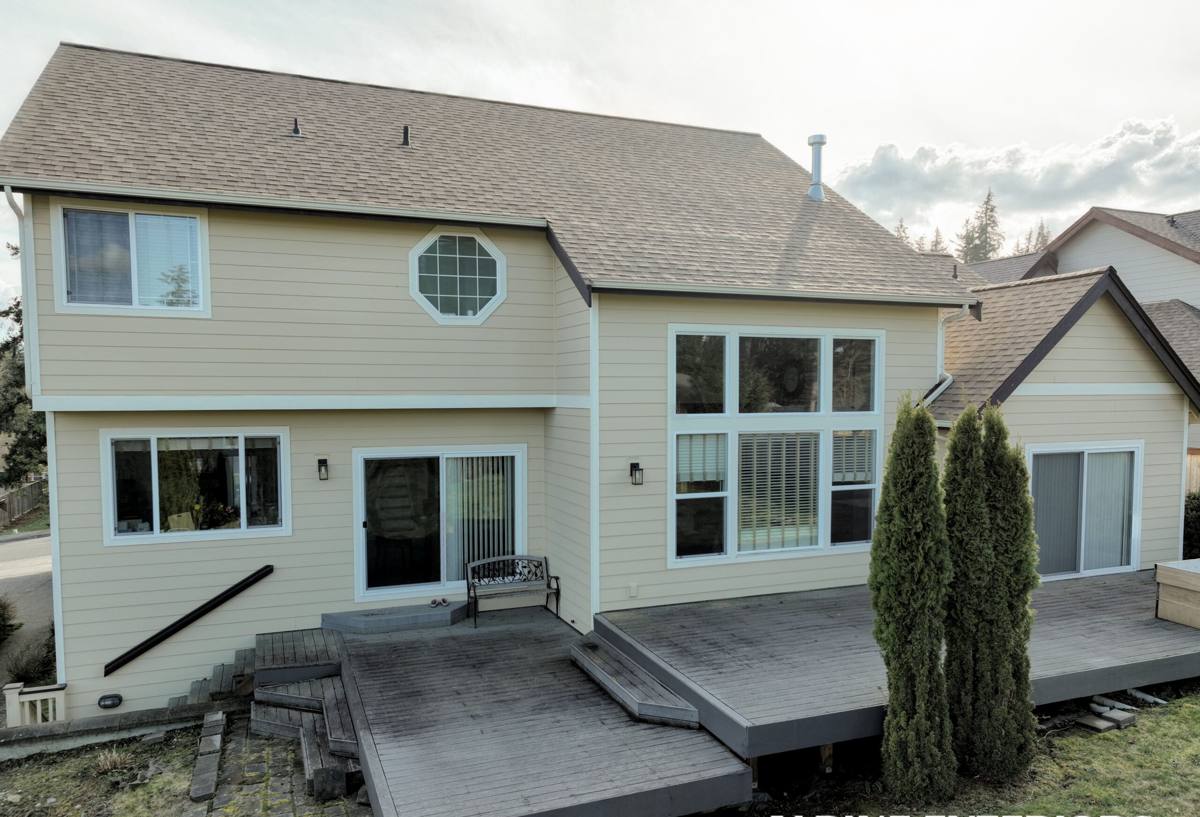
What Anacortes Weather Actually Does to Windows Over Time
It helps to understand the specific mechanisms at work, because they drive every recommendation below.
Salt Air and Corrosion
Airborne salt from the surrounding marine environment settles on exterior surfaces and accelerates corrosion of unprotected metal — hardware, hinges, aluminum frames, and fasteners. Over years, this shows up as pitting, stiff or seized operating hardware, and streaking on the frame finish.
Driving Rain and Wind Pressure
Storms coming off the water don't just fall straight down — wind pushes rain sideways and up under sills and trim. Any weak point in flashing, sealant, or the window-to-wall transition becomes a path for water intrusion, which is how you end up with rot inside the wall long before you see a stain on the interior.
Moss, Mildew, and the Long Wet Season
Anacortes gets an extended stretch of overcast, moist weather each year. On window sills, tracks, and shaded exterior trim, that moisture supports moss and mildew growth that traps additional water against wood and finishes, slowing drying and shortening the life of anything not built or finished to handle it.
What "Energy-Efficient" Should Mean in This Climate
Energy efficiency for a Puget Sound-region home isn't identical to what it means in a hot, dry climate. Here, the priorities are:
- Low U-factor — measures how well the window resists heat loss; lower is better for our cool, wet winters and the number of heating-degree days we log.
- Balanced solar heat gain coefficient (SHGC) — we don't need to block heat as aggressively as a desert climate, but excess summer gain on west-facing Skyline exposures can still overheat a room.
- Argon or krypton gas fill — improves insulating performance without changing the window's appearance.
- Warm-edge spacer systems — reduce condensation risk at the glass edge, which matters in a climate with persistent humidity and temperature swings between day and night.
- Multi-point locking hardware — pulls the sash tight against the weatherstripping, which is what actually stops wind-driven rain from finding a gap.
A window can carry a good efficiency rating on paper and still perform poorly here if the frame material, hardware, and installation aren't suited to salt air and driving rain. Efficiency and durability have to be solved together, not treated as separate decisions.
Frame Material: What Holds Up in Skyline's Exposure
This is where most of the long-term performance difference comes from. Here's how the common options compare for this specific environment.
| Frame Material | Salt Air Performance | Moisture Behavior | Maintenance |
|---|---|---|---|
| Vinyl | Good — won't corrode; UV-stable formulations resist chalking | Doesn't absorb water; welded corners need to be checked for seal integrity | Low — occasional cleaning |
| Fiberglass | Very good — dimensionally stable, doesn't pit or corrode | Excellent — very low expansion/contraction, resists warping | Low |
| Wood-clad | Fair — cladding protects the exterior face, but any breach exposes wood beneath | Requires intact cladding and sealant; vulnerable at cuts and joints | Moderate to high |
| Aluminum | Poor to fair unless marine-grade and properly finished — prone to pitting near saltwater exposure | Conducts heat and cold readily; can promote condensation | Moderate |
We don't install bare or lower-grade aluminum on Skyline homes given the exposure — not because aluminum is a bad material everywhere, but because our professional standard is to match the frame to the site, and unprotected aluminum's corrosion behavior and thermal conductivity are a poor fit for a home sitting in salt air. Vinyl and fiberglass are our default recommendations for most Skyline replacements; wood-clad remains a reasonable choice where the look is a priority and the homeowner understands the added maintenance commitment.
How We Install Windows to Actually Keep Water Out
The window unit itself is only part of the equation. Most of the water intrusion problems we get called out to fix started at the installation, not the product. Our process for Skyline homes includes:
- Opening inspection — checking existing framing and sheathing for hidden moisture damage before anything new goes in.
- Proper flashing sequencing — sill pan flashing, then side flashing, then head flashing, layered so water always sheds outward and down, never into the wall.
- Correct sealant selection and placement — using sealants rated for our climate and application, placed to allow the assembly to drain rather than trap moisture.
- Shimming and squaring — a window that's out of square stresses the frame, strains hardware, and can compromise the seal over time — especially relevant where wind pressure is a regular factor.
- Interior and exterior trim-out — finished cleanly and sealed at the right points, not over-sealed in ways that trap moisture behind trim.
Wind-driven rain finds every shortcut. An installation that looks fine on day one can leak in year three if the flashing sequence was rushed or the sealant wasn't right for the exposure. This is the step where experience with this specific coastline matters more than the window brand on the label.
Signs Your Skyline Home's Windows Need Attention
Because failure often starts hidden, it helps to know what to look for before it becomes a bigger repair:
- Fogging or moisture between panes (failed seal on a double- or triple-pane unit)
- Hardware that's stiff, sticking, or showing pitting or rust
- Visible gaps, drafts, or a noticeable temperature difference near the window in winter
- Soft spots, discoloration, or a musty smell in the wall or sill area below a window
- Moss or persistent green growth building up on sills or exterior trim
- Difficulty opening, closing, or locking a sash that used to operate smoothly
- Visible daylight or drafts around the frame when the window is closed and locked
Any one of these on its own might be minor. Several together, especially on a home that's original to its build or hasn't had windows replaced in a couple of decades, are worth a professional look before the next wet season.
What Affects the Cost of a Skyline Window Project
Every home and every opening is different, so we won't quote a number without seeing the job, but these are the main factors that move the price:
| Factor | Why It Matters |
|---|---|
| Number and size of openings | More units and larger glass areas increase material and labor cost directly |
| Frame material chosen | Vinyl is typically the most budget-friendly; fiberglass and wood-clad cost more upfront |
| Replacement vs. new construction install | Full frame replacement (tear-out to the studs) costs more than a retrofit into an existing, sound frame |
| Condition of the existing opening | Hidden rot or water damage found during removal adds repair scope before new windows go in |
| Access and elevation | Second-story or hard-to-reach openings on sloped Skyline lots take more time and equipment |
| Glazing package | Upgraded gas fill, coatings, or triple-pane glass add cost but improve performance |
Broadly, homeowners should expect a meaningful range depending on these factors — a single small window swap costs far less than a whole-house replacement with full frame removal. We'll walk through the real numbers for your specific home during an on-site estimate.
Why a Crew That Already Works Skyline Makes a Difference
General contractors who don't work this specific coastline regularly can still do competent work, but they're often learning the site conditions as they go. A crew that's already handled homes in Skyline and similar Anacortes neighborhoods knows:
- Which exposures on a given lot take the worst of the wind-driven rain and need extra attention at flashing and sealant
- How Skagit County permitting and inspection typically works for window replacement projects
- Which frame materials and finishes have held up over time in this specific salt-air, high-moisture environment
- How to sequence work around our wet season so openings aren't left exposed longer than necessary
That local pattern-recognition is hard to replace with generic experience. It's the difference between a window install that looks right on move-out day and one that's still performing correctly five and ten winters later.
Get a Straightforward Estimate
If your Skyline home's windows are drafty, fogged, hard to operate, or just original to a build from a few decades back, it's worth having them looked at before another wet winter puts more stress on them. We'll walk the exterior, check the openings, and give you a clear, honest picture of what's going on and what your options are — no pressure, no upsell. Use the form below to request a free estimate.