 Anacortes Exterior
 Exterior Work Built for March Point's Waterfront Climate
March Point sits on a peninsula along Fidalgo Bay, just outside Anacortes in Skagit County, with water on multiple sides and open exposure to wind coming off the bay. That location is part of what makes the area distinctive to live in, and it's also exactly why exterior materials here take more abuse than they would a few miles inland. Salt-laden air, driving rain that comes in sideways during winter storms, and a moss season that can stretch for most of the year all work against ordinary siding, roofing, and trim. We've built our approach around those conditions rather than treating March Point like a generic Pacific Northwest job site.
A house near the water in Skagit County ages differently than one tucked into a inland subdivision. Salt air accelerates corrosion on fasteners and metal flashing. Persistent moisture keeps wood-based products damp longer between dry spells, which is what feeds rot and mold. And moss doesn't just grow on roofs — it colonizes north-facing siding, deck boards, and anywhere shade and dampness combine. None of this means a home in March Point is doomed to constant repairs. It means the materials and installation details matter more here than they do in drier parts of the state.
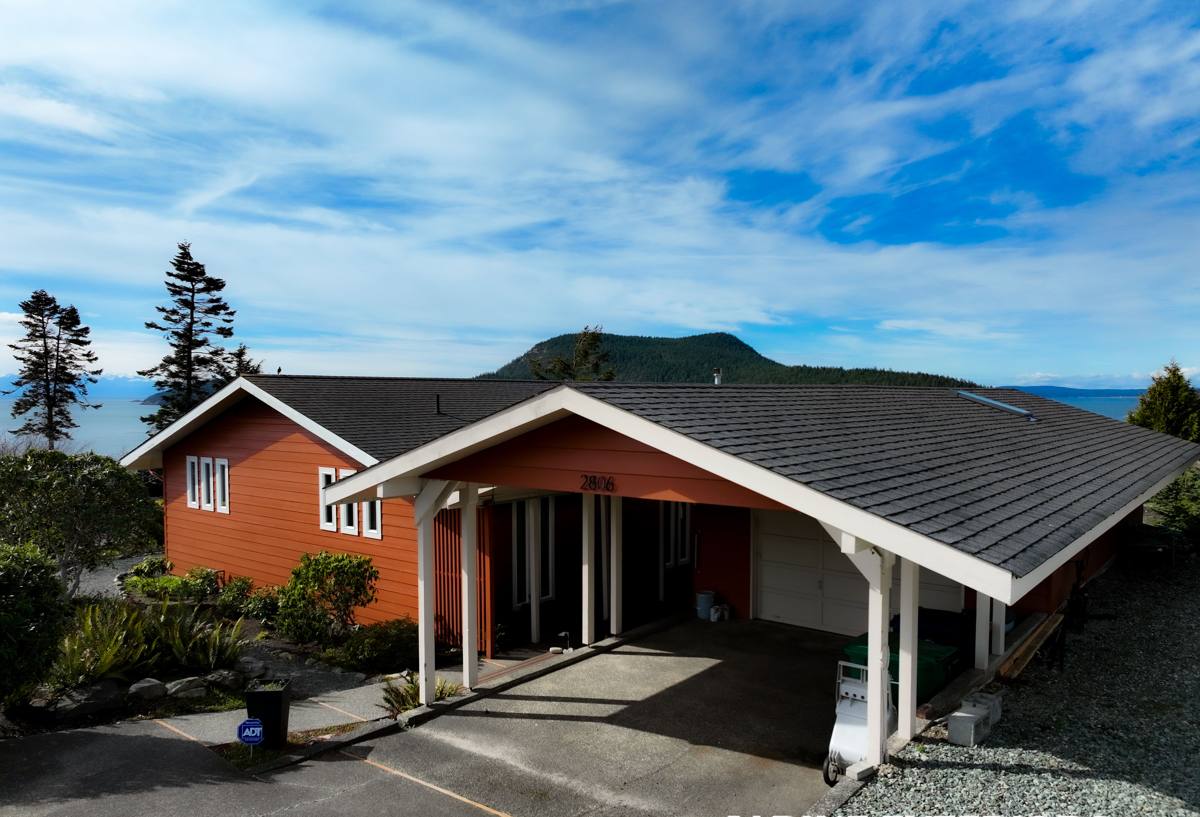
What We See on March Point Homes
Siding Under Salt and Moisture Stress
Wood-based and composite siding products that hold up reasonably well elsewhere tend to show their weaknesses faster this close to the water. Swelling at butt joints, paint failure on sun-and-rain-exposed elevations, and soft spots near ground level or under gutters are common complaints we hear from homeowners in this area. Vinyl siding, while low-maintenance in some respects, can also show its limits here — it doesn't stand up as well to wind-driven debris and can look dated quickly against the moss and mildew staining that's common on shaded elevations.
Roofing Exposed to Wind-Driven Rain
Roofs on the peninsula deal with wind-driven rain that pushes water sideways and upward under laps that would stay dry in calmer conditions. Moss buildup on north- and shade-facing roof planes is close to universal if it isn't managed, and it accelerates shingle wear by holding moisture against the roofing material long after a storm has passed.
Windows and Deck Structures
Older window installations often show air and water infiltration around frames that have loosened or whose flashing has failed over the years — salt air is hard on aluminum and steel fasteners in particular. Decks facing the water take a similar beating: fastener corrosion, moss on the walking surface, and moisture trapped between boards are the most common issues we're called out for.
Why We Install Only James Hardie Fiber Cement Siding
We made a decision as a company to install James Hardie fiber cement siding exclusively, and we don't install LP SmartSide, vinyl, Cemplank, Allura, primed spruce, or cedar. That's not a marketing position — it's a judgment call based on what actually holds up in Skagit County's coastal conditions over the long run, and what we're willing to warranty our work on.
Wood-based siding, including engineered wood products, depends on an intact factory coating and careful field sealing at every cut edge to keep moisture out. In a location with this much sustained dampness and salt exposure, any gap in that protection — a missed caulk joint, a scratch during installation, a fastener that backs out — becomes an entry point for water. Cedar and primed spruce carry the same vulnerability in a more traditional package: they look good initially but require an ongoing maintenance commitment (repainting, resealing, moss treatment) that most homeowners don't want to sign up for indefinitely. Vinyl sidesteps the moisture-absorption problem but brings its own trade-offs — it can crack in cold snaps, fade unevenly under UV exposure, and it doesn't offer the fire-resistance or the factory-finish durability that fiber cement does.
James Hardie fiber cement is non-combustible, doesn't absorb water the way wood-based products do, and comes with a factory-applied ColorPlus finish that's baked on rather than field-painted — which matters enormously in an area where field-applied paint gets tested hard by sun, rain, and salt in the same season. Hardie's HZ5 product line is engineered specifically for regions with significant moisture and freeze-thaw cycling, which describes coastal Skagit County well. It carries a strong transferable warranty, which matters to homeowners who may sell in the years ahead. When it's installed correctly — proper clearances, correct fastening, sealed joints — it's the material we're most comfortable standing behind on a home exposed to this kind of weather.
How Our Process Works for March Point Properties
- Free on-site inspection where we look at siding, roofline, window flashing, and deck condition together — problems in one area often explain issues in another
- Honest assessment of what needs replacement now versus what can be monitored
- Written estimate with clear scope, not a vague verbal number
- Scheduling that accounts for weather windows — we don't rush siding or roofing installation into a forecast that works against proper curing and sealing
- Correct installation to manufacturer spec, including the flashing and fastening details that matter most in high-moisture, salt-air conditions
Why a Local Crew Matters Here
Exterior work in a coastal Skagit County community isn't the same job as exterior work forty minutes inland, even though the material list can look identical on paper. A crew that works this area regularly knows which elevations take the worst of the wind-driven rain, how aggressively moss needs to be managed on shaded roof and siding sections, and where salt air causes fasteners and flashing to fail early if the wrong hardware is used. That local knowledge shows up in small decisions — fastener selection, flashing details, where extra sealant is worth the time — that add up to a exterior that actually holds up rather than one that looks right on installation day and starts failing within a few winters.
Comparing Siding Options for a March Point Home
| Material | Moisture Behavior | Maintenance | Our Position |
|---|---|---|---|
| James Hardie Fiber Cement | Doesn't absorb water; factory finish resists coastal wear | Low — occasional wash, no repainting cycle | What we install |
| Vinyl | Doesn't absorb water but can crack/warp with temperature swings | Low, but limited repair options when damaged | Not installed |
| Cedar | Absorbs moisture; needs sealed finish maintained continuously | High — refinishing on a recurring schedule | Not installed |
| Engineered Wood (LP SmartSide) | Vulnerable at cut edges and joints if sealing fails | Moderate — depends on coating integrity | Not installed |
| Primed Spruce | Similar exposure risk to cedar without the natural rot resistance | High | Not installed |
Roofing, Windows, and Decks: The Full Exterior Picture
Siding is only part of what protects a home here. A roof with failing flashing or moss-damaged shingles can drive moisture into wall assemblies from above, undermining even well-installed siding. Windows with degraded seals let wind-driven rain track in around frames regardless of how sound the siding is. Decks facing the water need fastener hardware and board spacing that account for both moss growth and the corrosive salt air. We handle all four — siding, roofing, windows, and decks — because they function as one system on a coastal property, and treating them separately tends to leave gaps.
Signs It's Time for an Exterior Evaluation
- Soft or spongy siding, especially near the ground or under gutters
- Persistent moss on north-facing roof slopes or siding that keeps returning after cleaning
- Paint peeling or bubbling on sun- and rain-exposed wall sections
- Visible rust streaking near fasteners, flashing, or hardware
- Drafts or water staining around window frames during storms
- Deck boards that stay damp long after rain has stopped, or fasteners showing corrosion
What Correct Installation Looks Like
Hardie siding's performance depends on installation as much as the material itself. That means correct clearance from grade and roof lines, proper fastener type and placement, sealed butt joints, and flashing details that direct water away from the wall assembly rather than trapping it. In a location where the margin for error is smaller than it would be inland, skipping these details is where premature failures come from — not from a shortcoming in the material.
If your March Point home is due for a siding, roofing, window, or deck evaluation, we're happy to take a look and give you a straight answer about what it needs. There's no cost and no pressure — just a clear picture of where things stand and what your options are.