 Anacortes Exterior
 Two Products, Same Material Category — Different Outcomes
Homeowners in Anacortes sometimes come to us with a quote in hand for Cemplank fiber cement siding, usually from a bid that's a little lower than ours, and ask why we won't just match the material. It's a fair question, and the honest answer starts with a fact that surprises most people: Cemplank and James Hardie siding are both fiber cement. They're made from the same basic recipe — portland cement, sand, and cellulose fiber, cured under pressure into a rigid, non-combustible board. Neither one is vinyl, neither one is wood, and neither one is going anywhere in a stiff wind off Guemes Channel.
So this isn't a "real material vs. fake material" comparison. It's a comparison between two manufacturers making the same category of product, with real differences in how that product is engineered, finished, warrantied, and supported after installation. Those differences matter more here than they would in a mild, dry climate, because Skagit County siding has to deal with salt-laden air off Fidalgo Bay, long stretches of driving rain, and a moss season that can run most of the year. We install one of these two products. Here's the reasoning, laid out plainly.
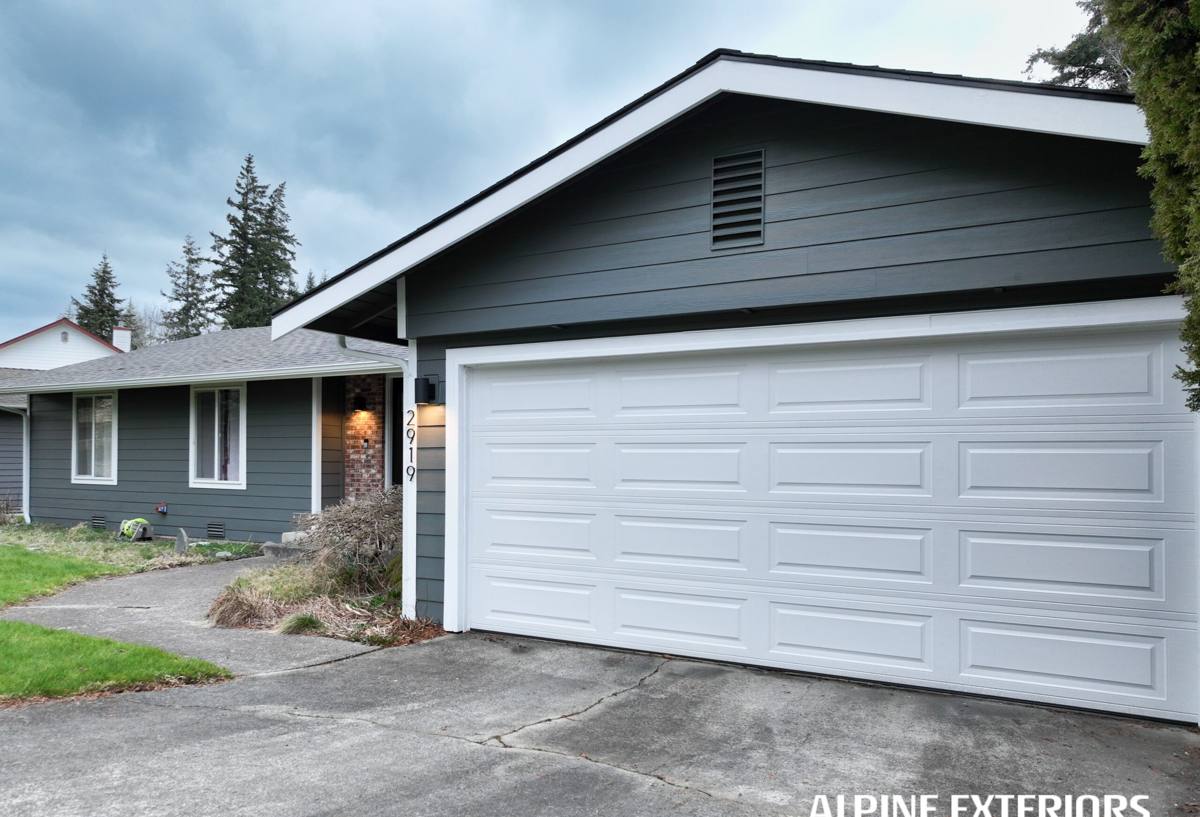
What Cemplank Gets Right
We're not going to pretend Cemplank is a bad product just because we don't install it. Fiber cement as a category earns its reputation: it doesn't rot, it doesn't feed insects, it holds paint far longer than wood, and it carries a Class A fire rating. Cemplank boards meet those same baseline standards. It's a legitimate fiber cement product, it's typically priced a bit below Hardie, and contractors who install it aren't cutting corners by choosing it. For some homes and some budgets, it does the job.
Where things diverge isn't the core material — it's everything built around it: the factory finish, the climate engineering, the warranty backing, and the support network a contractor and homeowner can lean on ten or twenty years down the road. Those are the pieces that actually get tested by a Pacific Northwest winter.
Where the Differences Show Up in Skagit County Weather
Salt Air and Coating Longevity
Anacortes sits close enough to saltwater that airborne salt is a real factor in how exterior finishes age. A factory-cured finish that's baked on under controlled conditions holds its bond and color far more consistently over years of salt exposure than a finish that depends on field application and touch-up. This is one of the clearest reasons we standardized on Hardie's ColorPlus finish system rather than products that ship primed and rely on the installer or homeowner to apply the topcoat.
Driving Rain and Water Management
Fiber cement itself doesn't absorb water and swell the way wood does, but the assembly around it — caulking, flashing, panel joints, butt seams — is where water actually gets into a wall system during a sideways November storm. Hardie's HZ5 product line is specifically formulated for high-moisture, freeze-thaw climates like ours, with density and moisture-resistance characteristics tuned for the Pacific Northwest rather than a one-size-fits-all national formulation. That's a meaningful difference in a county that gets well over 100 inches of rain a year in the foothills and a steady soak on the flats.
Moss Season and Surface Chemistry
Anacortes homes deal with moss and algae growth for a large part of the year, especially on north-facing and shaded elevations. How a siding's surface finish resists organic growth and how easily it cleans without stripping the coating affects how the house looks in year eight, not just year one. A durable, factory-baked finish holds up to periodic gentle cleaning far better than a field-applied coat that's already thinner and less uniform to begin with.
Factory Finish vs. Field Finish
This is the single biggest practical difference between the two products, and it's worth explaining plainly. ColorPlus finish is applied and cured in a factory environment, in multiple coats, under conditions no job site can replicate — consistent temperature, no wind-blown debris, no weather interruptions. Many competing fiber cement products, including primed lines, are designed to be painted after installation, on-site, by the contractor or a painting crew, using standard exterior paint.
Field-applied paint on a job site in the Skagit Valley has to fight actual weather while it cures, and it's simply a thinner, less consistent system than a factory-baked finish. That doesn't make it fail immediately — most homeowners won't notice a difference in year one. It shows up later, as a repaint that comes due years sooner than it would with a factory finish, and as color mismatch when a panel gets replaced or repaired down the line.
Warranty Structure — What's Actually Transferable
Every fiber cement manufacturer offers some form of warranty, and on paper the numbers can look similar. The details matter more than the headline years. What we look at with any product before we'll put our labor behind it:
| Factor | What to Check | Why It Matters |
|---|---|---|
| Coverage scope | Substrate only, or substrate + finish? | A finish failure with no coverage means a full repaint at your cost |
| Transferability | Does it transfer to a new owner, and how many times? | Affects resale value and buyer confidence at listing time |
| Labor coverage | Does it cover the cost of removal and reinstallation, or just the board? | Board replacement is a small fraction of the total repair cost |
| Manufacturer longevity | How long has the company backed warranties at this scale? | A warranty is only as good as the company standing behind it in twenty years |
| Regional claims history | How does the manufacturer handle claims in wet, coastal climates specifically? | National averages can hide poor performance in our specific conditions |
Hardie's warranty structure on both the substrate and the ColorPlus finish, combined with a long manufacturing track record at scale, gave us something we could stand behind without hedging. That's the bar we hold every product to before we'll install it.
Installer Training and Long-Term Parts Availability
A siding job doesn't end at final walkthrough. Homes get a new window installed, a deck rebuilt, a satellite dish removed — and siding gets patched. Ten years later, that patch needs to match the original color and profile, or the house ends up with a visible scar on the front elevation.
Two things determine whether that repair goes smoothly: whether the original installer was trained on manufacturer-specific installation standards (fastener patterns, clearances, flashing details — all of which affect warranty validity, not just appearance), and whether the exact product and color are still readily available regionally years later. Hardie's certified contractor network and broad regional distribution mean we can generally source a color match without guesswork. That continuity is harder to guarantee with less widely distributed product lines, which is a real consideration for anyone planning to stay in a home for the long haul.
Cost: What the Price Difference Actually Buys
We won't tell a homeowner that price doesn't matter — it does, and Cemplank bids often come in somewhat lower than Hardie on material cost alone. What we will say is that the gap isn't just brand markup. It reflects the factory finish process, the climate-specific formulation, the certified installer training program, and the warranty backing described above. For a homeowner planning to sell within a few years, that gap may matter less. For a homeowner planning to stay in an Anacortes home through several more Pacific Northwest winters, it tends to pay for itself in fewer repaints and fewer callback repairs.
Questions Worth Asking Before You Sign a Siding Contract
Whether you end up choosing us or another contractor, these are the questions that separate a durable siding job from a disappointing one, especially in a wet coastal climate like ours:
- Is the finish factory-applied and warrantied, or will it need field painting after install?
- Is the specific product line engineered for high-moisture, freeze-thaw climates, or is it a general national formulation?
- What does the warranty actually cover — board only, finish, labor, or all three?
- Is the installer manufacturer-certified for this specific product, and can they show it?
- Will the exact color and profile still be available regionally in ten to fifteen years for repairs?
- What does the manufacturer's track record look like specifically in coastal Washington conditions?
If a contractor can't answer those clearly, that's worth knowing before, not after, the siding goes up.
Why We Standardized on One Product
We install exclusively James Hardie fiber cement siding — not vinyl, not LP SmartSide, not primed spruce or cedar, and not Cemplank — because every job we do needs to hold up to the same conditions: salt air off the water, sustained driving rain, and a moss season that tests every exterior finish on the house. Standardizing on one manufacturer means our crews are trained to one installation standard, our warranty conversations are consistent and honest, and we can source matching materials for repairs years after the original install. That consistency is the whole point of narrowing our lineup to a single product rather than offering whatever's cheapest to quote.
If you're weighing siding options for a home in Anacortes or elsewhere in Skagit County, we're glad to walk through what we saw on your specific house and give you a straightforward, no-pressure estimate — no pitch beyond what your home actually needs.