 Anacortes Exterior
 Why Siding Cost Questions Rarely Have a One-Line Answer
Every homeowner asks the same question first: "What's this going to cost?" It's a fair question, and it deserves an honest answer instead of a made-up number pulled from a national average that has nothing to do with a house in Anacortes. Siding replacement cost is really the sum of several separate decisions — material, square footage, the condition of what's underneath, the complexity of the house, and labor in this specific market. Once you understand what each of those variables actually does to the final number, the estimate you get stops feeling like a mystery and starts feeling like math.
This page walks through those variables in order, from biggest to smallest, so you can see where your own project is likely to land and why two houses that look similar from the street can end up with very different quotes.
Material Is the Starting Point, Not the Whole Story
The material you choose sets the floor for the project, but it doesn't set the ceiling — labor, prep, and detail work do that. Broadly, exterior siding materials fall into a few cost tiers, and it's worth understanding where each one sits before comparing quotes.
| Material | Relative Material Cost | Typical Lifespan | Common Trade-Offs |
|---|---|---|---|
| Vinyl siding | Lowest | 15-25 years | Can warp or crack in cold snaps and sun exposure; seams are visible up close |
| Primed wood / spruce lap | Low-Mid | 10-20 years with upkeep | Needs repainting on a cycle; vulnerable to moisture if caulking fails |
| Engineered wood (LP SmartSide) | Mid | 20-30 years | Edge-swelling risk if cut edges and seams aren't sealed exactly to spec |
| Fiber cement (James Hardie) | Mid-High | 30-50+ years | Heavier material, more labor-intensive install, but non-combustible and dimensionally stable |
| Cedar siding | High | 20-40 years with heavy upkeep | Beautiful but demands ongoing sealing/staining, especially in wet climates |
We install James Hardie fiber cement exclusively, and we're upfront about why: it holds paint and color longer, it doesn't feed a fire, and it doesn't swell or rot the way wood-based products can when a seam gets wet and stays wet — which happens more than people expect in a marine climate. That's a cost decision as much as a performance one, because a product that needs repainting every 7-10 years or replacing at year 18 isn't actually "cheaper" once you look at the 30-year picture.
Why We Don't Quote Vinyl, LP, or Cedar
Homeowners sometimes ask why we don't offer a lower-cost alternative alongside Hardie. The honest answer is that once we stopped installing those other products, our callback rate for moisture and warranty issues dropped, and we didn't want to keep offering something we no longer stood behind. Vinyl and wood-based products aren't bad materials — they're just a different set of trade-offs than what we're willing to install and warranty in Skagit County's climate.
Square Footage and House Shape
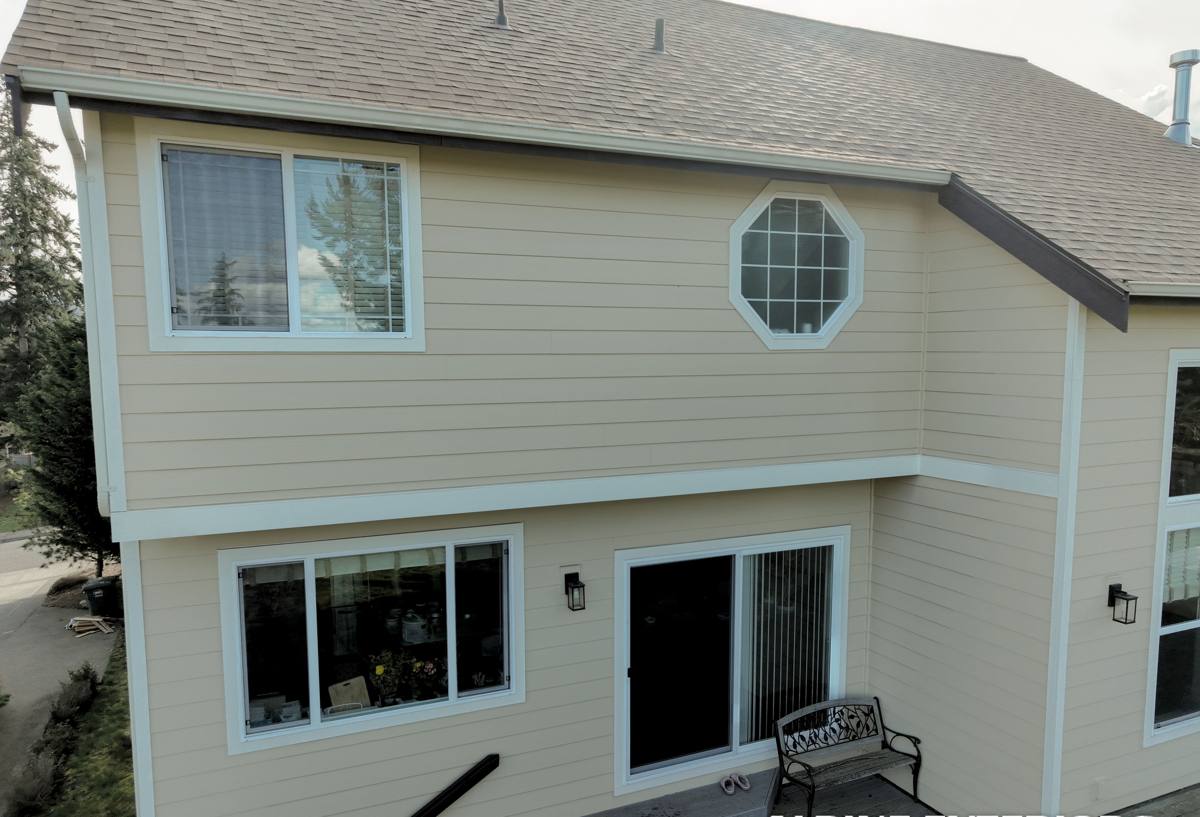
Square footage drives cost in the obvious way — more siding, more material and more labor hours. But shape matters almost as much as size. A simple rectangular ranch with few corners and a low, walkable roofline sides faster and cheaper per square foot than a two-story house with dormers, bump-outs, and a steep roof pitch that requires staging and extra fall-protection setup. Anacortes has plenty of both: newer subdivision homes with simpler massing, and older character homes near the waterfront with more architectural detail. Expect the per-square-foot labor rate to climb with every additional corner, gable, and roofline transition.
What's Underneath Matters More Than People Expect
This is the variable that turns an estimate into a range instead of a fixed number, and it's also the one that causes the most sticker shock mid-project. You cannot fully know what condition the sheathing, house wrap, and framing are in until the old siding comes off. In a region with this much driving rain and salt-laden air, we routinely find:
- Soft or delaminated sheathing behind window and door trim where flashing failed years ago
- Missing or degraded house wrap that let moisture track behind the old siding
- Rot at bottom plates and rim joists, especially on north-facing walls that stay damp longer
- Undersized or missing kick-out flashing where roof lines meet walls
None of that is visible from a curbside estimate. A responsible contractor will build a contingency allowance into the quote for sheathing repair, and will show you the damage before doing the repair — not bill for it after the fact on faith. If a bid seems unusually low, ask directly whether it includes any allowance for hidden damage; if it doesn't, that's not a better price, it's a bid that's going to change once the walls open up.
Labor: The Piece That Varies Most by Contractor
Labor is typically the largest single line item in a siding replacement, and it's also where quotes diverge the most between contractors, because it reflects crew experience, crew size, and how carefully the manufacturer's installation instructions are actually followed. James Hardie in particular is unforgiving of installation shortcuts — proper clearances, fastener patterns, and joint treatment are what the warranty is actually built on. A crew that installs it fast and loose can make the same material fail early. Paying for a crew that installs it correctly the first time is usually the difference between a 30-year exterior and a 10-year headache.
Tear-Off, Disposal, and Site Access
Removing and hauling away old siding adds cost, and it varies with material — pulling off brittle old vinyl is quick, while removing heavy cedar or stripping old paint layers takes longer. Site access matters too: a tight lot with limited driveway clearance or a steep waterfront-adjacent yard slows down staging, scaffolding, and material staging compared to a flat, open lot.
Trim, Flashing, and Detail Work
The visible siding panels are only part of the job. Window and door trim, corner boards, fascia, soffits, and flashing details all get touched during a full replacement, and this is where quality separates itself. Correct flashing at every penetration — hose bibs, light fixtures, vents, deck ledgers — is what actually keeps water out over the next three decades, more than the siding panel itself. Skimping here is the single most common cause of the moisture problems we find when we tear into a house that was re-sided within the last 10-15 years.
How Anacortes and Skagit County Climate Factors Into the Number
Coastal exposure changes what "correct installation" looks like, which changes labor time and material choices. Salt-laden air accelerates corrosion on fasteners and flashing if the wrong grade is used, so we spec corrosion-resistant fasteners as standard rather than an upsell. Driving rain off the Strait pushes water sideways into wall assemblies far more aggressively than a calmer inland climate would, which is why house wrap continuity and flashing sequencing get extra attention on every job here. And the long moss season that Western Washington is known for keeps north- and shaded-side walls damp for weeks at a stretch, which is exactly the condition that rewards a rigid, non-absorbent material like fiber cement over a wood-based product that can wick moisture at cut edges.
None of this makes a quote "more expensive for no reason" — it's the same reason a roofer in Anacortes specs different underlayment than one in eastern Washington. Building for the actual climate the house sits in is what keeps the cost of ownership down over time, even if the upfront number is a bit higher than the cheapest possible bid.
A Practical Checklist Before You Compare Bids
When you're holding two or three quotes side by side, the sticker price alone won't tell you much. Use this list to make sure you're comparing the same scope of work:
- Does the bid specify the exact material line and profile, or just say "siding"?
- Is there a stated allowance for hidden sheathing or framing repair, and how is it billed if found?
- Does the quote include house wrap replacement, or reuse of the existing wrap?
- Are flashing details at windows, doors, and penetrations called out specifically?
- Is fastener type and corrosion resistance specified for a marine/coastal environment?
- Does the quote include full tear-off and disposal, or is that a separate line?
- What's the manufacturer warranty term, and is it tied to certified installation?
- Is a project timeline and payment schedule spelled out in writing?
A bid that answers all of these clearly is usually more trustworthy than one that's simply the lowest number on the page.
Getting a Number You Can Actually Rely On
The only way to get a cost that means something for your specific house is to have someone walk the exterior, measure it, and look closely at trouble spots — trim returns, old caulk lines, roof-wall intersections, and any areas that have stayed damp or discolored. From there we can give you a real range, explain what's driving it, and flag anything we expect to find once the old siding comes off.
If you're weighing a siding replacement in Anacortes or elsewhere in Skagit County, we're happy to come take a look and walk you through the numbers in plain terms — no pressure, no inflated quote to "leave room to negotiate." Reach out for a free estimate and we'll give you a straight answer about what your project actually needs.