 Anacortes Exterior
 Why Ship Harbor Homes Need a Different Approach to Siding
Ship Harbor sits close enough to the water that salt air, wind-driven rain, and shoulder-season damp are just part of daily life. Homes here take a different kind of beating than a house a few miles inland in Anacortes proper. Salt-laden air accelerates corrosion on fasteners and trim, wind off the water drives rain sideways into wall assemblies that were never designed for it, and the long stretches of gray, low-sun months keep siding damp longer than it should be. Add in the moss and algae that thrive in Skagit County's shade and moisture, and you've got a siding assignment that punishes anything less than a correctly detailed, genuinely water-resistant product.
This page is about one job in one place: installing James Hardie fiber cement siding on Ship Harbor homes, done the way this climate actually demands. We don't cover other siding materials here because we don't install them — that's a deliberate choice we explain further down.
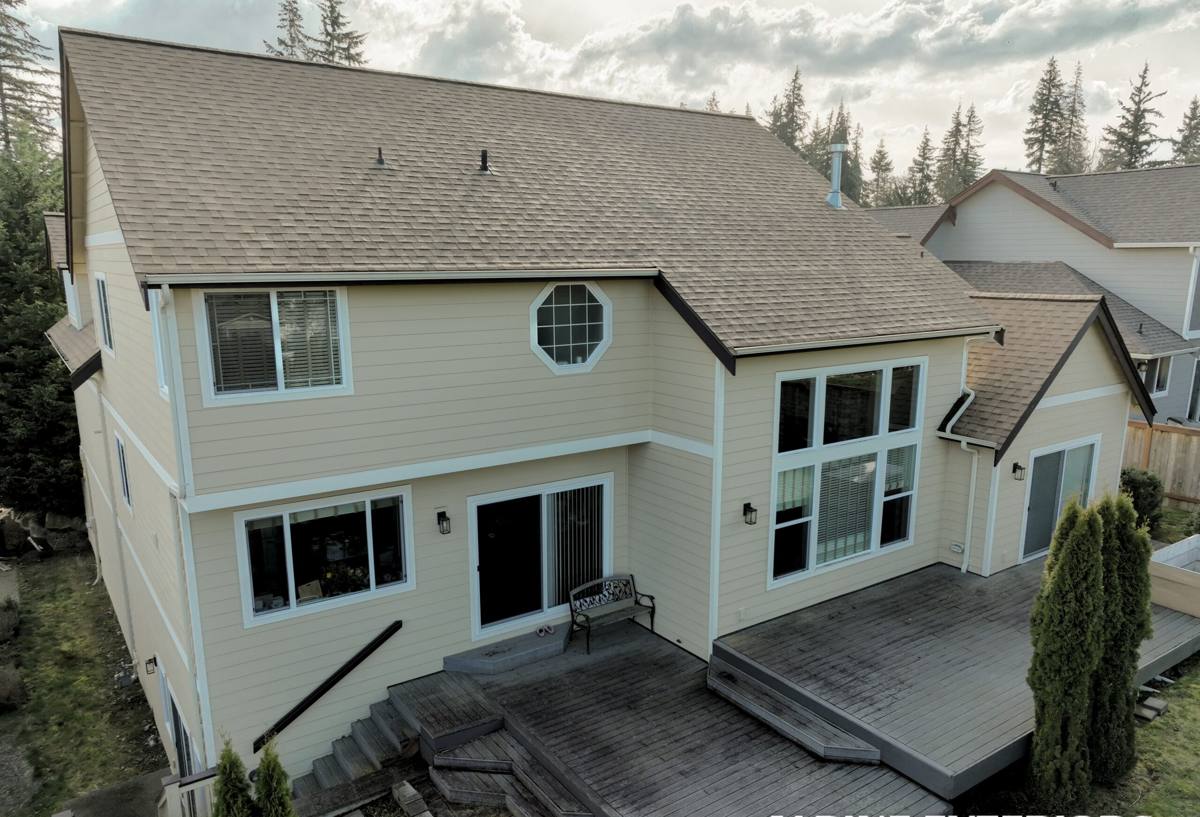
What Ship Harbor's Climate Actually Does to Siding
Salt Air and Corrosion
Proximity to marine water means airborne salt settles on every exterior surface. Over years, that salt attacks unprotected metal fasteners, cheap trim hardware, and any exposed edge where a coating has worn thin. It also holds moisture against surfaces longer than dry inland air would, which matters more than people expect — it's not the salt alone causing damage, it's the salt keeping things wet.
Driving Rain and Wind Exposure
Storms coming off the water don't fall straight down — they come in sideways. That means siding laps, seams, and butt joints on wind-exposed elevations take on water that a calmer inland install would never see. Flashing details and lap coverage that are "good enough" elsewhere aren't good enough on a wind-exposed Ship Harbor wall.
Moss, Algae, and the Long Damp Season
Skagit County's extended cool, wet stretches keep north-facing and shaded walls damp for long periods, which is exactly what moss and algae need to take hold. Once organic growth gets a foothold on a porous or poorly finished surface, it holds moisture against the wall and accelerates whatever degradation is already happening underneath.
Why We Install Only James Hardie Fiber Cement Here
We standardized on James Hardie fiber cement siding for every home we work on, including Ship Harbor, for reasons that are especially relevant to this specific stretch of coastline:
- Non-combustible core — fiber cement doesn't feed a fire the way wood-based products can, a real consideration anywhere with dry summer stretches.
- Engineered for moisture cycling — Hardie's fiber cement is formulated to handle repeated wet-dry cycles without the swelling, delaminating, or soft edges that plague wood-based and some composite sidings.
- ColorPlus factory finish — a baked-on finish applied under controlled conditions holds up to UV and moisture exposure better than field-applied paint, and it resists the fading and chalking that shows up fast in marine-adjacent light.
- Climate-engineered HZ product lines — Hardie manufactures regional formulations suited to different climate zones, so the product specified for the Pacific Northwest is built for exactly the wet, cool conditions Ship Harbor sees most of the year.
- A strong, transferable warranty — backed by a manufacturer with decades of fiber cement manufacturing behind it, not a startup formulation.
We get asked why we won't install LP SmartSide, vinyl, Cemplank, Allura, primed spruce, or cedar. Each of those products has legitimate uses and each has real trade-offs — cost, moisture sensitivity, maintenance burden, or installation forgiveness — that we've decided aren't worth the risk on the homes we put our name behind, especially in an environment as unforgiving as coastal Skagit County. That's our standard, not a claim that those products can't work anywhere for anyone.
What a Correct Fiber Cement Job Involves in a Coastal Setting
Fiber cement siding is only as good as the assembly behind it. A correct install in a wind- and salt-exposed location like Ship Harbor includes:
- Weather-resistive barrier installed and lapped correctly, shingle-style, so water is directed out and down rather than trapped behind the cladding.
- Rainscreen or drainage gap where the wall assembly and budget allow, giving incidental moisture a path to drain and dry instead of sitting against the back of the siding.
- Flashing at every penetration — windows, doors, hose bibs, light fixtures, and any trim transition — detailed so wind-driven rain can't work its way behind the plane.
- Correct fastener selection — corrosion-resistant fasteners driven to Hardie's specified pattern and depth, not overdriven or underdriven, which matters even more where salt air accelerates corrosion on the wrong hardware.
- Proper clearances from grade, roofing, and decks, so the bottom edge of the siding isn't sitting in a moisture trap.
- Caulking and sealant only where Hardie's installation instructions call for it — over-caulking traps moisture just as badly as under-caulking lets it in.
None of this is exotic. It's disciplined, by-the-book installation, done by a crew that treats the manufacturer's instructions as the floor, not a suggestion.
Our Process for a Ship Harbor Project
1. On-Site Assessment
We walk the exterior, note wind-exposed elevations, existing moisture damage, trim condition, and any areas already showing moss or algae growth. Wind exposure and prevailing weather direction shape where we pay closest attention to flashing and laps.
2. Tear-Off and Sheathing Check
Once old siding is off, we inspect the sheathing underneath. This is the point where hidden moisture damage from years of a failing weather barrier or bad flashing shows up — and where it needs to be addressed before anything new goes back on.
3. Weather Barrier and Flashing
New weather-resistive barrier, correctly lapped, with flashing integrated at every window, door, and penetration before a single piece of siding goes up.
4. Hardie Installation to Spec
Siding installed to James Hardie's published instructions — fastener pattern, lap coverage, clearances, and joint treatment — with attention to the wind-exposed sides of the home.
5. Trim, Caulking, and Final Detail
Trim and corner details finished, sealant applied only where specified, and a final walk-through so nothing is left ambiguous.
Why Hiring a Crew That Already Works Ship Harbor Matters
A crew that's worked this specific stretch of coastline already knows which elevations take the worst wind-driven rain, where moss tends to establish first, and how the local moisture cycle behaves across the seasons. That's not something you get from a general contractor who occasionally works near the water — it comes from repetition in this exact environment. It also means fewer surprises during the job: we're not guessing at how a coastal wall assembly here behaves, we're applying what we already know.
Cost Factors for Ship Harbor Siding Projects
Every home is different, but the factors that actually move the number on a Ship Harbor project are consistent. Broad ranges only — a firm number comes from an on-site look.
| Factor | Why It Matters Here |
|---|---|
| Wind exposure of the home's site | More exposed elevations need more careful flashing and detailing, which adds labor time |
| Condition of existing sheathing | Hidden moisture damage found at tear-off can require repair before new siding goes on |
| Amount of trim and penetrations | Windows, doors, and fixtures each need individual flashing detail |
| Existing moss/algae buildup | Heavier growth can indicate a longer-standing moisture issue worth investigating before covering it up |
| Product line and profile selected | Hardie offers multiple plank profiles and finishes at different price points |
| Home size and wall complexity | More corners, gables, and transitions mean more cutting and detail work |
Signs a Ship Harbor Home Needs Siding Attention Soon
- Soft spots or visible swelling, especially near the bottom courses or under windows
- Persistent moss or algae streaking that comes back soon after cleaning
- Peeling, chalking, or fading paint that's outpacing the rest of the neighborhood
- Visible fastener corrosion or rust streaks running down the siding face
- Gaps opening up at trim, corners, or window and door casings
- A musty smell or visible staining on interior walls that back onto exterior siding
Any one of these is worth a look. Several together usually mean the weather barrier or flashing behind the siding has already been compromised.
What to Expect During Your Project
Coastal jobs move around Skagit County's weather windows — we plan tear-off and weather barrier work for stretches where we can keep the wall assembly protected, and we don't leave a home open to the elements longer than necessary. Timelines vary with home size and complexity, and we'll walk through a realistic schedule for your specific project before work starts, not after.
If you're weighing a siding project for a Ship Harbor home, we're glad to come take a look and give you a straightforward, no-pressure estimate — what your home actually needs, what it would involve, and what it would cost. Use the form below to get started.