 Anacortes Exterior
 Why March Point's Climate Is Hard on Siding
March Point sits close to open water on the edge of Anacortes, and that location comes with a specific set of siding problems that inland Skagit County homes don't deal with in the same way. Salt-laden air, near-constant wind exposure, and a long wet season combine to wear down siding materials faster than most manufacturers' warranties assume. If you're planning a siding replacement here, it's worth understanding exactly what you're up against before you pick a product.
Salt Air Off the Water
Homes near the water pick up airborne salt that settles on exterior surfaces year-round. Over time, that salt accelerates the breakdown of paint films, corrodes fasteners and trim metal that aren't rated for coastal exposure, and speeds up the fading and chalking that lower-grade siding finishes are prone to. Materials and finishes that hold up fine forty miles inland can visibly degrade faster on a home this close to the shoreline.
Driving Rain and Wind-Driven Moisture
Anacortes gets weather off the water, and that means rain doesn't always fall straight down — it drives sideways into wall assemblies, especially on exposed gable ends and second-story walls. Siding that isn't installed with the right clearances, flashing, and water-shedding laps will let moisture work behind the surface, where it causes rot in sheathing and framing long before anything looks wrong from the curb.
A Long Moss and Algae Season
Western Washington's wet months stretch long, and March Point's proximity to water keeps humidity and shade-driven dampness around even longer in some spots. Moss and algae don't just look bad — they hold moisture against the siding surface, degrade paint finishes faster, and can find their way into any gap where installation wasn't tight to begin with. A siding job here has to account for that reality, not just for how the house looks on a dry day.
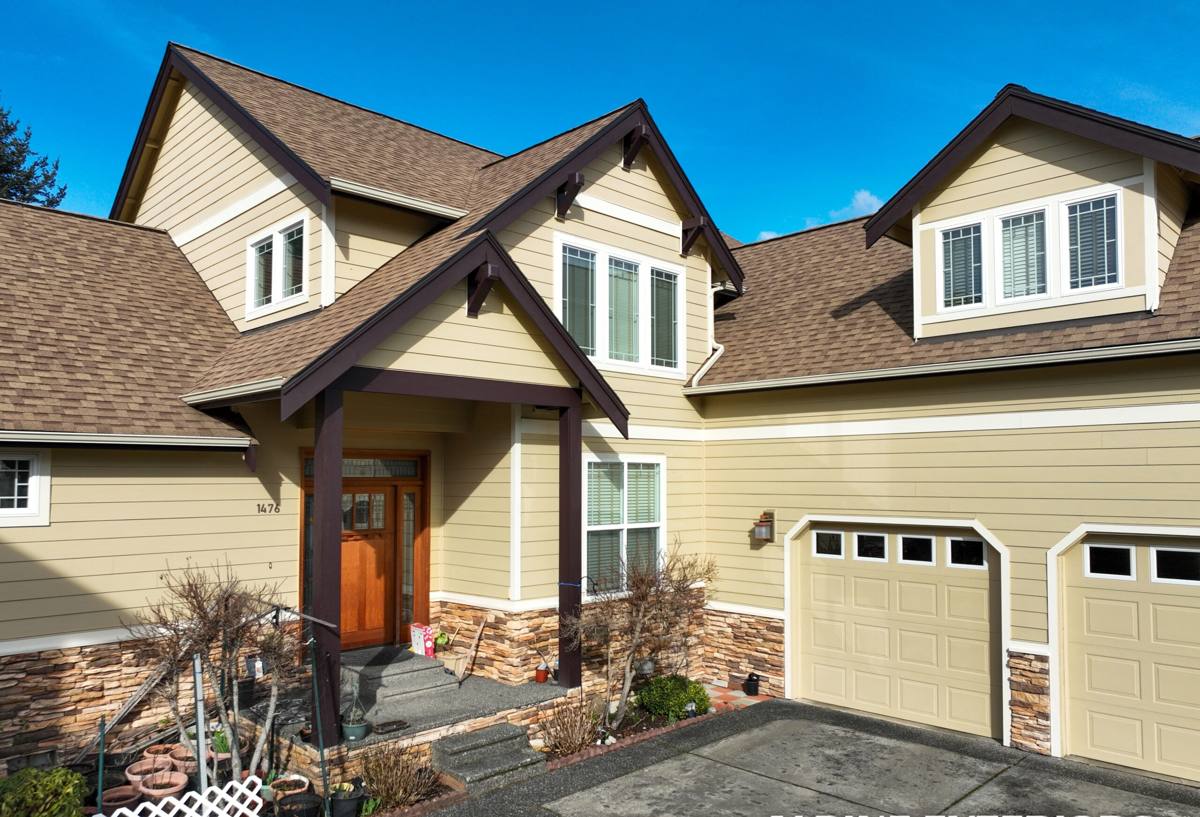
Why We Install Only James Hardie Fiber Cement Siding Here
We made a deliberate decision to install James Hardie fiber cement exclusively, and on a site like March Point, that decision matters more than most places. Fiber cement is non-combustible and dimensionally stable — it doesn't expand and contract with moisture the way wood-based products do, and it doesn't absorb water into its core the way engineered wood siding can. That matters directly for a home dealing with salt air and driving rain, because the material itself isn't the weak point in the system.
James Hardie's ColorPlus factory-applied finish is baked on under controlled conditions rather than field-sprayed, which gives it better adhesion and UV resistance than most job-site paint jobs can match. On a home exposed to constant salt and wind, a finish that holds its color and doesn't chalk prematurely is the difference between repainting in eight years and repainting in twenty. Hardie also backs its products with a strong, transferable limited warranty — something worth real weight when you're investing in a coastal-adjacent home you may eventually sell.
Choosing the Right HZ Product Line and Panel Profile
James Hardie engineers its siding by climate zone under what it calls the HZ system, and the Pacific Northwest's wet, moderate climate calls for the HZ5 formulation, built specifically to resist moisture-related damage in regions like ours. That's not a marketing distinction — it changes how the product performs over a wet Skagit County winter and a salty Anacortes summer alike.
Beyond the formulation, the right profile matters too. Lap siding is the most common choice for March Point homes and gives strong horizontal water-shedding lines, while panel systems (with battens or in a board-and-batten style) suit certain architectural styles and accent walls. Texture options range from smooth to cedar-grain, and color selection should factor in how a finish will read against the grey, water-influenced light this area gets for much of the year. We walk through these choices with you rather than defaulting to whatever's easiest to install.
What a Correct Fiber Cement Installation Involves
Fiber cement siding is only as good as the installation behind it. This is true everywhere, but it's especially true on a site exposed to wind-driven rain, where a shortcut in flashing or clearance shows up as a moisture problem within a few wet seasons rather than a few decades.
Flashing and Water Management
Every window, door, and horizontal trim transition needs proper flashing integrated with a weather-resistive barrier behind the siding — not caulk used as a substitute for flashing. Water has to have a planned path out of the wall assembly, not just a hope that it never gets in.
Clearances and Fastening
James Hardie specifies minimum clearances from grade, roofing, decks, and other horizontal surfaces for a reason — those gaps keep splashback and standing water away from the bottom edge of the siding, which is where rot most often starts. Fasteners need to be corrosion-resistant and set at the correct depth; overdriven or underdriven nails compromise both the weatherproofing and the finish.
Cut Edges and Field Finishing
Any field-cut edge on fiber cement siding needs to be sealed and touched up to match the factory finish. Skipping this step leaves a raw edge exposed to moisture absorption — a small detail that becomes a visible failure point within a few years on a site this exposed.
Our Process, Start to Finish
We approach a March Point siding project the same methodical way every time, because that consistency is what keeps water out of the wall assembly for the long haul.
- Walk the exterior and assess the existing siding, sheathing, and any signs of past moisture intrusion before quoting anything.
- Remove old siding and inspect the sheathing underneath, repairing or replacing any compromised material before new siding goes on.
- Install a proper weather-resistive barrier and integrate flashing at every penetration and transition point.
- Install James Hardie siding to manufacturer specifications for clearance, fastening, and panel/lap alignment.
- Finish and seal all field-cut edges, trim, and transitions, then walk the finished job with you before we consider it done.
What Fiber Cement Siding Costs and What Moves the Number
Every home is different, and the honest answer is that final cost depends on the specifics of your house. That said, a few factors consistently move the number up or down, and it helps to understand them before you start comparing quotes.
| Factor | Why It Matters | Typical Impact |
|---|---|---|
| Extent of sheathing repair needed | Rot or moisture damage found once old siding comes off has to be addressed before new siding goes on | Moderate to high |
| Home height and roofline complexity | Multi-story walls, steep gables, and cut-up rooflines take more labor, staging, and flashing detail | Moderate |
| Panel profile and trim package | Lap versus panel systems, and the amount of custom trim work, affect material and labor time | Low to moderate |
| Color and finish selection | Standard ColorPlus colors versus premium or custom options carry different material costs | Low |
| Access and site conditions | Tight lots, landscaping to protect, and proximity to the water can affect staging and scheduling | Low to moderate |
We give a firm, itemized quote after walking your home in person — not a rough estimate based on square footage alone.
Keeping Moss and Algae From Taking Over
Even with the right product and a correct installation, siding on a home this close to the water benefits from some basic upkeep. None of it is complicated, but skipping it lets moss and algae get a foothold faster than it would inland.
- Rinse siding annually to clear salt residue, pollen, and early moss growth before it takes hold
- Keep gutters clear so overflow doesn't run down the siding face and stay damp longer than it should
- Trim back vegetation and tree cover that keeps shaded wall sections from drying out between rains
- Address any caulking or trim gaps promptly rather than letting small openings become bigger ones
- Inspect low-clearance areas near grade and decking periodically, since those spots dry out slowest
James Hardie's factory finish resists this buildup better than field-applied paint, but no exterior surface in this climate is maintenance-free.
Why Hire a Crew That Already Works in March Point
A contractor who's worked exteriors around Anacortes and the rest of Skagit County knows the difference between how a wall assembly behaves on a sheltered inland lot and how it behaves on a site catching wind and salt off the water most of the year. That knowledge shows up in small decisions — which clearances to hold to strictly, where extra flashing attention pays off, which orientations need the most protection — that don't come from a spec sheet alone. It's the kind of judgment that only comes from having done the work in this specific area, in this specific climate, more than once.
Questions Worth Asking Before You Hire a Siding Contractor
- Do they install to the manufacturer's written specifications for clearance, fastening, and flashing — and can they explain what those are?
- Do they carry proper licensing and insurance for exterior work in Washington State?
- Will they inspect and address sheathing damage before installing new siding, not just cover it up?
- Can they explain why they recommend a specific product or line for a coastal-adjacent property?
- Do they provide a written, itemized estimate rather than a vague square-footage price?
- Will they walk the finished job with you and address punch-list items before calling it complete?
If your March Point home is due for new siding, we're happy to walk the exterior with you, explain exactly what we're seeing, and put together a straightforward, no-pressure estimate — use the form below to get started.