 Anacortes Exterior
 Decks Near Oak Harbor Face a Different Kind of Wear
Oak Harbor sits close enough to the water that every deck in the area is dealing with the same three enemies year-round: salt-laden air, long stretches of driving rain, and a moss season that can run from October well into spring. None of these are dramatic on their own. The damage they cause builds slowly, which is exactly why so many decks in this area look fine from a distance while quietly failing underneath.
Salt air accelerates corrosion in anything metal — nails, screws, joist hangers, bolts. Driving rain, especially when it comes in sideways off the water, gets pushed into places a dry-climate deck was never designed to shed water from: ledger connections, stair stringers, the gap where decking meets a house wall. And moss, once established on damp wood, holds moisture against the surface far longer than open air would, which is what actually causes rot — not the moss itself, but what it traps underneath it.
We work decks throughout the Anacortes and greater Fidalgo/Whidbey Island area, and Oak Harbor's exposure is a regular part of that work. A deck repair done for this specific environment looks different than a generic repair, and that difference is usually what determines whether a fix lasts five years or fifteen.
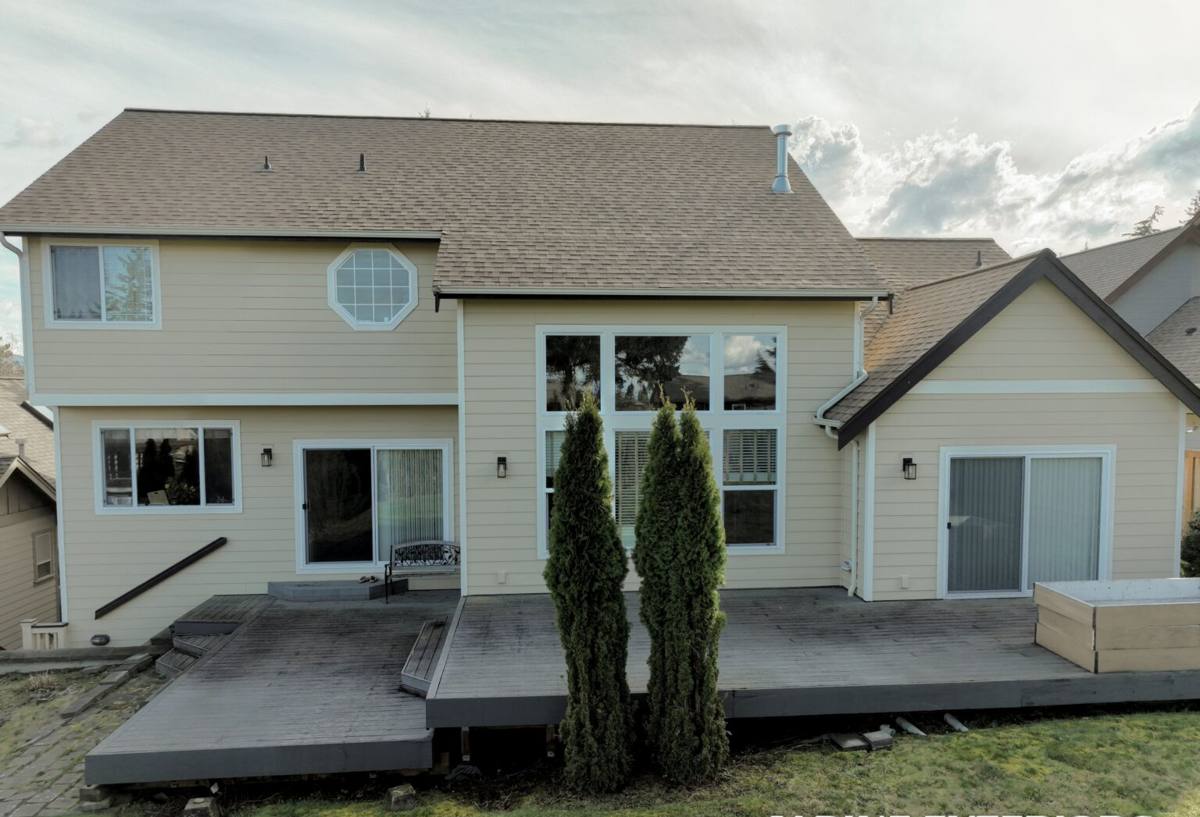
Signs a Deck Needs Repair — And What They Usually Mean
Homeowners often wait for something to visibly break before calling. By that point, the underlying problem has usually been developing for a while. Catching it earlier is cheaper and safer.
What to look for
- Soft or spongy decking boards — usually moisture that's gotten past the surface finish and into the wood grain.
- Rust streaks below fasteners — a sign the hardware is corroding faster than the wood around it is wearing.
- Gaps or movement at the ledger board (where the deck attaches to the house) — this is a structural connection, not cosmetic, and it's one of the most common failure points we find.
- Green or black film on north-facing or shaded boards — moss and algae holding moisture against the wood.
- Wobbly railings or stair stringers — often connected to fastener corrosion rather than the wood itself.
- Discoloration or staining on the house siding just above the deck — can indicate water is being trapped or redirected against the wall.
Any one of these on its own might be minor. Several together, or anything near the ledger connection, is worth a real inspection rather than a guess.
What a Correct Repair Actually Involves
A deck repair that's done right isn't just swapping bad boards for new ones. In a climate like this, the parts you can't see usually matter more than the parts you can.
Structural connections come first
The ledger board attachment, joist hangers, and any post-to-footing connections get checked before anything cosmetic is touched. If there's hidden rot at the ledger or corrosion in the hangers, replacing surface boards over that problem just hides it for another season.
Flashing and water paths
Where the deck meets the house, there should be flashing directing water away from the wall assembly, not into it. We check whether that flashing exists, whether it's intact, and whether it's actually doing its job — this is one of the most commonly skipped details in older deck construction and a frequent source of hidden rot behind siding.
Fasteners matched to the environment
Standard galvanized fasteners corrode faster near salt air than most homeowners expect. Repairs in this area should use fasteners and hardware rated for coastal or marine-grade exposure — it costs a little more up front and prevents the exact rust-streak, loose-connection problem that brings people to us in the first place.
Drainage and airflow underneath
Decks built low to the ground or without adequate ventilation underneath trap moisture longer after rain. Part of a proper repair is making sure water has somewhere to go and air can actually circulate, not just replacing what's visibly damaged.
Repair or Replace? What Actually Drives That Decision
Not every deck problem means starting over, but sometimes replacement is genuinely the more honest recommendation. Here's how we think through it:
| Factor | Favors Repair | Favors Replacement |
|---|---|---|
| Ledger board condition | Solid, properly flashed | Rotted or improperly attached |
| Extent of affected boards | Isolated sections | Widespread soft spots or rot |
| Framing/joists | Sound, dry | Soft, cracked, or corroded hangers throughout |
| Age of structure | Under ~15 years, built to a reasonable standard | Original construction unknown or clearly outdated |
| Fastener condition | Localized rust | Corrosion throughout connections |
We'll always tell you honestly which side of this table your deck falls on. There's no upside for us in patching something that needs to come down, and no upside for you in replacing something that just needed targeted repair.
How Our Process Works
1. Inspection
We look at the whole structure, not just the spot you called about — ledger connection, framing underneath, fastener condition, drainage, and any signs of moisture intrusion into the house itself.
2. Honest diagnosis
We explain what we found in plain terms: what's cosmetic, what's structural, and what's urgent versus what can reasonably wait a season.
3. The repair itself
Structural issues get addressed first. Boards, fasteners, and any flashing are replaced with materials suited to this specific climate, not whatever happens to be cheapest at a big-box store.
4. Finish and protect
Depending on the deck material, this may mean sealing, staining, or simply making sure surfaces are properly draining so moss doesn't get a foothold again right away.
Materials That Actually Hold Up Here
We don't push a single product as the answer for every deck — the right call depends on your budget, the deck's exposure, and how much upkeep you want to take on.
Wood decking
Still a solid, cost-effective option, but it needs a real maintenance commitment in this climate — sealing on a regular schedule and prompt attention to any spot where moss or standing water develops. Skipping maintenance is the single biggest reason wood decks fail early here.
Composite decking
Lower ongoing maintenance and generally better moisture resistance than wood, but it's not maintenance-free — it still needs proper drainage and airflow underneath, and installation quality matters as much as the material itself. Poor installation can trap moisture against composite boards just as easily as wood.
Our standard on hardware
Regardless of decking material, we treat fastener and connector selection as non-negotiable in coastal exposure. It's a small line item in the overall repair cost and the most common point of premature failure if it's cut.
Moss, Algae, and the Maintenance That Actually Prevents Repeat Repairs
Moss doesn't rot wood by itself — it rots wood by holding water against it far longer than the wood would otherwise stay wet. In shaded or north-facing sections of a deck, that can mean the wood underneath is damp for weeks at a stretch through the wetter months.
A few habits make a real difference between now and your next repair:
- Keep decking swept clear of leaves and debris, especially going into fall.
- Address moss growth early with an appropriate cleaner rather than letting it spread season over season.
- Check that gaps between boards haven't closed up with debris or swelling — those gaps are there to let water and air through.
- Trim back vegetation that's shading the deck and keeping it from drying out between rains.
- Have connections and fasteners checked every few years, not just when something feels loose.
Why Local Experience in Oak Harbor Matters
A deck built for a dry inland climate and a deck built for the wind and rain patterns near Oak Harbor shouldn't be repaired the same way. A crew that mostly works other regions may default to standard fasteners, skip flashing details, or underestimate how much airflow a deck here actually needs underneath. That's not negligence — it's just working outside the conditions they know.
We work the Anacortes area and the surrounding island communities regularly, which means we've seen how decks in this specific environment actually fail over time, not just how they're built to spec on paper. That's the difference between a repair that holds up through a few more wet winters and one that brings you right back to the same spot in a year or two.
Get an Honest Look at Your Deck
If your deck has soft spots, rust streaks, loose railings, or persistent moss, it's worth getting a straight answer on what's actually going on before it gets more expensive to fix. We offer free, no-pressure estimates and will tell you plainly whether you're looking at a targeted repair or something bigger — use the form below to get started.