 Anacortes Exterior
 Why Guemes Island Puts Siding Through More Than the Mainland Does
Guemes Island sits in the marine waters off Anacortes, and that location is exactly what makes siding decisions here different from a house a few miles inland in Skagit County. Homes on the island catch salt-laden air coming straight off the water, take on wind-driven rain that gets pushed sideways into wall assemblies rather than just falling straight down, and sit through a long, damp moss season that keeps north-facing and shaded walls wet for weeks at a stretch. That combination — salt, driving rain, and persistent moisture — is hard on any exterior material, but it's especially hard on anything that isn't dimensionally stable or that relies on paint film alone to keep water out.
We install James Hardie fiber cement siding exclusively, and Guemes Island is one of the clearer examples of why. Hardie's HZ5 product line is engineered specifically for climates like this one — freeze-thaw cycles, sustained moisture exposure, and coastal air — and it's the siding system we're comfortable standing behind on an island where a callback means a ferry ride, not a quick drive across town.
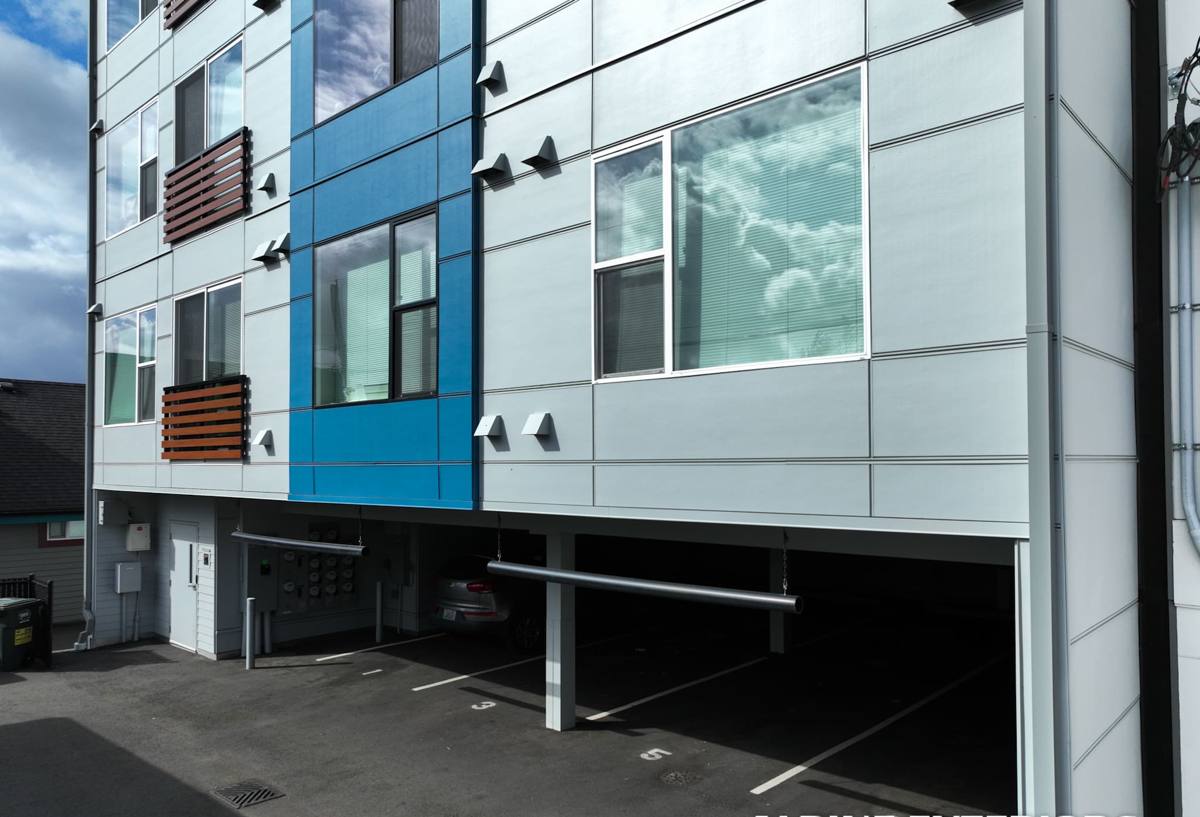
What Salt Air Actually Does to Siding
Salt air isn't just a nuisance smell near the water — it's mildly corrosive and it accelerates the breakdown of a lot of common building materials. Fasteners, flashing, and trim details that aren't rated for coastal exposure can start showing rust bleed years before they would inland. Wood-based siding products absorb the moisture that salt air carries and are prone to swelling, cupping, and paint failure at a faster rate near open water. Vinyl can become brittle faster under UV and salt exposure, and its seams give salt-laden moisture an easy path behind the cladding.
Fiber cement doesn't solve every one of these issues by itself, but it starts from a stronger position: it's not wood, so it doesn't swell and shrink with moisture the way solid or engineered wood products do, and it isn't degraded by salt the way bare or thinly coated metal components can be. The bigger factor is what's used alongside it — fasteners, flashing, and trim rated for coastal/marine exposure — which is a detail we don't skip on island jobs.
Where Salt Exposure Shows Up First
- Fastener heads and cut edges that weren't properly sealed or back-primed
- Trim-to-siding transitions where flashing was undersized or omitted
- Lower courses closest to grade, where splash-back concentrates both moisture and salt
- Corner boards and window trim, which take direct weather from multiple directions
Driving Rain and Wind-Driven Moisture
Anacortes and the surrounding islands get plenty of straightforward rainfall, but the more damaging pattern for siding is wind-driven rain — storms that push moisture sideways into wall assemblies instead of letting it run straight down and off. On an exposed island lot, this can mean water finding its way behind poorly lapped siding, undersized flashing, or gaps at penetrations (hose bibs, light fixtures, vents) that would barely register as a problem on a sheltered inland wall.
This is a water-management problem as much as a material problem. Correctly lapped Hardie panels or lap siding, paired with a properly installed weather-resistive barrier and rainscreen or drainage plane behind the cladding, gives wind-driven rain somewhere to go instead of somewhere to sit. Skipping or shortcutting that drainage layer is one of the most common ways a siding job fails early — regardless of which siding product sits on top of it.
Moss Season and Sustained Moisture
The long, wet stretch of fall through spring in Skagit County means shaded and north-facing walls on Guemes Island can stay damp for extended periods, which is exactly the environment moss, algae, and mildew need to take hold. On porous or absorptive siding materials, sustained dampness works its way into the substrate itself, not just the surface — leading to soft spots, delamination, or paint failure over time.
James Hardie's ColorPlus factory finish is baked on under controlled conditions and holds up better to sustained moisture exposure than field-applied paint, which is one of the reasons it matters more here than it would in a drier climate. A factory finish that's consistently cured and properly adhered gives moss and mildew less to grip onto, and it means the color coat isn't the only thing standing between the weather and the substrate underneath.
What a Correct James Hardie Install Looks Like on the Island
The product is only half the equation. A correct install is what actually determines whether a home holds up to Guemes Island's conditions for the long haul. On every job we do out here, that means:
- A continuous, properly lapped weather-resistive barrier behind the siding — no gaps, no shortcuts at seams
- Flashing at every window, door, and penetration, sized and installed to shed water outward, not trap it
- Correct fastener type, spacing, and penetration depth per Hardie's published installation requirements
- Proper clearance at grade, decks, and roof lines so siding isn't sitting in standing water or constant splash-back
- Factory-cut and factory-primed edges used wherever possible, with any field cuts sealed per Hardie's specifications
- Caulking and sealant only where Hardie's install guide calls for it — not as a substitute for proper flashing
Hardie's product warranty is tied to installation that follows their published requirements. A crew that treats those requirements as optional isn't just risking a callback — they're risking the homeowner's warranty coverage.
Working on an Island: Logistics Most Contractors Don't Plan For
Guemes Island is accessed by a short ferry crossing from Anacortes, and that changes how a siding job needs to be run. Materials, crews, and equipment all move on ferry schedules, which means a contractor who doesn't plan ahead can turn a straightforward job into a stretched-out one — half-finished walls exposed to weather longer than they should be, or return trips burned on forgotten materials.
We plan Guemes Island jobs around the ferry from the start: staging materials in Anacortes ahead of the crossing, batching crew trips to minimize how many round-trips a job takes, and sequencing the work so exposed wall sections aren't left open to the weather between visits. That planning is part of what "a crew that already works Guemes Island" actually means in practice — it's not just familiarity with the climate, it's familiarity with how to get a job done efficiently when a body of water sits between the job site and the supply yard.
Comparing How Common Siding Materials Handle This Climate
| Factor | James Hardie Fiber Cement | Vinyl | Wood / Engineered Wood |
|---|---|---|---|
| Salt air exposure | Not degraded by salt; performance depends on coastal-rated fasteners and trim | Can become brittle faster under UV plus salt exposure | Absorbs moisture, accelerating rot and finish failure near salt air |
| Wind-driven rain | Dimensionally stable; performance relies on correct lap and flashing | Seams and panel joints can allow moisture intrusion | Swelling at seams and joints under repeated wetting |
| Moss/algae in shaded, damp areas | Factory finish resists staining better than field-applied paint | Doesn't feed moss growth but shows staining on the surface | Porous surface holds moisture, encouraging moss and mildew growth |
| Finish durability | Factory-cured ColorPlus finish, long fade/wear warranty | Color is through-body but can fade and chalk over time | Field-applied paint or stain, needs recoating on a regular cycle |
| Fire resistance | Non-combustible fiber cement | Combustible, can melt or deform under heat | Combustible |
What Homeowners on Guemes Island Should Ask a Siding Contractor
Given the added logistics and the climate demands, a few questions separate a contractor who's actually set up for island work from one who isn't:
- Do you have experience installing on Guemes Island specifically, and how do you handle ferry logistics for materials and crew?
- What weather-resistive barrier and drainage plane do you install behind the siding, and is it continuous?
- What fastener and flashing materials do you use, and are they rated for coastal/marine exposure?
- How do you sequence the job to limit how long any wall section sits open to the weather?
- What does the manufacturer's warranty actually require from the installation, and how do you document that you've met it?
A contractor who can answer these clearly, without hedging, is one who's actually thought through what this island asks of a siding job — not just the product on the wall, but everything behind it.
Why We Standardized on James Hardie for Homes Like These
We don't install LP SmartSide, vinyl, Cemplank, Allura, primed spruce, or cedar. Some of those products have real strengths in the right setting. But for a climate that combines salt air, wind-driven rain, and a long moss season — Guemes Island's climate — we wanted a product that's dimensionally stable, non-combustible, backed by a factory finish rather than a field-applied one, and supported by a manufacturer warranty that's meaningful when it's installed correctly. James Hardie's HZ5 line and ColorPlus finish are the combination that best matches what this island actually demands from an exterior, and it's what we put on homes here.
If you're weighing a siding project on Guemes Island, we're happy to walk your property, talk through what your walls are dealing with, and give you a straightforward, no-pressure estimate — fill out the form below and we'll get in touch.