 Anacortes Exterior
 Conway sits in the low, wet part of Skagit County — river delta flatland between Mount Vernon and the county line, with moist marine air moving in off Puget Sound and a rain pattern that leans more "steady and driving" than "quick showers." If you're building new out here, the windows are one of the first things that decide whether that house stays dry for the next 30 years or starts fighting moisture problems in year five. New-construction window installation is a different job than swapping out an old window in an existing wall, and it needs to be treated that way from the day the rough openings get framed.
New-Construction Windows Aren't the Same Job as a Replacement
"New-construction" windows are built with a nailing fin — a flange around the perimeter of the frame that gets fastened directly to the wall sheathing before siding goes on. That's different from a "replacement" or "block frame" window, which is sized to slide into an existing opening without disturbing the exterior wall covering. Because a new-construction window goes in during framing, before the weather-resistant barrier (WRB) and siding are closed up, the installer has full access to build the water management system in the correct order — sill pan first, then window, then flashing tape integrated with the housewrap, shingle-style, so water always sheds outward and down.
That access is an advantage, but only if it's used correctly. A new-construction window installed sloppily is arguably worse than a replacement window installed carefully, because the flashing details get buried behind siding and trim for good. There's no going back to fix a bad sill pan once the house is finished.
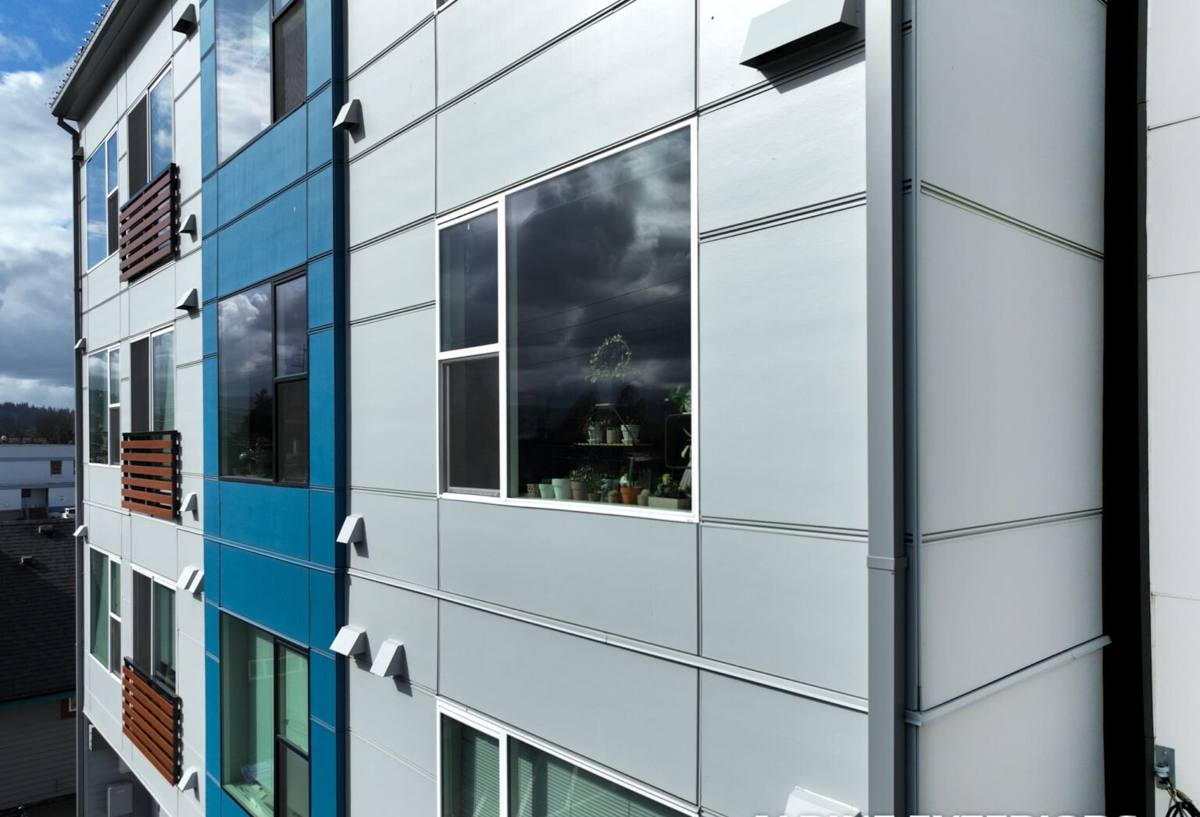
What Conway's Climate Actually Demands From a Window Install
Driving Rain and Wind-Driven Water
Skagit County storms don't just fall straight down — wind pushes rain sideways into wall assemblies, which is exactly the condition that exposes weak flashing details. A window that only sheds water in a calm rain isn't good enough here.
Humidity and a Long Moss Season
Low-lying, river-adjacent ground like Conway holds humidity longer than higher, drier terrain. Combined with the region's long moss and mildew season, any moisture that gets trapped behind trim or siding has more time and more encouragement to cause rot before anyone notices.
Marine Air
Salt-laden air off the Sound doesn't hit Conway as directly as it hits a home right on Fidalgo Island, but it's still part of the regional air moving through Skagit County, and it's one more reason to spec hardware and fasteners rated for a marine-influenced climate rather than the cheapest option available.
The Anatomy of a Correct New-Construction Window Install
There's a specific order of operations that makes a new-construction window watertight for decades instead of years. Skipping steps or doing them out of sequence is the single biggest cause of window-related water damage we see in newer homes.
- Rough opening check — verify the opening is square, plumb, and sized correctly before anything else happens.
- Sill pan flashing — a sloped, back-dammed pan at the bottom of the opening so any water that gets past the window has a built-in path back outside instead of soaking into the framing.
- Window set and shimmed — set into the sill pan, shimmed square and plumb, fastened through the nailing fin per the manufacturer's schedule (this affects the warranty, not just the install).
- Flashing tape, shingle-style — jambs first, then the head flashing last, each layer overlapping the one below it so water is directed down and out, never trapped behind a layer above.
- WRB integration — the housewrap is lapped over the head flashing and taped so the whole wall plane sheds water as one continuous system, not a patchwork of separate pieces.
- Interior air seal — a bead of sealant or low-expansion foam around the interior perimeter to control air leakage and condensation without over-filling the shim space.
Every one of those steps needs to happen before the next trade covers it up with siding or interior finish. That's why timing with the builder's schedule matters as much as the install itself.
Choosing a Frame Material for a Conway Build
New construction gives you a real choice of frame material, since you're not constrained by an existing opening. Here's how the common options stack up for this climate specifically:
| Frame Material | Moisture Behavior Here | Maintenance | Typical Cost |
|---|---|---|---|
| Vinyl | Handles moisture fine, but can flex and gap slightly over time in temperature swings | Low | Lowest |
| Fiberglass | Very stable dimensionally; holds its seal against driving rain better than vinyl over the long run | Low | Mid to upper-mid |
| Wood-clad (exterior clad) | Good if flashing details are done right; clad exterior protects the wood from the weather side | Moderate — cladding needs to stay sealed at joints | Highest |
| Aluminum | Conducts cold and can condense on the interior in a wet climate like this | Low | Mid |
We don't push one brand or material on every job — the right call depends on the home's design, the budget, and the builder's spec. What we won't compromise on is the installation detailing underneath, because that's what actually determines whether the window performs in Skagit County weather, regardless of what the frame is made of.
Our Process on a Conway New Build
Working on new construction means working inside someone else's schedule — the general contractor's — so coordination matters as much as craftsmanship.
- We review the window schedule and rough openings against the plans before delivery, so any sizing conflicts surface early instead of on install day.
- We coordinate directly with the builder on dry-in timing, since windows need to go in before the house is buttoned up but after the WRB is in place and ready to integrate.
- We install sill pans and flashing in the sequence above on every unit, not just the ones that face the weather — wind-driven rain in this area doesn't respect which wall "should" be the wet side.
- We photograph flashing details before they're covered by siding, so there's a record of what's behind the finish if anything ever needs to be traced back.
- We walk the finished install with the builder or homeowner before trim and siding lock everything in, so there's still time to correct anything that isn't right.
A Pre-Drywall Checklist for Conway Builds
If you're a homeowner working with a builder and you want to sanity-check the window install before the walls close up, these are the things worth asking to see or asking about directly:
- Was a sill pan installed under every window, not just the ones on the weather side?
- Is the flashing tape sequence shingle-lapped (jambs before head, head last) rather than taped in a single wrap?
- Is the housewrap integrated over the head flashing, or just butted against it?
- Were the windows fastened per the manufacturer's schedule (this affects whether the warranty is actually valid)?
- Is there a visible gap for interior sealant/foam, or was the shim space over-filled?
Why It Matters to Hire a Crew That Already Works Conway and Skagit County
A window installer who mostly works drier inland regions can do a technically fine install and still get it wrong for this area, because the details that matter most here — sill pan sizing, flashing sequence, fastener corrosion resistance — are exactly the ones that don't show up as a problem until a few wet seasons in. A crew that regularly works Conway, Anacortes, and the rest of Skagit County has already seen what driving rain and a long moss season do to a house that was flashed for a drier climate, and builds accordingly from the start. That also means familiarity with local permitting and inspection expectations, and a working relationship with the builders and lumber yards already active in this area — which keeps a new-construction job moving on schedule instead of stalling on details nobody anticipated.
Cost Factors Worth Understanding Up Front
New-construction window costs vary by opening count, size, frame material, and glass package, so broad ranges are more useful here than a single number. What tends to move the price on a Conway job specifically:
- Number and size of openings — straightforward, but it's the biggest single driver of total cost.
- Frame material chosen (see the comparison above) — often the largest per-unit cost swing.
- Performance glass package — upgraded low-E coatings and gas fills add cost but matter more in a marine climate with real temperature swings between seasons.
- Access and building complexity — multi-story openings or tricky rooflines add labor time regardless of the window itself.
None of these are places to cut corners on the installation labor itself — the flashing and sill pan work costs roughly the same whether the window is a $300 vinyl unit or a $1,500 wood-clad unit, and skipping it to save money is the single most common way a new build ends up with a moisture problem behind the walls.
If you're building in Conway or elsewhere in Skagit County and want a straight answer on window scope, timing, and what a correct install looks like for your specific plans, we're happy to walk through it. Reach out for a free, no-pressure estimate — the form below gets you started.