 Anacortes Exterior
 Why Decks in Bow Wear Out Faster Than the Manual Says
Bow sits close enough to Samish Bay and the open water of Skagit County that salt-laden air is a daily fact of life, not an occasional event. Add in a rain season that runs long and heavy, plus a moss season that can stretch from late fall well into spring, and you have three forces working against a deck at the same time: corrosion, moisture intrusion, and organic growth that holds water against wood and fasteners far longer than manufacturers ever tested for. A deck built to a generic national spec often shows its age here five to ten years earlier than the same deck would in a drier inland climate.
Most of the decks we're called out to look at in Bow aren't failing because they were built badly. They're failing because they were built for a different climate than the one they're actually sitting in. That distinction matters, because it changes what "replacement" should actually fix.
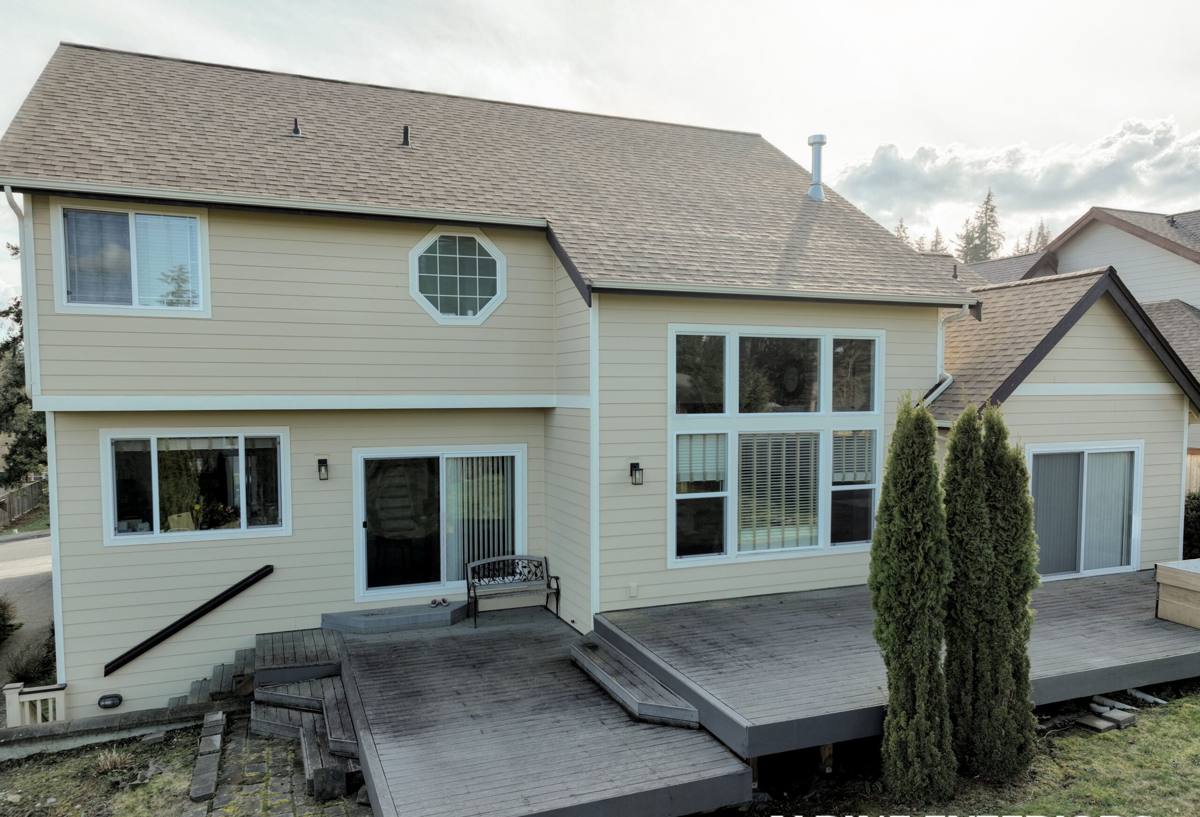
Replacement vs. Resurfacing: Know What You're Actually Buying
A lot of deck jobs sold as "replacement" are really just resurfacing — new boards screwed down over the same old framing. That can be the right call if the substructure is sound, but in a salt-air, high-moisture area like Bow, the framing is very often the part that's actually failed, even when the surface boards still look presentable from a few feet away.
What we check before recommending either option
- Ledger board condition where the deck attaches to the house — this is the single most common hidden rot location
- Joist and beam condition, especially anywhere moss or standing water has been sitting on top of the framing
- Post bases and footings, checking for heave, rot at ground contact, or undersized footings for the deck's actual load
- Fastener and hardware corrosion — rust streaking on the surface almost always means compromised hardware underneath
- Railing post attachment, since this is a life-safety item and one of the first things to loosen as framing degrades
If the framing is sound, resurfacing with better materials can be a reasonable, lower-cost path. If it isn't, resurfacing just buries the real problem under new boards for a few more years before it resurfaces — often literally, as soft spots or spongy decking.
The Ledger Board and Flashing: The Job's Most Important Detail
The connection between a deck and the house is where water intrusion does the most damage, and it's also the detail that's easiest to get wrong or skip entirely. A correct ledger attachment includes proper flashing that sheds water away from the house sheathing, not just a bead of caulk and a hope. In a climate with as much driving rain as Skagit County sees, a poorly flashed ledger board can be feeding moisture into the house framing for years before anyone notices — usually not until there's visible damage on an interior wall or rot that's spread well past the ledger itself.
Any deck replacement worth doing addresses this connection properly: correct flashing, proper fastener spacing and type, and a ledger board attachment that accounts for the wall assembly behind it, not a generic one-size-fits-all detail.
Choosing Decking Material for Salt Air and a Long Moss Season
There's no single "best" decking material for Bow — there are trade-offs, and the right answer depends on how much maintenance you're willing to do versus what you're willing to pay upfront.
| Material | How It Handles Salt Air & Moisture | Moss & Algae Behavior | Maintenance Burden |
|---|---|---|---|
| Pressure-treated lumber | Good rot resistance when properly maintained; fasteners are the weak point | Moss takes hold readily on the textured, absorbent surface | Highest — needs regular cleaning and periodic sealing |
| Cedar | Naturally decay-resistant but still needs finish upkeep in wet climates | Moderate — smoother grain sheds moisture better than PT lumber | Moderate to high — finish reapplication every few years |
| Composite decking | Excellent moisture resistance; doesn't rot | Can still grow moss/algae on the surface, especially in shaded, low-airflow spots — but it wipes off without damaging the board | Low — occasional cleaning |
| PVC decking | Fully moisture-proof, no rot risk | Similar surface growth potential to composite in shaded areas; cleans off easily | Low |
Composite and PVC products cost more upfront but remove wood rot from the equation entirely, which carries real weight in a climate where moisture is the main enemy. Wood decking isn't a bad choice — it's a lower upfront cost with a real maintenance commitment attached. We'll walk you through the honest trade-offs for your specific deck rather than pushing one product line.
Fasteners and Hardware: Where Cheap Decisions Show Up First
Salt air accelerates galvanic corrosion, and it does it quietly. Standard electro-galvanized screws and joist hangers that would last decades inland can start rusting and losing holding strength in a fraction of that time this close to the water. That corrosion doesn't just look bad — it's a structural issue, since a corroded fastener has less grip and a corroded joist hanger loses load capacity exactly where the deck needs it most.
For any Bow deck replacement, we spec stainless steel or heavy hot-dip galvanized fasteners and connectors rated for coastal/high-moisture exposure, not the standard-grade hardware that's fine in drier parts of the state. It costs a bit more upfront and it's not a corner worth cutting.
Drainage and What's Happening Underneath the Deck
A deck that sheds water well on top but traps it underneath is still a deck with a moisture problem. Poor grading, no gap for airflow, or landscaping that's crept up against the framing all create conditions where moss, mildew, and rot take hold out of sight. Part of a proper replacement is looking at what's happening below the joists — not just what happens on the walking surface — and correcting drainage and airflow issues so the new structure doesn't just fail the same way the old one did.
Permits and Code Considerations Around Skagit County
Deck replacement work in and around Anacortes and unincorporated Skagit County generally requires a permit once you're replacing structural components — framing, footings, or anything affecting the guardrail and stair system — rather than a simple like-for-like board swap. Requirements can vary depending on your specific parcel, whether it falls under county or city jurisdiction, and proximity to shoreline areas near Samish Bay, which can carry additional review. We handle the permit process as part of the job so you're not stuck untangling jurisdiction questions on your own.
Our Process for a Bow Deck Replacement
- On-site evaluation of the existing deck, focusing on framing, ledger, and footings, not just the visible boards
- Honest assessment of whether you need full replacement or whether resurfacing is a legitimate option
- Written estimate with material options and clear trade-offs, no pressure toward the most expensive choice
- Permit handling where required, based on your specific location and scope of work
- Demo of the old structure and correction of any drainage, flashing, or grading issues found underneath
- Framing rebuild with coastal-rated fasteners and hardware
- Decking, railing, and stair installation to current code for guardrail height and spacing
- Final walkthrough so you know what maintenance, if any, your new deck needs going forward
Living With Your New Deck Through Moss Season
Whatever material you choose, a little seasonal upkeep goes a long way in this climate. Keeping the deck surface clear of wet leaves and debris before moss season sets in, making sure gutters upslope aren't dumping extra water onto the deck, and giving the surface an occasional cleaning will keep any decking material performing the way it's supposed to. Composite and PVC owners have it easier here, but even wood decking holds up reasonably well if moisture isn't allowed to sit on it for weeks at a time.
Why It Matters to Hire a Crew That Already Works in Bow
A contractor who mostly works drier, inland jobs can build a technically sound deck that still isn't right for this environment — standard hardware, standard flashing details, standard material assumptions. Working regularly in Bow and the surrounding Anacortes area means we're not guessing at how salt air and moss season affect a deck over time; we're building around it from the start, because we're the ones who get the call when it wasn't accounted for the first time around.
If your deck is showing rust streaks, soft spots, moss that won't stay gone, or you're just not sure whether it needs a full replacement or a simpler fix, we're happy to take a look. The estimate is free, there's no pressure, and you'll get a straight answer about what your deck actually needs.