 Anacortes Exterior
 Board & Batten Fits Burlington's Farmhouse and Craftsman Character
Burlington sits in the Skagit Valley, where a lot of the housing stock — old farmhouses, newer craftsman-style builds, and everything in between — leans toward simple, vertical lines. Board and batten siding, with its wide panels and narrow vertical strips covering the seams, has always paired well with that look. It reads as clean and a little rustic without trying too hard, and it works whether the house is a century-old farmhouse near the fields or a newer build on a quarter-acre lot.
The style isn't just cosmetic. Vertical siding sheds water differently than horizontal lap siding, and when it's detailed correctly, it can hold up very well in a wet climate. When it's detailed poorly, it's one of the faster ways to trap moisture against a wall. The difference comes down to what's behind the panels, not just what's on the surface.
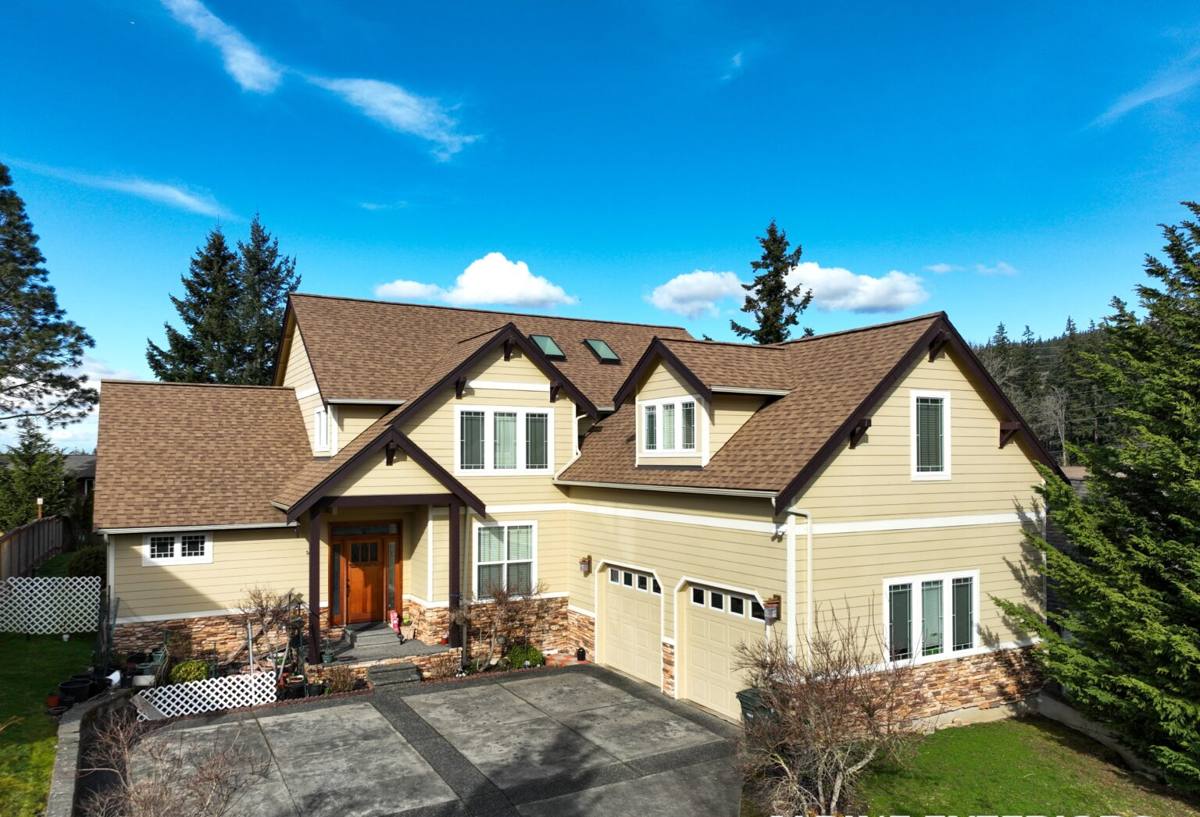
What Burlington's Climate Actually Does to Vertical Siding
Burlington and the surrounding Skagit County towns get a specific combination of weather that's harder on siding than people expect: salt-laden air moving in off the Salish Sea and Padilla Bay, long stretches of driving, wind-pushed rain rather than gentle straight-down rain, and a moss and algae season that can run most of the year on shaded or north-facing walls.
- Salt air accelerates corrosion on fasteners, flashing, and any exposed metal trim — cheap or mismatched hardware fails faster here than it would inland.
- Driving rain gets pushed sideways and upward under battens and around window trim, which means flashing and joint details matter more than the siding material itself.
- Moss and algae take hold fastest where a wall stays damp — under overhangs with poor airflow, on north-facing elevations, and anywhere the siding sits tight against wet sheathing with no drainage gap.
None of that means board and batten is a bad choice here. It means the installation has to account for these conditions from the start, not patch around them later.
Board & Batten in James Hardie Fiber Cement
We install board and batten exclusively in James Hardie fiber cement — either HardiePanel vertical siding with wood or fiber cement battens over the seams, or Hardie's Artisan-series panels for a more refined, tighter-grain look. We don't offer this style in vinyl, LP SmartSide, primed spruce, or cedar, and that's a deliberate call, not a limitation of what we're able to install.
Fiber cement doesn't absorb water the way wood-based panels do, so it doesn't swell, cup, or rot at the seams — which is exactly where board and batten is most vulnerable. It's also non-combustible, holds paint and factory finish far longer than wood substrates, and the panels come pre-primed or with Hardie's ColorPlus factory finish baked on, so the color isn't relying on a field-applied coat to hold up through a Skagit Valley winter.
Why we skip the alternatives
Vinyl board and batten looks the part from the street but it's a thin extruded product with visible seams and panel movement in temperature swings — it doesn't hold up to close inspection or decades of coastal weather the way a rigid fiber cement panel does. Wood board and batten (cedar or primed spruce) looks great new, but every joint, every batten edge, and every fastener hole is a place for moisture to get in, and in this climate that maintenance burden shows up fast — repainting, caulk failure, and eventually rot at the bottom courses. We'd rather put a product on the house that doesn't need that fight every few years.
What a Correct Board & Batten Installation Involves
Board and batten has more ways to go wrong than lap siding, mainly because it's vertical and every seam runs with gravity instead of shedding water sideways the way overlapped lap siding does. A correct install leans on the assembly behind the panels, not just the panels themselves.
Drainage and the rainscreen gap
Fiber cement siding — board and batten especially — should sit on a drainage plane with a real air gap behind it (furring strips or a purpose-built rainscreen product), not directly against the house wrap. That gap lets any moisture that does get past the siding dry out and drain down instead of sitting against the sheathing. This matters more in Burlington than in a dry climate, because the wall assembly rarely gets a long stretch of time to fully dry out between rain events.
Fastening and battens
Battens need to land on solid framing or blocking, not just the panel edge, and fastener spacing has to follow Hardie's published specs for the panel width and exposure. In a salt-air environment, we use fasteners rated for that exposure — stainless or hot-dip galvanized, matched so you don't get galvanic corrosion between dissimilar metals at flashing and trim.
Flashing and joints
Every window, door, and horizontal trim break is a place driving rain will try to get behind the siding. Head flashing above openings, proper kickout flashing where a roofline meets a wall, and correctly lapped house wrap at every seam are what actually keep water out — the siding material is really only the last line of defense.
Quick checklist for a correct job
- Rainscreen gap or drainage furring behind every panel, not siding tight to the wrap
- Fasteners rated for coastal/salt-air exposure, no bare steel
- Battens landing on solid blocking, spaced and fastened to manufacturer spec
- Head flashing over every window and door, kickout flashing at roof-wall intersections
- Factory-finished (ColorPlus) panels where possible to avoid early field-paint failure
- Bottom clearance from grade, decks, and roof lines to keep splash-back off the lowest course
Board & Batten Material Options Compared
| Material | Moisture behavior | Finish durability | Fit for Burlington's climate |
|---|---|---|---|
| James Hardie fiber cement | Doesn't swell or rot; dimensionally stable when wet | Factory ColorPlus finish, decades before repaint | Built for this — salt air, rain, and moss resistance are engineered in |
| Cedar / primed wood | Absorbs moisture at joints and fastener holes; prone to cupping | Field-applied paint, typically needs attention every 3-7 years | Classic look, but high maintenance in a wet coastal climate |
| Vinyl | Doesn't rot, but seams and battens can trap moisture behind the panel | Color molded in but fades and chalks over time | Low cost, but thin profile and visible panel movement over time |
Our Process on a Burlington Board & Batten Project
We start with an on-site walk of the exterior — checking existing siding condition, sheathing and moisture damage where old siding comes off, roofline transitions, and how the house sits relative to prevailing wind and rain direction. From there we scope the tear-off, any sheathing repair, the rainscreen and moisture barrier, and the panel and batten layout so seams line up cleanly with window and trim lines. Installation follows Hardie's fastening and clearance specs for our region, with flashing detailed at every penetration before panels go on. We close out with a final walk so you can see the trim, joints, and finish before we call it done.
Why a Crew That Already Works Burlington Matters
A lot of siding failures in this area aren't a bad product — they're a correct product installed the way it would be installed in a drier climate. A crew that works Skagit County regularly knows how far the driving rain pushes water sideways here, how long the moss season really runs on a shaded elevation, and where salt air off the bay does the most damage to fasteners and trim. That local pattern recognition is what keeps a board and batten job looking right ten and twenty years out, not just on install day.
Maintenance and What to Expect Over Time
A correctly installed James Hardie board and batten system is genuinely low-maintenance compared to the alternatives — no repainting cycle every few years, no repeated caulk maintenance at every seam. You'll still want to rinse off accumulated moss or algae on shaded walls periodically and keep an eye on caulking at trim transitions, since sealants are the one component that ages faster than the siding itself. Beyond that, it's mostly a matter of keeping gutters and downspouts clear so water isn't dumping directly onto a wall section.
If you're planning a siding project in Burlington and want board and batten done with the drainage, flashing, and fastening details this climate actually requires, we're happy to walk the house with you and put together a straightforward, no-pressure estimate.