 Anacortes Exterior
 Why Skyline Homes Take a Harder Hit Than Most
Skyline sits up on the water side of Anacortes, and that elevated, open exposure is exactly what makes it beautiful and exactly what makes it hard on exterior materials. Homes here catch wind coming straight off Rosario Strait and Guemes Channel, which means rain doesn't just fall on this siding — it drives into it sideways, again and again, for months at a time. Add the salt content in that marine air and you have a combination that ages ordinary siding faster than almost anywhere else in Skagit County.
Then there's the moss. Western Washington's long, wet, low-light stretch from fall through spring gives moss and algae months to establish themselves on any siding surface that holds moisture or has a rough, absorbent face. On a shaded or north-facing wall in Skyline, that season can run six months or longer. Siding that isn't dense, sealed, and properly detailed becomes a moss farm — and once moss gets a foothold, it holds water against the wall behind it, which is where the real damage starts.
None of this is unique to Skyline in a broad sense — it's the story for waterfront and view-lot homes all along the Anacortes shoreline. But the combination of elevation, open wind exposure, and consistent moisture load is intense enough that we treat siding work here differently than we would on a more sheltered inland lot.
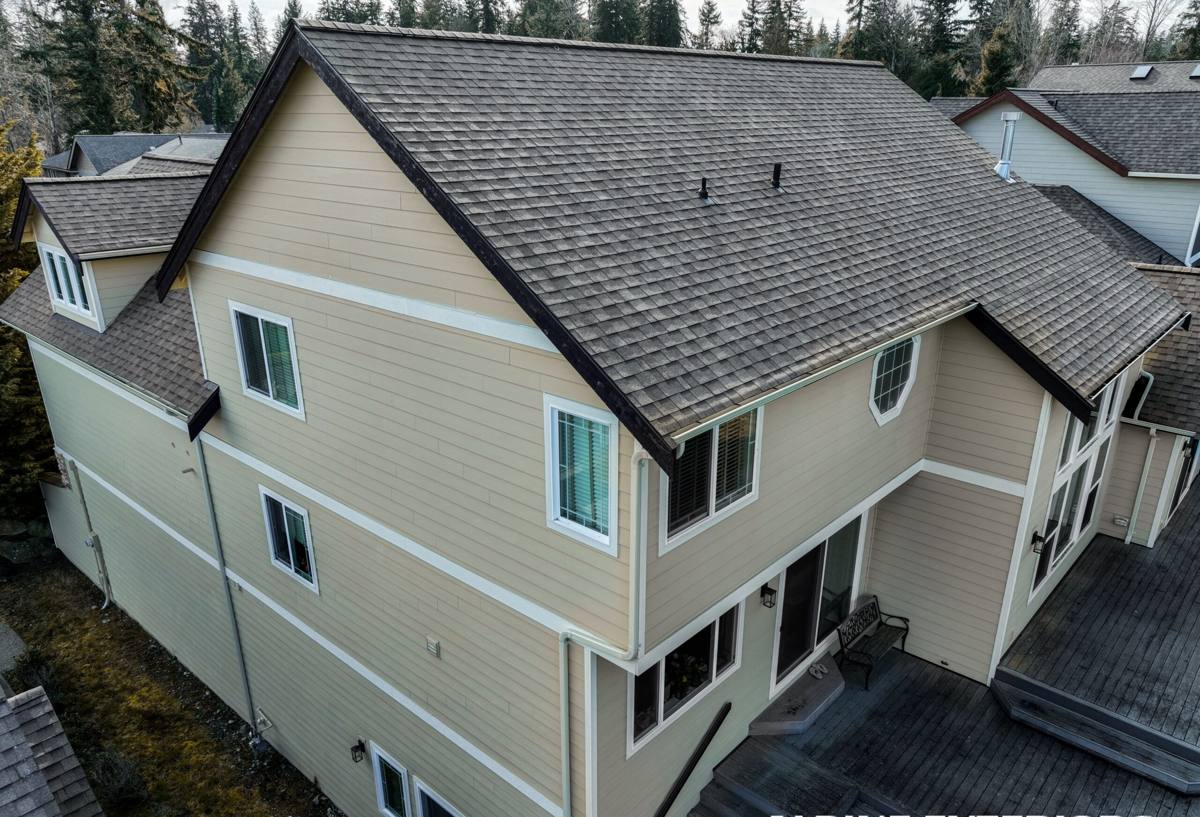
What "Correct" Actually Means in This Climate
A siding job can look finished and still be wrong. In a marine climate like Skyline's, the parts you can't see after installation matter more than the parts you can. Correct siding for this area means:
Moisture Has to Have Somewhere to Go
Water will get behind siding eventually — through a nail hole, a hairline gap at a trim joint, wind-driven rain forced past a lap. The question isn't whether that happens, it's what happens next. A proper weather-resistive barrier, correctly lapped flashing at every window, door, and penetration, and an air gap or drainage plane behind the siding give that moisture a path back out instead of a place to sit and rot the sheathing.
The Material Itself Has to Resist Water, Not Just Shed It
This is where fiber cement earns its place on a home like this. James Hardie siding is engineered from cellulose fiber, sand, and cement — a dense composite that doesn't absorb and swell the way wood-based products can, and doesn't expand and contract with temperature swings the way vinyl does. That stability matters on a house that's getting soaked, dried by wind, and soaked again on a weekly cycle for half the year.
The Finish Has to Survive UV and Salt, Not Just Look Good on Day One
James Hardie's ColorPlus finish is baked on at the factory in multiple coats, engineered specifically to hold color and resist fading, chipping, and cracking under sun and salt exposure that field-applied paint struggles with over time. On a Skyline lot with open water views, that finish is also under more direct sun than a shaded inland home would see.
Why We Only Install James Hardie
We made a decision as a company to install James Hardie fiber cement and nothing else — not vinyl, not LP SmartSide, not Cemplank or Allura, not primed spruce or cedar. That's not a marketing position, it's a practical one built on what holds up in this exact climate. Vinyl expands, contracts, and can warp or crack in sustained wind and temperature swings. Wood-based and engineered wood products depend heavily on maintaining an intact factory coating — any breach and moisture starts working into the substrate. Cedar is a genuinely handsome, traditional material, but it demands ongoing maintenance and refinishing to perform in a wet marine environment, and that upkeep burden falls on the homeowner for the life of the siding.
James Hardie is non-combustible, dimensionally stable, backed by a strong transferable warranty, and it's the product we're willing to stand behind on a home that's going to spend decades facing the water. We only install one system because we'd rather be excellent at the right material than average at five.
Product Lines That Fit Skyline's Home Styles
Skyline's homes range from older, more modest builds to newer construction with clean, view-forward architecture, so we don't push one profile on every house.
- HardiePlank lap siding — the classic horizontal look, available in smooth or cedar-textured finish, works on both traditional and updated homes
- HardiePanel vertical siding — often paired with lap siding as an accent, or used on modern-leaning builds for a cleaner architectural line
- Board and batten configurations — a strong fit for the more contemporary homes going up in the area
- HardieTrim — matched trim boards that don't rot at corners and window returns the way wood trim does
For homes with this level of wind and salt exposure, we also talk with homeowners about James Hardie's HZ5 engineered product line, which is formulated specifically for wetter, harsher climate zones.
What Salt Air and Driving Rain Actually Do to a Wall
It helps to be specific about the failure path, because it's the same story on nearly every problem siding job we get called out to inspect on a waterfront lot.
| Climate Factor in Skyline | What It Does Over Time | How Correct James Hardie Installation Responds |
|---|---|---|
| Wind-driven rain off the water | Forces water past laps and trim joints that would stay dry on a sheltered inland wall | Proper flashing, lap spacing, and caulking at every joint stop water at the surface instead of behind it |
| Salt-laden air | Corrodes exposed fasteners and accelerates finish breakdown on lower-grade coatings | Correct fastener specification plus ColorPlus factory finish resist salt-driven degradation |
| Long moss season (fall–spring) | Moss and algae take hold on absorbent or moisture-trapped surfaces, holding water against the wall | Dense fiber cement resists surface absorption; proper drainage plane keeps the wall cavity dry |
| Sun exposure on open view lots | UV breaks down field-applied paint and lower-quality coatings faster than shaded walls | Factory-applied ColorPlus finish is engineered for UV and color retention |
| Temperature swings, wet-to-dry cycling | Causes expansion/contraction stress that opens gaps in less stable materials | Fiber cement's dimensional stability keeps joints tight through the cycle |
How Our Process Works on a Skyline Home
Every job starts with a real look at the wall, not just a bid off a photo.
Assessment
We check the existing siding and sheathing for hidden moisture damage, evaluate wind exposure on each elevation, and look at where past water intrusion has likely occurred — usually around windows, at deck ledgers, and at any trim penetration.
Tear-Off and Substrate Repair
Any rotted sheathing or framing gets replaced before new siding goes on. Covering a compromised substrate with new siding just hides the problem for a few more years.
Weather-Resistive Barrier and Flashing
We install a continuous weather-resistive barrier with correctly lapped flashing at every window, door, and penetration — the single most important step for a home taking on this much wind-driven rain.
Drainage Plane
Where the wall assembly calls for it, we build in a drainage gap behind the siding so any moisture that does get past the cladding has a way out instead of sitting against the sheathing.
Installation to James Hardie Spec
Fastener type, spacing, lap dimensions, and clearances all follow James Hardie's published installation requirements for this climate zone — not shortcuts, because the product's warranty depends on it being installed correctly, and so does the wall behind it.
Finish Detailing
Trim, caulking, and touch-up are done last, with attention to the joints and terminations that take the brunt of the wind and rain in an exposed setting like this.
What Skyline Homeowners Should Expect for Maintenance
James Hardie siding installed correctly is genuinely low-maintenance compared to wood or vinyl, but "low-maintenance" doesn't mean "no maintenance" — especially in this climate. A short seasonal routine keeps a Hardie exterior performing the way it's designed to:
- Rinse the siding once or twice a year, focusing on shaded and north-facing walls where moss is most likely to establish
- Walk the exterior each fall and check caulking at trim joints, window returns, and penetrations before the wet season sets in
- Keep gutters clear so overflow isn't running down the wall face during heavy rain events
- Trim back vegetation that shades walls or holds moisture against the siding
- Watch for any soft spots, staining, or paint failure at ground-contact areas, which can signal a drainage issue rather than a siding problem itself
Why a Crew That Already Works Skyline Matters
Siding installation isn't one-size-fits-all, and a crew that's only worked drier, more sheltered inland jobs will make different — and sometimes wrong — calls on flashing details, fastener choice, and drainage planning than a crew that already knows what this specific stretch of Anacortes waterfront throws at a wall. We've built our installation standards around Skagit County's marine exposure, not a generic climate zone, and that shows up in the details that don't get noticed until years later when a poorly detailed wall starts failing and a correctly detailed one doesn't.
If you're planning a siding project on a Skyline home, we're happy to walk the exterior with you, point out what your specific exposure and elevation actually require, and give you a straightforward, no-pressure estimate. There's no cost and no obligation to get our read on your home — just fill out the form below to get started.