 Anacortes Exterior
 Burlington Sits in a Tougher Climate Than It Looks
Burlington doesn't get hit with surf spray the way a waterfront lot in Anacortes does, but it's close enough to Padilla Bay and the Salish Sea that salt-laden marine air still rides inland on winter storms. Add in the Skagit Valley's own weather pattern — low-lying fog off the river bottom, long stretches of steady rain, and shaded, tree-lined older neighborhoods that stay damp for days after a storm passes — and you get a climate that's genuinely hard on exterior building materials, even though it doesn't look dramatic on paper.
The combination that matters most for siding is moisture that lingers plus organic growth that thrives in it. Skagit County's mild, wet winters are ideal for moss and algae, and once either takes hold on a wall, it holds water against the surface far longer than open air and sun would allow. That's the slow, unglamorous way siding fails here — not one big storm, but years of damp cycling that wood-based products in particular are not built to shrug off.
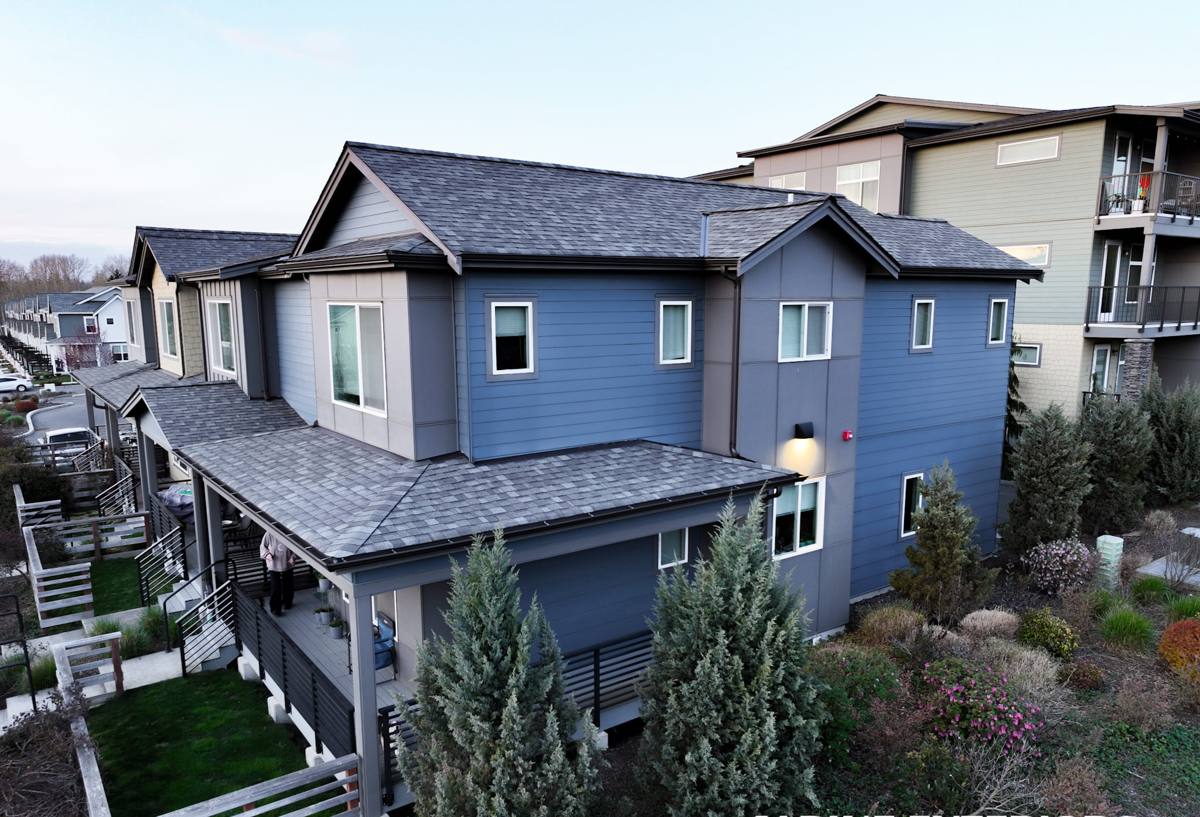
What Happens When Siding Isn't Built for This
Most siding failures we see in Burlington aren't dramatic. They're quiet problems that compound over a few winters:
- Butt joints and seams that swell, split, or telegraph through paint as the material behind them absorbs moisture
- Moss and algae colonizing north-facing walls and shaded soffit lines, trapping damp air against the substrate
- Caulk joints that dry out and crack in the wind-driven rain, opening a path for water behind the cladding
- Paint film failing early on wood-based products because the substrate itself is moving with moisture, not because the paint was bad
- Vinyl panels that warp, buckle, or grow brittle after repeated wet-cold-wet cycling over several Skagit Valley winters
None of these are freak events. They're the predictable result of a product and a climate that don't match well. That mismatch is exactly why we made the decision to install one siding system, everywhere, and stand behind it.
Why We Install Only James Hardie Fiber Cement
We don't install vinyl, LP SmartSide, cedar, primed spruce, or other fiber cement brands like Cemplank or Allura. That's a deliberate professional standard, not a marketing line, and it's worth explaining honestly rather than just asserting it.
Vinyl is inexpensive and low-maintenance in mild, dry climates, but it moves with temperature swings, can crack in a hard freeze, and simply melts if it sits too close to heat. Wood-based siding — cedar, primed spruce, engineered wood products — looks warm and traditional, but every one of those products depends on an intact paint film and consistent maintenance to keep moisture out; once that film fails in a climate this wet, the substrate underneath is compromised faster than most homeowners expect. Other fiber cement brands aren't necessarily bad products, but we've standardized our crews, our fastening details, and our warranty relationship around one manufacturer so that every job we do is installed exactly to spec, every time, by people who've done it hundreds of times.
James Hardie fiber cement is non-combustible, dimensionally stable across our wet-dry swings, and factory-finished with ColorPlus technology, which bakes the color into the board under controlled conditions rather than relying on a field-applied coat that has to fight Skagit County humidity while it cures. Hardie also engineers its HZ product line by climate zone — the Pacific Northwest falls under HZ5, which is formulated specifically for regions with sustained moisture exposure rather than extreme heat or cold. That's a meaningful difference from a one-size-fits-all siding product.
The Right Hardie Product Line for a Burlington Home
Hardie makes several distinct product lines, and the right one for a given house depends on its architecture, exposure, and the look the homeowner wants. Most Burlington homes fall into one of three profiles:
| Product | Best For | What It Does Well Here |
|---|---|---|
| HardiePlank lap siding | Traditional and craftsman-style homes | Classic horizontal reveal, sheds driving rain efficiently, most common choice in the valley |
| HardiePanel vertical siding | Modern homes, accent gables, shop/outbuildings | Clean vertical lines, works well paired with board-and-batten trim details |
| HardieShingle | Cottage and cape-style homes, accent gables | Staggered or straight-edge shingle look without the moisture sensitivity of cedar shakes |
| HardieTrim boards | Corners, window and door casing, fascia | Won't rot or split like wood trim in shaded, damp areas |
Color is factory-baked ColorPlus finish in most cases, which matters more here than in a drier climate — a field-painted board has to cure properly before the next rain, and in Skagit County that window isn't always reliable.
What Correct Installation Actually Involves
Hardie siding is only as good as the installation behind it. The material is engineered well; most of the failures we get called out to inspect on other contractors' work trace back to installation shortcuts, not the product itself. A correct install in a climate like ours means:
Flashing and Water Management
Proper flashing at every window, door, and roofline intersection, with a weather-resistant barrier installed and lapped correctly behind the siding — not just caulk covering a gap. Caulk fails; flashing that directs water down and out doesn't depend on caulk staying intact.
Clearance and Gaps
Hardie's manual specifies clearance from grade, roof lines, and decks, plus expansion gaps at butt joints and trim. Skipping these to make a job "look tighter" is one of the most common shortcuts we see, and it's exactly what lets moisture wick into the board over time.
Fastening
Correct nail or screw type, spacing, and placement per Hardie's published fastening schedule — not a generic fastening pattern borrowed from wood siding. Fastener choice and depth affect how the board performs over years, not just on install day.
Manufacturer Compliance
Hardie's transferable warranty depends on installation matching their published instructions. A crew that isn't following those details to the letter can leave a homeowner with a warranty that looks good on paper but doesn't actually hold up if a claim is ever needed.
Our Process, Start to Finish
We start with an on-site inspection of the existing siding and the sheathing behind it, since Burlington's damp, shaded lots occasionally hide rot or moisture damage that isn't visible until the old cladding comes off. From there we measure, confirm the product lines and trim details with the homeowner, and schedule tear-off.
During tear-off, we check the sheathing and weather barrier before anything new goes up — covering a compromised wall with new siding just hides the problem. Installation follows Hardie's HZ5 specifications for fastening, flashing, and clearances, with attention to the details that matter most in this climate: joint placement, caulk points, and drainage paths. We finish with trim, caulking, and a walkthrough so the homeowner sees exactly what was done and why.
Cost Factors for a Burlington Siding Project
Every home is different, so we don't quote a number without seeing the house, but these are the factors that actually move the price on a Hardie project in this area:
| Factor | Why It Matters |
|---|---|
| Home size and story height | More square footage and multi-story access both add labor time |
| Product line and trim complexity | Lap siding is typically simpler than mixed panel, shingle, and trim combinations |
| Condition of existing sheathing | Rot or moisture damage found during tear-off requires repair before new siding goes up |
| Number of window, door, and roofline intersections | Each one needs proper flashing, which adds detail work |
| Site access | Tight lots, fencing, or landscaping close to the house can slow staging and material handling |
Maintenance Burlington Homeowners Should Actually Expect
Hardie fiber cement is genuinely low-maintenance compared to wood, but "low-maintenance" isn't "no-maintenance," especially with moss season being what it is here. A simple annual routine keeps a Hardie exterior performing the way it's supposed to:
- Rinse the exterior once a year with a garden hose, focusing on shaded, north-facing walls where moss and algae take hold first
- Keep gutters and downspouts clear so water isn't sheeting down the siding face during heavy rain
- Trim back trees and shrubs that keep a wall shaded and damp longer than necessary
- Check caulk joints at trim and penetrations every year or two and re-caulk if it's cracked or pulling away
- Keep the factory ColorPlus touch-up pen on hand for small nicks so bare edges don't sit exposed to moisture
Why a Crew That Already Works Burlington Matters
Skagit County's building department, the local wind-driven rain patterns, and the specific mix of older tree-shaded lots versus newer open developments in and around Burlington all shape how a siding job should actually be built — not just what product goes on the wall. A crew that's already worked this area knows which walls tend to hold moss, which details fail first in valley fog conditions, and how to sequence a job around the wet stretches that define a typical Skagit winter. That local pattern recognition is worth as much as the product spec sheet.
If you're weighing a siding replacement on a Burlington home, we're happy to walk the property, look at what's there now, and give you a straight, no-pressure estimate for doing it right with James Hardie. There's a form below — reach out and we'll set up a time to take a look.