 Anacortes Exterior
 Why Decks Near Similk Beach Wear Out Faster
Similk Beach sits close to the water on Similk Bay, just outside Anacortes in Skagit County, and that proximity to salt water changes how a deck ages. Salt-laden air corrodes fasteners and metal connectors from the inside out, long before the visible wood surface looks bad. Combine that with the region's driving rain — wind-blown rain that gets pushed sideways into ledger boards, railings, and stair stringers — and you have two forces working against a deck at the same time: corrosion and moisture intrusion.
Then there's moss. Skagit County's long, wet, low-sun season from fall through spring gives moss and algae months to establish themselves on any horizontal wood or composite surface that doesn't get regular sun and airflow. A shaded deck near mature trees or a home's north side can stay damp for days after a storm, which is exactly the environment moss needs to take hold — and exactly the environment that accelerates rot underneath it.
None of this means a deck can't last in Similk Beach. It means the details that get rushed or skipped on a lot of deck jobs — fastener grade, flashing, drainage, ventilation under the structure — matter more here than they do a few miles inland.
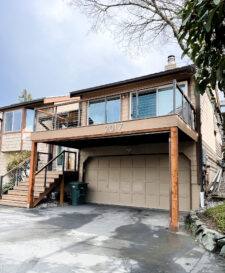
Signs Your Similk Beach Deck Needs Replacing, Not Repairing
Not every problem deck needs to come down. But there's a point where patching boards or sistering a joist is just delaying a full tear-off, and spending money on a deck past that point is money that doesn't hold value. Here's what tells us a deck has crossed that line:
- Soft, spongy decking in multiple areas, not just one or two boards
- Rot or rust at the ledger board where the deck attaches to the house — this is a structural connection, not cosmetic
- Visibly corroded joist hangers, bolts, or screws (rust streaks on the wood are an early warning sign)
- Railings that flex or feel loose when you lean on them
- Persistent moss or algae staining that keeps coming back within weeks of cleaning
- Footings that have shifted, settled unevenly, or show visible cracking
- A deck built without permits or proper flashing, where the underlying framing was never protected correctly to begin with
If it's one or two of these, repair may still make sense. If it's several at once, especially anything involving the ledger board or footings, replacement is usually the more honest recommendation — and the safer one.
What a Correct Deck Replacement Involves Here
A deck replacement built for this stretch of Skagit County coastline needs to address the framing, the fasteners, and the water management as one system. Skipping any one of them shortens the life of the whole structure.
Framing and Fasteners for Salt Air
Standard hot-dip galvanized hardware holds up fine in a lot of inland climates, but in a salt-air environment like Similk Beach, we treat corrosion resistance as a baseline requirement, not an upgrade. That means stainless steel or heavy-coated fasteners rated for coastal exposure, and structural connectors matched to the same standard. Mixing metals — for example, an incompatible fastener in a treated-lumber connector — can accelerate corrosion through galvanic reaction, so the hardware has to be specified as a matched system, not assembled piece by piece from whatever's on the shelf.
Flashing and Ledger Attachment
The ledger board — where the deck bolts into the house — is the single most common failure point on decks in wet climates, because it's the one spot where water can get trapped between two surfaces with nowhere to drain. A correct installation uses proper flashing that directs water out and away from the house framing, not just a bead of caulk and a hope. Given how much driving rain this area gets, we don't treat ledger flashing as optional or something to value-engineer out.
Footings and Drainage
Near the water, soil conditions can vary block to block — some lots drain well, others hold moisture longer, especially in low spots. Footings need to be sized and set to local frost depth and soil-bearing requirements, and the area under the deck needs enough airflow and grading that water doesn't pool and sit against posts or framing. A deck that traps standing water underneath it is a deck that's rotting from below, invisibly, while the top looks fine.
Choosing Decking Material for a Moss-Prone, Salt-Air Climate
There's no single "best" decking material for every home — it depends on budget, maintenance appetite, and how much sun the deck actually gets. Here's how the common options hold up specifically against Similk Beach's salt air and moss season:
| Material | Salt Air Behavior | Moss/Algae Resistance | Maintenance |
|---|---|---|---|
| Pressure-treated wood | Holds up well if fasteners and hardware are corrosion-rated; wood itself is unaffected by salt | Needs regular cleaning and periodic sealing to resist moss in shaded areas | Annual cleaning, re-sealing every 2-3 years |
| Cedar | Naturally rot-resistant, but still needs corrosion-rated hardware | Prone to moss and graying without upkeep; natural oils fade over time | Regular cleaning, staining or sealing to maintain appearance |
| Capped composite | Excellent — the cap layer doesn't corrode or absorb salt | Better resistance than wood but still needs periodic washing in shaded spots | Low — occasional washing, no sealing or staining |
| PVC decking | Excellent — fully synthetic, unaffected by salt exposure | Best resistance of the group; smooth surfaces shed moss more easily | Lowest — soap and water as needed |
We'll walk through these tradeoffs honestly during your estimate rather than steering you toward whatever's easiest to install. A shaded, low-sun deck near mature landscaping is a different conversation than a deck that gets full afternoon sun most of the year.
Permits and Site Considerations Near the Water
Deck replacements in Skagit County, and particularly for properties close to the shoreline, typically require a building permit, and depending on your lot's proximity to the water, there may be additional shoreline or setback considerations that come into play. Requirements vary by parcel and jurisdiction, so we check what applies to your specific property before work starts rather than assuming a one-size-fits-all answer. Pulling the correct permit isn't a formality — it means the framing, footings, and railings get inspected against code, which protects you if you ever sell the home or need to make an insurance claim down the road.
Our Deck Replacement Process
We keep the process straightforward and try not to leave you guessing at any stage:
- On-site assessment. We inspect the existing deck's framing, ledger attachment, footings, and any moisture or rot damage, and give you a straight answer on repair versus replacement.
- Material and design conversation. We go over decking material options, railing style, and layout, with honest tradeoffs for your specific site — sun exposure, shade, and how close you are to the water.
- Permitting. We handle the permit application and coordinate any required inspections.
- Demolition and disposal. The old deck comes out, and we haul away the debris — no scrap wood or fasteners left in your yard.
- Framing and flashing. New footings, joists, ledger flashing, and corrosion-rated hardware go in first, since this is the part that determines how long the deck actually lasts.
- Decking and railings installed. Final surface and railing system go in per your chosen material and design.
- Final walkthrough and inspection. We review the finished deck with you and make sure any required inspection is completed and closed out.
Maintenance That Actually Matters After Replacement
A new deck in Similk Beach still needs some seasonal attention to get the most out of it — the climate doesn't stop working on it just because it's new:
- Rinse or sweep debris off the surface regularly, especially in fall when leaves and needles trap moisture
- Clean shaded areas more often — they're the first spots moss and algae take hold
- Check railings and stair connections once a year for looseness
- Keep gutters and downspouts near the deck clear so runoff isn't dumping directly onto or under the structure
- If you chose wood, plan on re-sealing on the schedule your material calls for — skipping it shortens its life fast in this climate
Why Hiring a Crew That Already Works Similk Beach Matters
A deck built to a generic inland spec doesn't hold up the same way here. Crews unfamiliar with Skagit County's shoreline conditions sometimes under-spec hardware, skip proper ledger flashing, or choose materials that look fine on day one but struggle once moss season sets in. Working regularly in Similk Beach and the surrounding Anacortes area means we've already seen how salt air and driving rain affect decks over years, not just how a job looks the day it's finished — and we build accordingly, with hardware, flashing, and drainage decisions that match the actual conditions your deck will face.
If your deck is showing its age, or you're just not sure whether it needs repair or full replacement, we're happy to take a look and give you a straight, no-pressure answer. Fill out the form below for a free estimate.