 Anacortes Exterior
 James Hardie Siding in Sedro-Woolley: What "Correct" Actually Means
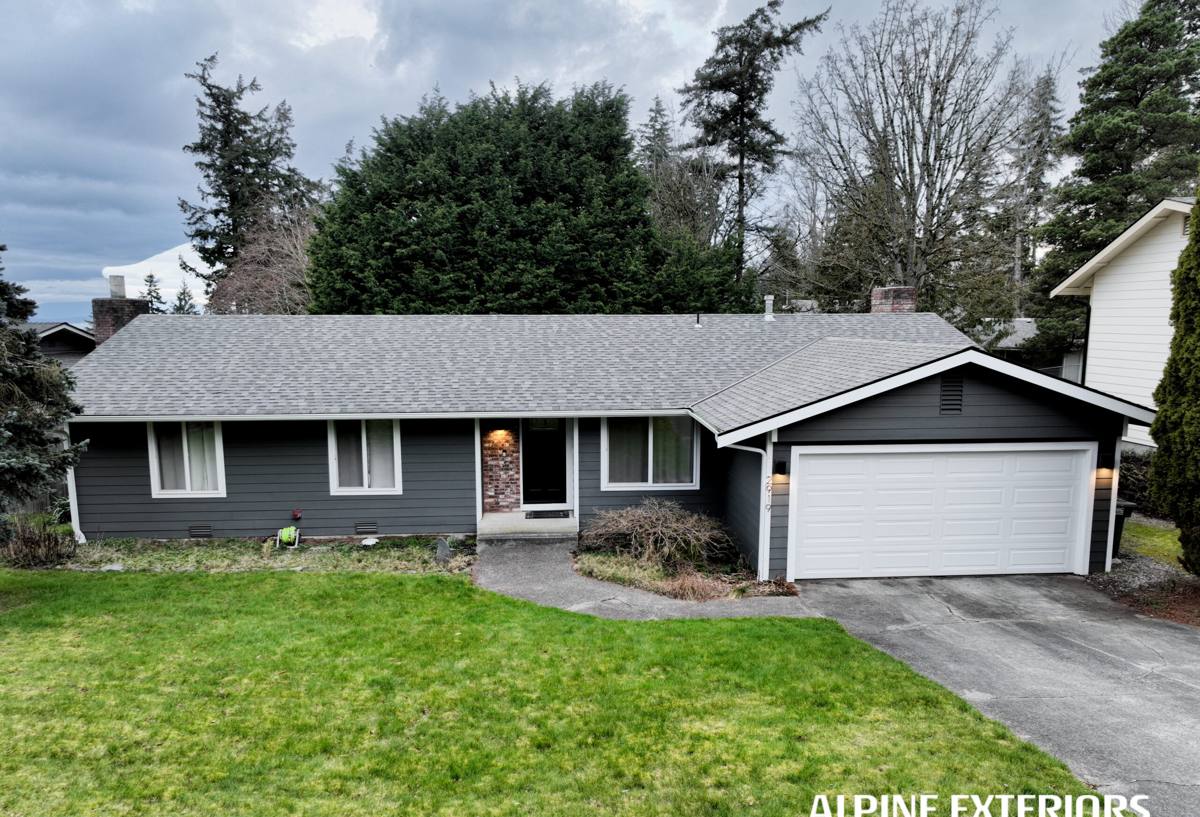
Sedro-Woolley sits back from Fidalgo Island and the Sound, in the part of Skagit County where the valley narrows toward the foothills. Homes here don't take the same direct salt exposure our coastal Anacortes jobs do, but they get the same weather systems moving through — driving rain that gets funneled and intensified as it pushes up the valley, humid air that lingers under tree cover longer than it does on more open, breezier lots, and a moss season that runs close to year-round on shaded walls. We're an Anacortes-based crew, and we make the drive out to Sedro-Woolley regularly enough to know the difference between installing siding correctly for a wind-exposed island property and installing it correctly for a valley home with mature trees on three sides. The engineering answer is the same product family either way — James Hardie fiber cement — but the details that make an installation actually hold up shift depending on which conditions a specific wall is facing.
This page isn't a general "why we like Hardie" pitch. It's a look at what the product system actually is, which lines and profiles make sense on a Sedro-Woolley home, what a correct installation involves step by step, and why the warranty and long-term performance depend on details that are easy to skip and hard to spot once the siding's up.
The HZ5 System: Engineered for This Exact Climate
James Hardie doesn't sell one universal siding product — the company formulates different HZ (Hardie Zone) product lines for different climate exposures across the country, and the version we install throughout Skagit County is the HZ5 line, built for regions that see significant moisture cycling and freeze-thaw stress. That's a meaningfully different engineering target than the formulations Hardie sells into hot, dry climates in the Southwest or humid, low-freeze regions in the Southeast.
For a Sedro-Woolley home, that matters because the valley setting doesn't dry out between weather systems the way a more exposed, wind-swept site might. Siding here spends more of the year holding some level of moisture than siding on, say, an open coastal lot, and it also sees more freeze-thaw cycling in winter than towns sitting directly on the milder, marine-buffered Sound. HZ5 fiber cement is dimensionally stable under that kind of cycling — it doesn't swell, cup, or crack the way engineered wood or lower-grade fiber cement can when it repeatedly takes on and releases moisture through a cold, wet winter.
Why the Formulation, Not Just the Brand Name, Is the Point
We bring this up because "James Hardie" gets used loosely sometimes, including by installers who don't specify which product line or don't order the climate-appropriate version for the job. The HZ5 designation is a bill-of-materials detail, not marketing language, and it's one of the first things we confirm on the order sheet before material ever shows up at a Sedro-Woolley jobsite.
Matching the Right Hardie Product to a Sedro-Woolley Home
James Hardie's fiber cement system isn't a single board — it's a family of profiles that solve different design and performance needs. Picking the right one is a design decision as much as a technical one, and it's worth understanding the differences before a project gets quoted.
| Product | Profile | Best Fit |
|---|---|---|
| HardiePlank lap siding | Horizontal overlapping boards, smooth or cedarmill texture | The most common choice on Sedro-Woolley homes; traditional look, proven water-shedding overlap design |
| HardiePanel vertical siding | Large flat vertical sheets, often with battens | Board-and-batten look on gables, farmhouse-style homes, or accent walls |
| HardieShingle | Individual or panelized shingle profile | Craftsman-style homes, accent gables, a softer shadow-line look |
| HardieTrim | Smooth boards for corners, fascia, window and door surrounds | Used alongside any of the above to finish edges and penetrations correctly |
Most Sedro-Woolley projects we quote use HardiePlank as the primary field material with HardieTrim at corners and openings, sometimes with a HardiePanel or HardieShingle accent on a gable or entry feature. There's no single right answer — it depends on the home's existing architecture, the roofline, and what the homeowner wants the house to say from the road. What matters more than the profile choice is that whichever combination gets picked is installed to the clearances and flashing details each profile actually requires, which isn't identical across the product line.
ColorPlus Factory Finish: The Part That's Easy to Undervalue
Most Hardie siding we install goes on with the ColorPlus factory finish rather than a primed board meant for field painting. The color coat is applied and cured in a controlled factory process — multiple coats, consistent conditions, no rain interruption or temperature swing mid-application — which is simply not something any jobsite, however careful the crew, can replicate. In a climate where paint film gets tested by long wet stretches and a moss season that keeps surfaces damp, that factory-cured finish holds its color and resists chipping and chalking longer than field-applied paint typically manages.
ColorPlus siding carries a finish warranty that's separate from the substrate warranty on the fiber cement board itself, which is worth understanding as two different guarantees bundled into one product. Primed boards for field painting still have a place — custom color matching to existing trim is the most common reason — but for most Sedro-Woolley homeowners, the factory finish is the stronger long-term bet given how much of the year this area spends wet.
What Correct Installation Actually Involves
Fiber cement siding rarely fails on its own. When we get called out to fix a failing Hardie job someone else installed, the board itself is almost never the problem — the installation shortcuts around it are. Manufacturer specification isn't a suggestion; it's the difference between a wall system that manages water correctly and one that traps it.
Clearances and Starter Strip
Hardie siding needs a minimum clearance above grade, roof lines, decks, and paved surfaces, plus a proper starter strip at the base of the wall to kick the first course out at the correct angle. Skip the clearance and you're inviting splash-back moisture and, on a valley lot where snow and standing water linger longer in shaded spots, ongoing wicking at the bottom course.
Fastener Pattern and Nailing
Hardie specifies fastener type, spacing, and placement relative to each board's edge. Installers who nail too close to an edge, use the wrong fastener for the substrate, or skip blind-nailing where it's called for create stress points that show up later as cracking or popped fasteners — exactly the kind of damage that's expensive to trace back to an install mistake years after the fact.
Flashing at Every Penetration
Windows, doors, hose bibs, vents, light fixtures — every penetration through the siding plane needs flashing that directs water back out, not behind the cladding. This is the single most common failure point we find during inspections on other companies' work, and it's invisible from the outside until a wall cavity has already been wet for a while.
Joints, Caulking, and Gaps
Hardie's engineered joints are designed to move with temperature and moisture cycling without needing to rely on caulk as the only line of defense. Correct installation follows the specified gap widths at butt joints and uses sealant as a backup, not a substitute for proper flashing and lap technique. Over-caulking is as much a red flag to us as under-caulking — it's often a sign an installer is compensating for gaps that shouldn't be there in the first place.
Weather-Resistive Barrier Behind the Board
Correct installation always includes a code-compliant weather-resistive barrier between the sheathing and the siding, integrated properly with the window and door flashing so water that does get past the cladding has a way to drain back out rather than sitting against the sheathing.
Our Process for a Sedro-Woolley Hardie Installation
- Walk-through and assessment: we inspect the current exterior, noting moisture patterns, shaded and tree-adjacent walls, and any existing damage before quoting anything.
- Tear-off and substrate check: old siding comes off and we inspect the sheathing and framing underneath. Water-damaged substrate gets repaired before anything new goes up — never covered over.
- Weather barrier and flashing: a correctly integrated weather-resistive barrier goes on, with flashing detailed at every window, door, and penetration before the first course of siding starts.
- HardiePlank, panel, or shingle installation to spec: starter strip, clearances, fastener pattern, and joint gaps follow Hardie's published installation guide for the specific product ordered.
- Trim and detail work: corners, fascia, and window surrounds go in with HardieTrim, matched to the field material's finish.
- Final walkthrough: we go over the completed job with the homeowner, checking seams and trim lines and covering basic long-term care.
Warranty: What's Actually Covered
James Hardie's warranty structure is one of the stronger ones in the fiber cement category, but it's worth understanding what it actually protects rather than treating it as a blanket guarantee. There are effectively two separate coverages at play, and both depend on installation to spec.
| Coverage | What It Protects | What Voids or Limits It |
|---|---|---|
| Substrate (board) warranty | The fiber cement material itself — cracking, defects in manufacturing | Installation that doesn't follow Hardie's published specifications |
| ColorPlus finish warranty | The factory-applied color coat — fading, peeling, chipping of the finish | Field-painting over the factory finish, or damage from improper cleaning methods |
Both warranties are transferable to a subsequent homeowner within a defined window, which is a real selling point if a Sedro-Woolley property changes hands within the coverage period — but transferability and coverage both assume the original installation was done to spec. That's the practical reason installation quality and warranty protection aren't really separate topics; a warranty claim on a poorly installed wall is a much harder conversation than one on a correctly installed system.
Cost Factors on a Sedro-Woolley Hardie Project
We don't quote fixed prices without seeing the house, but the variables that consistently move the number are the same from project to project:
| Factor | Why It Matters |
|---|---|
| Product line and profile mix | HardiePlank alone costs less than a combination with HardiePanel or HardieShingle accents |
| Substrate condition | Water-damaged sheathing found at tear-off adds repair scope before new siding goes on |
| Trim and architectural detail | Corners, gables, dormers, and window surrounds all add labor time |
| Site access | Tree cover, driveway grade, and staging room vary a lot on the more rural, wooded lots common around Sedro-Woolley |
| Finish choice | ColorPlus factory finish versus a primed board that requires field painting after install |
What to Check Before You Sign Off on a Hardie Install
- Confirm the HZ5 climate-specific product line is what's actually being ordered, not a generic or lower-cost formulation
- Ask to see the specific fastener type and spacing plan for your home's siding profile
- Confirm flashing details at every window, door, and penetration before the siding closes those areas up
- Check that clearances above grade, roofs, and decks meet Hardie's published minimums
- Ask whether you're getting ColorPlus factory finish or a primed board that will need field painting
- Get the warranty registration paperwork completed and in your hands after the job, not left undone
Why an Anacortes Crew That Already Works Sedro-Woolley Matters
A crew that only occasionally makes it out to Sedro-Woolley is learning this stretch of Skagit County on your dime. We're based in Anacortes and treat Sedro-Woolley as regular service territory, which means we've already worked through the practical differences between a Fidalgo Island install and a valley one — which wall orientations here stay damp longest, how driving rain behaves differently once it's funneled up the valley versus coming straight off the Sound, and where tree cover changes the moss and drying picture from one side of a house to the other. Those aren't things you can read off a spec sheet; they come from doing the work here repeatedly.
It also means straightforward accountability. If a question comes up after the job — a warranty registration detail, a trim question, anything — we're a short drive away and easy to reach, not a call center ticket routed to whichever crew is available next.
Get a Free, No-Pressure Estimate
If you're planning a James Hardie siding project in Sedro-Woolley, or want a straight read on what your current exterior actually needs before committing to anything, we're glad to walk the property and talk through the right product mix for your home. No pressure, no upsell script. Use the form below to schedule a free estimate.