 Anacortes Exterior
 The Skagit Valley Climate Is Hard on Decks
Sedro-Woolley sits inland from the water compared to Anacortes proper, but the weather pattern that defines this whole stretch of Skagit County doesn't stop at the city line. Homes here still deal with driving, sideways rain for months at a time, heavy morning dew that never quite burns off under tree cover, and a moss season that can run from October well into April. Direct salt spray is less of a factor this far up the valley than it is right on the water, but the marine-influenced humidity that rolls in off Puget Sound still keeps everything damp longer than homeowners expect — and dampness, not salt, is what actually destroys most decks.
Wood doesn't rot because it gets wet. It rots because it stays wet. A deck that's shaded by fir trees, backed up against a hillside, or built low to the ground dries out slower after every storm, and in Sedro-Woolley that can mean weeks of the year where the structure underneath never fully dries between rain events. That's the environment we build for — not a generic "coastal Washington" deck, but one sized and detailed for this valley's specific combination of rain volume, shade, and slow drying time.
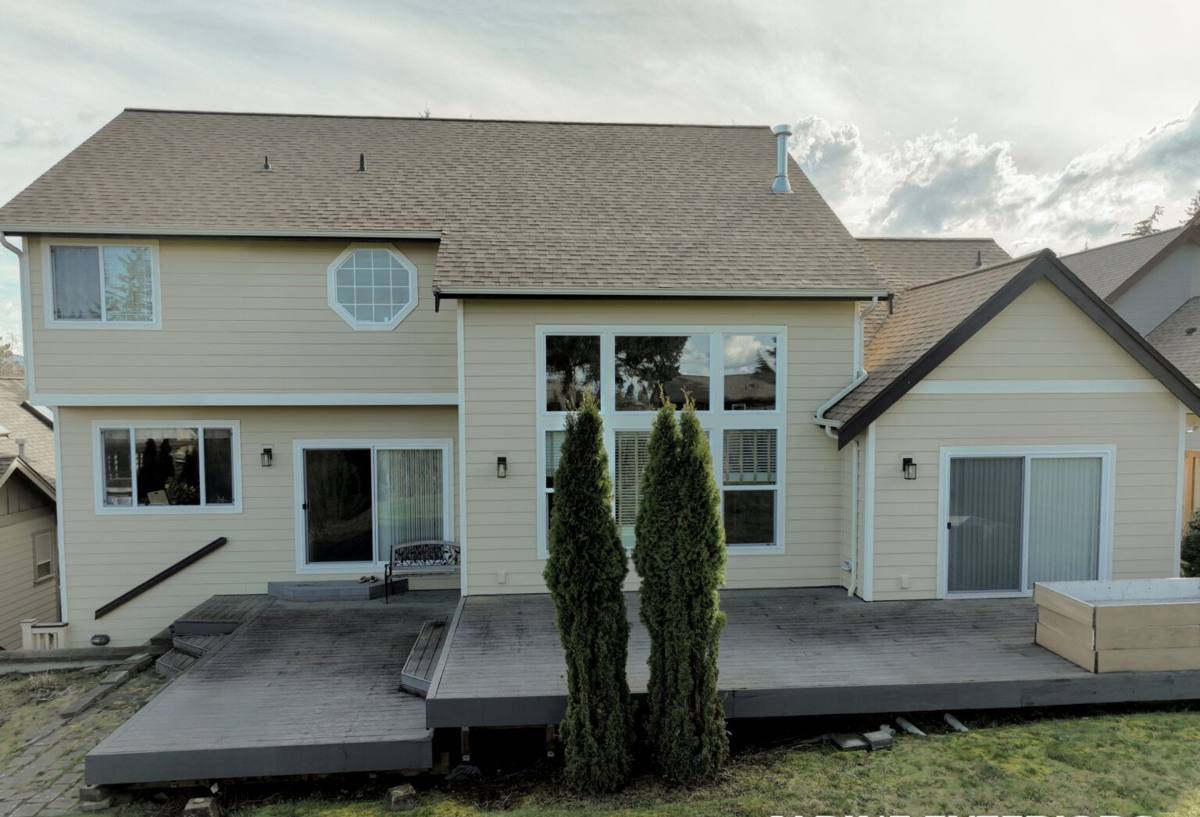
Repair or Replace? Signs It's Time
Not every tired-looking deck needs a full teardown. But there's a point where patching individual boards or sistering a joist here and there stops being a repair and starts being a losing chase against rot that's already spread through the structure. Here's what we look for during an assessment:
- Soft or spongy spots anywhere on the decking, not just at the edges
- A screwdriver or awl sinking easily into joists, beams, or the ledger board
- Visible daylight or gaps where the ledger meets the house — a common failure point in older builds
- Persistent moss or algae growth that comes back within weeks of cleaning
- Railings that flex or posts that wiggle at the base
- Fasteners that are rusted, popped up, or leaving black streaks in the wood
- A deck built before modern ledger-flashing and joist-hanger code requirements were common practice
If the framing underneath is sound and it's really just the decking boards that are worn, a resurfacing job can make sense and costs a fraction of a full replacement. But if the rot has reached the joists, beams, posts, or ledger connection, patching is a short-term fix on a structure that's already failing. We'll tell you honestly which category your deck falls into — we don't have any incentive to sell a full replacement to someone who only needs a resurface.
What a Proper Deck Replacement Actually Involves
A deck replacement is more than pulling old boards and screwing down new ones. The parts you can't see are the parts that determine whether the new deck lasts 10 years or 30.
Framing and Footings
We evaluate footing depth and condition, post spacing, and beam sizing against current load requirements — a lot of older Skagit County decks were built with framing that was undersized even by the standards of their own era. Footings that have settled, heaved from freeze-thaw cycles, or were never poured to frost depth get addressed before anything new goes on top. Joists get sized and spaced for the decking material you choose, since composite and PVC products often call for tighter spacing than solid wood.
Ledger Connection and Flashing
The ledger board — where the deck attaches to the house — is the single most common failure point we find on older decks in this area. Water gets behind the ledger, has nowhere to go, and rots both the ledger and the house rim joist behind it. A correct replacement includes proper flashing that sheds water away from the house, not just a bead of caulk hoping to hold back years of Skagit Valley rain.
Decking Surface and Fasteners
Whatever surface material you choose, it needs to be fastened with corrosion-resistant hardware rated for the wood treatment or composite product in use, with gaps set correctly for drainage and seasonal movement. We also look at how the deck surface pitches — a deck that's dead level, or worse, pitched slightly toward the house, will hold standing water and speed up moss growth no matter what decking material sits on top.
Decking Material Options for Sedro-Woolley Homes
There's no single "best" decking material — there's the right material for your budget, your maintenance appetite, and how much sun or shade your deck gets. Here's how the common options actually compare in this climate:
| Material | Upfront Cost | Maintenance | Moisture Behavior |
|---|---|---|---|
| Pressure-treated wood | Lowest | Annual cleaning, periodic sealing/staining | Prone to checking and splinter if not resealed; needs airflow underneath to dry properly |
| Cedar | Moderate | Regular sealing to hold color and resist moss | Naturally rot-resistant but still needs maintenance in shaded, damp spots |
| Composite (uncapped) | Moderate-High | Occasional washing, no staining | Can absorb moisture at cut edges over time if not properly sealed during install |
| Capped composite / PVC | Highest | Low — soap and water | Best moisture and moss resistance; cap layer sheds water and resists staining |
In heavily shaded yards or lots backed up against greenbelt — common around Sedro-Woolley — we generally steer clients away from uncapped composite and toward either capped composite or well-maintained cedar, since uncapped products can hold moisture at fastener holes and cut ends in low-airflow spots. That's a maintenance and moisture-behavior judgment on our part, not a knock on any manufacturer — every product on this list can perform well when it's matched to the site and installed correctly.
Our Deck Replacement Process
- On-site assessment. We get under the existing deck, check footings, probe the framing and ledger, and give you a straight answer on repair versus replacement.
- Written proposal. A clear scope covering framing, decking material, railings, and any structural corrections — no vague allowances.
- Permit filing. We handle the paperwork with the appropriate jurisdiction before any demo begins.
- Demolition and disposal. Old decking, framing, and any rotted ledger material removed and hauled off.
- Framing correction. Footings, posts, beams, and joists brought up to current load and spacing requirements.
- Ledger flashing. Proper flashing installed at the house connection before decking goes down.
- Decking, railings, and fasteners installed per manufacturer spec for your chosen material.
- Final walkthrough so you know how to maintain the new deck and what to watch for as it settles in through its first wet season.
Permits and Local Code Considerations
Deck replacements that involve new footings, structural framing changes, or a deck above a certain height typically require a permit through the applicable jurisdiction, and inspections are part of that process for good reason — footing depth, ledger attachment, and guardrail height are exactly the details that fail first when they're skipped. We handle permit filing as part of the job rather than leaving it to the homeowner, and we build to current code even in cases where an older deck was grandfathered in under looser requirements. That's not a sales pitch — it's the difference between a deck that passes inspection and one that becomes a problem when you go to sell the house.
Cost Factors to Expect
Deck replacement costs vary widely based on size, material, and how much framing correction is needed, so we won't quote a number here that doesn't mean anything without seeing your specific deck. What actually moves the price:
- Total square footage and shape complexity (multiple levels, angles, wraparounds cost more than a simple rectangle)
- Decking material chosen — pressure-treated wood sits at one end, capped composite/PVC at the other
- Condition of existing footings and framing — reusable footings save money, failed ones don't
- Railing style and material, especially if code requires updated guardrail height or spacing
- Ledger and house-side repair, if water damage has already reached the rim joist or siding
- Site access — decks reached easily by truck cost less to demo and rebuild than ones requiring material to be carried around the house
- Permit and inspection fees through the applicable jurisdiction
We give a written, itemized proposal after the on-site assessment so you know exactly what you're paying for and why — not a lump-sum number with no breakdown.
Keeping Moss and Moisture From Winning After the New Deck Goes In
A properly built deck still needs some upkeep in this climate — no material is fully maintenance-free when it's fighting a Skagit Valley wet season. A few habits go a long way: keep gutters and downspouts clear so runoff isn't dumping directly onto or under the deck, sweep leaves and debris off the surface before they compost into a moss bed, and keep any nearby shrubs or trees trimmed back enough that the deck surface gets some airflow and occasional sun. For wood and cedar decks, plan on resealing every couple of years rather than waiting until it visibly needs it. For composite and PVC, an occasional wash is usually enough. None of this is complicated, but skipping it is how a well-built deck ends up looking like a poorly-built one within a few years.
Why a Crew That Already Works Sedro-Woolley Matters
A contractor who works this specific area regularly already knows which lots sit in heavy shade most of the day, which neighborhoods deal with slower drainage, and which permitting office to call and what they'll ask for. That's not a small thing — it means fewer surprises mid-project, a framing plan that accounts for your actual site conditions instead of a generic spec, and a material recommendation based on how decks in this valley actually hold up over time rather than how they perform in a showroom. We're not commuting in from out of the area to bid a job and disappear — this is the region we work in every week.
If your deck is showing soft spots, chronic moss, or a shaky railing, we'll come take an honest look and tell you where it stands. Reach out for a free, no-pressure estimate using the form below — there's no obligation, just a clear picture of what your deck needs.