 Anacortes Exterior
 Oak Harbor's Weather Doesn't Go Easy on Siding
Homes near Oak Harbor sit close enough to the water that salt-laden air is a daily fact of life, not an occasional nuisance. That salt film settles on exterior surfaces, works into seams and fastener heads, and accelerates corrosion and finish breakdown on siding that isn't built to handle it. Add in driving rain that comes sideways off the Sound during winter storms, and you have a climate that tests every seam, joint, and piece of flashing on a house.
Then there's moss season, which in this part of Skagit and Island County stretches from fall through spring. Shaded north walls, areas under overhangs, and anything close to trees stay damp for months at a time. Moss and algae don't just look bad — they hold moisture against the wall assembly, and over years that constant dampness is what actually damages siding, trim, and the sheathing behind it. A siding system that can't shed water fast and dry out between storms is going to struggle here.
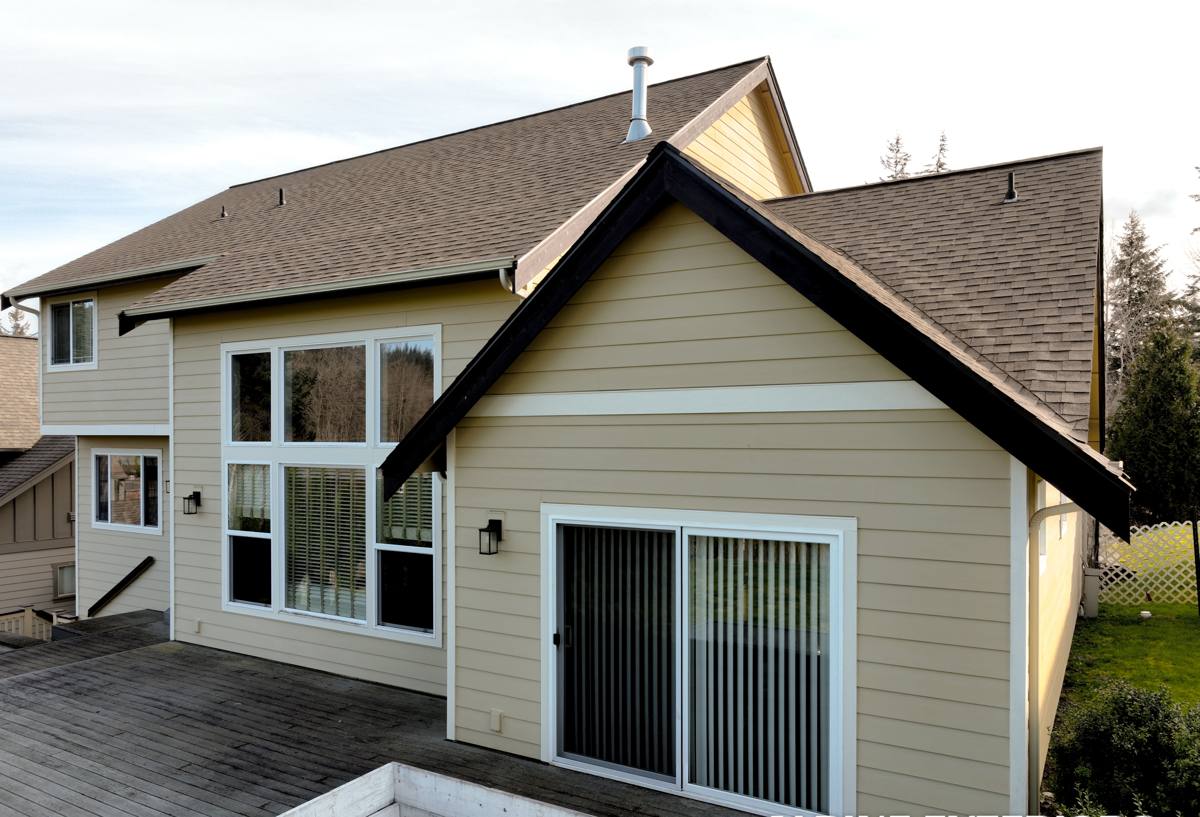
Why We Install Only James Hardie Fiber Cement
We made a decision a long time ago to install one siding system: James Hardie fiber cement. We don't install vinyl, LP SmartSide, Cemplank, Allura, primed spruce, or cedar, and it's not because those products are worthless — some of them are fine products for the right situation. It's because in a climate like Oak Harbor's, with salt air, sustained rain, and long damp stretches, we've seen which materials hold up over decades and which ones need more attention than a homeowner should have to give them.
James Hardie fiber cement is non-combustible, doesn't rot or feed pests the way wood-based products can, and comes from the factory with a baked-on ColorPlus finish rather than field-applied paint. Hardie also engineers its products by climate zone — the HZ5 line used in this region is built specifically for damp, temperate, moisture-heavy conditions like ours, not a generic national spec. That regional engineering matters more here than in a lot of the country.
Picking the Right Hardie Line for a Coastal Oak Harbor Home
Not every Hardie product is right for every house, and part of doing this job correctly is matching the product to the home and its exposure. HardiePlank lap siding is the workhorse for most Oak Harbor homes — it sheds water well, handles wind-driven rain, and comes in a range of textures and exposures. HardieShingle gives a more traditional look for homes that want a shingled or coastal-cottage style, while HardiePanel works well for modern designs or accent sections. Trim, soffit, and fascia should be Hardie as well wherever possible, so the whole envelope is behaving the same way in wet weather instead of mixing materials that expand, contract, and age differently.
Color and Finish Considerations Near the Water
Salt air is hard on paint. A factory-applied ColorPlus finish is baked on under controlled conditions and holds color and adhesion far better than a field-painted product exposed to salt spray and UV. That doesn't mean it never needs attention — cut edges and any field-touch-up areas should be sealed properly during install, and it's worth rinsing salt film off the siding periodically, the same way you'd rinse a car parked near the water. But you're not repainting the whole house every five to seven years the way you might with some other siding materials in this environment.
What a Correct Installation Actually Involves
Fiber cement siding is only as good as the installation behind it. Most of the siding failures we get called out to inspect trace back to installation shortcuts, not the material itself — gaps sealed wrong, flashing skipped, or fasteners driven incorrectly. In a wet, salty climate those mistakes show up faster and cost more to fix later.
- A continuous weather-resistive barrier installed and lapped correctly, with no gaps for wind-driven rain to exploit
- Proper flashing at every window, door, and roofline intersection — not just caulk standing in for flashing
- A minimum 1/4-inch gap between siding and any horizontal surface like a deck, roof, or foundation, so water has somewhere to go
- Correct fastener type, spacing, and placement per Hardie's published installation specs, not a generalized "close enough" pattern
- Caulking used only where Hardie's guidelines call for it, with the right sealant — over-caulking traps moisture instead of releasing it
- Attention to inside and outside corners, where poor detailing is one of the most common places water gets behind siding
Skipping any one of these doesn't usually cause a problem in year one. It shows up in year five or ten, as trapped moisture, stained sheathing, or siding that's failing from behind where you can't see it until it's already a bigger repair.
Our Process From Estimate to Cleanup
We start by walking the home and looking at what's actually there — the condition of the existing siding, trim, and any visible signs of past water intrusion, especially around windows, roof lines, and lower wall sections where splash-back is common. That inspection shapes the estimate and tells us whether we're looking at a straightforward re-side or one that needs sheathing repair first.
Once material is ordered and on site, we remove the old siding and take a real look at what's underneath — sheathing, framing, and any hidden moisture damage get addressed before a single piece of new siding goes up. From there it's weather barrier, flashing, and Hardie installation following manufacturer specs, followed by any necessary paint touch-up on cut edges and a full site cleanup. We don't cover up a problem with new siding; if we find rot or water damage during tear-off, we'll show you and talk through the fix before moving forward.
What It Costs — Factors That Move the Number
Every home is different, so we won't quote a number without seeing the house, but these are the main factors that move a project up or down in cost.
| Factor | Why It Matters |
|---|---|
| Home size and number of stories | More surface area and taller walls mean more material and more time, plus added scaffolding or lift access on multi-story homes |
| Tear-off and disposal of old siding | Removing and hauling away existing siding, especially older materials, adds labor and disposal cost |
| Sheathing or framing repair | Hidden water damage found during tear-off has to be repaired before new siding goes on, which isn't always visible at estimate time |
| Siding line and profile chosen | HardiePlank, HardieShingle, and HardiePanel have different material and labor costs, and custom exposures or trim details add time |
| Trim, soffit, and fascia work | Replacing trim alongside siding costs more up front but keeps the whole exterior aging at the same rate |
| Site access and complexity | Tight lots, landscaping, decks, and multiple roof intersections all add time on top of the base siding install |
Why a Crew That Already Works Oak Harbor Matters
A crew that's spent time on homes in this area already knows how salt exposure, driving rain, and moss build-up actually behave on a house here — which walls take the worst weathering, where moss tends to establish first, and what kind of detailing holds up over a Pacific Northwest winter versus what looks fine on paper. That's the difference between a generic installation and one that's actually built for this coastline, just across Deception Pass from our home base in Anacortes.
It also means fewer surprises during the job. We're not learning the local building department's expectations or figuring out how this climate treats a house on your dime — we've already done that groundwork on other homes nearby, and we bring that experience to your project from day one.
Living With Hardie Siding in a Salt-Air, Moss-Heavy Climate
Hardie siding installed correctly is low-maintenance, not no-maintenance. A periodic rinse to knock salt film off the surface, especially on walls facing open water or prevailing wind, goes a long way. Keep gutters and downspouts clear so water isn't sheeting down the wall face during heavy rain, and keep an eye on shaded, north-facing sections where moss and algae are most likely to establish. Trimming back vegetation that's crowding the house helps airflow and speeds up drying time after storms, which is one of the simplest things a homeowner can do to extend the life of any siding system in this climate.
If you're weighing a siding replacement on an Oak Harbor-area home and want an honest look at what your house actually needs, we're glad to come take a look. Reach out for a free, no-pressure estimate using the form below.