 Anacortes Exterior
 What Skagit Valley Weather Does to Exterior Siding
Mount Vernon sits low in the Skagit River valley, where moisture off the Salish Sound moves inland and gets trapped by the surrounding hills. The result is a long wet season, driving rain that hits siding at an angle instead of falling straight down, and shaded, damp conditions that keep moss and algae growing on north-facing walls for much of the year. Add in salt-tinged air working its way up the valley and you get a climate that is genuinely hard on exterior building materials — not dramatically, but relentlessly, year after year.
Most siding failures we see in this area aren't sudden. They're slow: paint that chalks and fades faster than it should, seams that wick water instead of shedding it, and panels that swell, delaminate, or grow soft at the bottom edge because water got behind them and had nowhere to go. Wood-based products are especially vulnerable because wood wants to absorb the moisture that's constantly in the air here. Vinyl holds up to water fine but flexes, gaps, and fades under UV and temperature swings in ways that show within a decade or two. The siding on a Mount Vernon home needs to handle sustained dampness, not just the occasional storm.
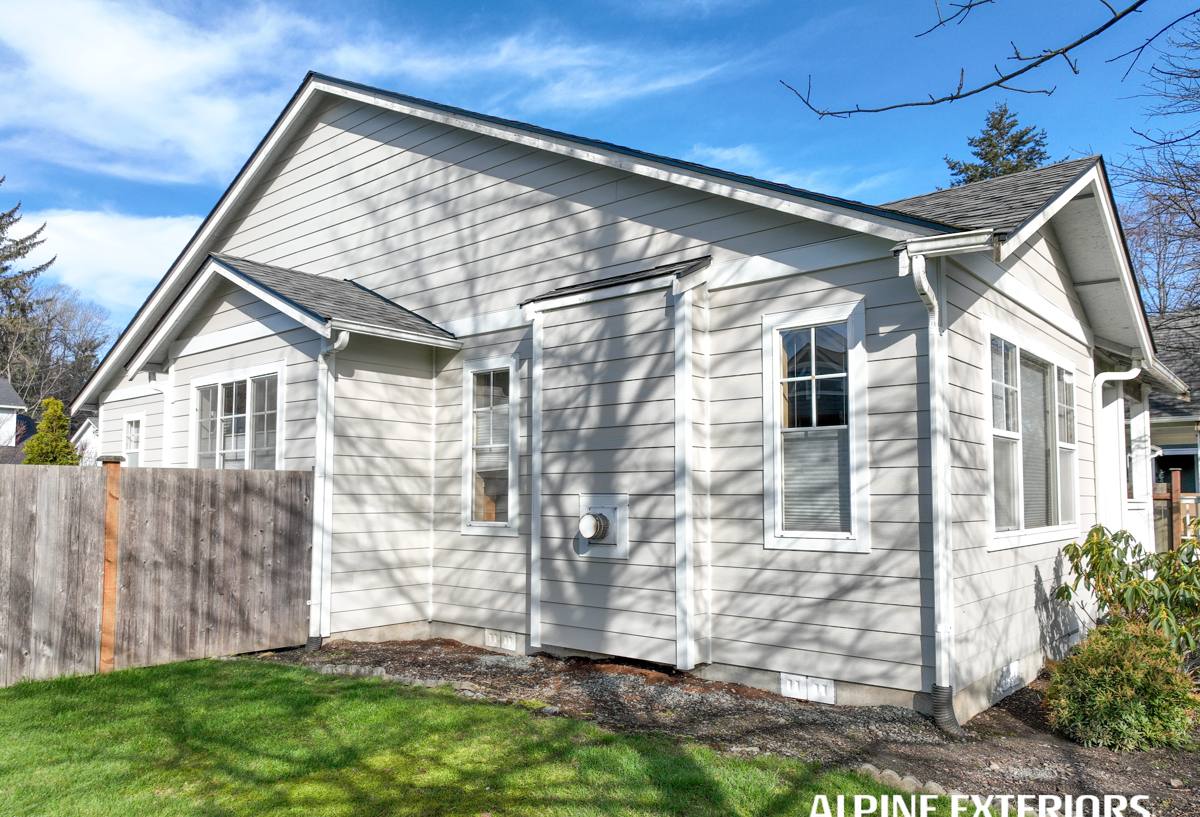
Why We Install James Hardie and Nothing Else
We standardized on James Hardie fiber cement for one reason: it's engineered to do the specific things this climate demands, and it does them consistently when installed correctly. Hardie siding is roughly 90% sand, cement, and cellulose fiber — it doesn't rot, it doesn't feed moss and mildew the way wood fibers can, and it's dimensionally stable, meaning it doesn't swell and shrink with every wet-dry cycle the way engineered wood products do. That stability matters more here than in a drier climate, because Mount Vernon siding almost never gets a long dry stretch to fully recover between rain events.
Hardie's factory-applied ColorPlus finish is also a real advantage in a valley with this much sun-to-shade variation and airborne moisture. Field-applied paint on any siding material is only as good as the prep, primer, and weather conditions on install day — and it's the first thing to fail when a product sits damp. ColorPlus is baked on under controlled conditions before the boards ever leave the plant, and it carries its own finish warranty separate from the substrate warranty. We won't install products that ask a homeowner to gamble on job-site paint holding up through a Skagit Valley winter.
What a Correct James Hardie Installation Actually Involves
James Hardie siding is only as good as the water management system underneath it. In a low-lying, high-rainfall area like Mount Vernon, the details most homeowners never see are the ones that determine whether siding lasts 30+ years or starts showing problems in five.
Water Management and Flashing
Every penetration — windows, doors, hose bibs, light fixtures, vents — needs proper flashing that directs water back out, not into the wall cavity. We install a code-compliant weather-resistant barrier with correctly lapped seams, flash all openings before siding goes on, and maintain proper clearance between the bottom edge of the siding and roofing, decks, and grade. Skipping or rushing this step is the single most common cause of hidden rot behind siding that looks fine from the street.
Fastening and Clearances
Hardie publishes specific fastener patterns, nail spacing, and gap requirements for butt joints and corners, and those specs change depending on the product line and exposure. Panels installed too tight, face-nailed when they should be blind-nailed, or hung without the minimum ground clearance are common ways an installer can void the manufacturer's warranty without the homeowner ever knowing — until there's a claim to file.
Caulking and Joint Treatment
Hardie's own installation guidance is specific about where caulk belongs and where it doesn't — over-caulking traps moisture just as effectively as leaving a gap unsealed. We follow Hardie's published details rather than generic "when in doubt, caulk it" habits some crews fall back on.
Choosing the Right Hardie Product for Your Home
Not every Hardie product line is the right fit for every house. Part of a correct install is picking the product and profile that suits your home's exposure, style, and how much of the year it sits in shade or direct wet weather.
| Product | Best Suited For | Key Consideration |
|---|---|---|
| HardiePlank Lap Siding | Most single-family homes; traditional or modern lap look | Widest range of textures and exposures; the most common choice locally |
| HardiePanel Vertical Siding | Modern facades, accent walls, gable ends | Needs battens or trim detailing to manage water at seams |
| HardieShingle | Craftsman or cottage-style homes, accent gables | More labor-intensive install; higher visual detail |
| HardieTrim | Corners, window and door casing, fascia | Pairs with any of the above to keep the whole exterior consistent |
Homes with a lot of shaded, north- or west-facing wall area — common on lots with mature trees or tight neighboring setbacks — benefit from smoother, tighter-lapped profiles that shed water fast and give moss less to hold onto. We walk each home's exposure before recommending a profile rather than defaulting to whatever's easiest to install.
Signs Your Current Siding Is Losing the Battle
- Soft, spongy, or crumbling spots when you press on the siding, especially near the bottom courses or under windows
- Persistent moss or dark streaking that comes back within weeks of cleaning
- Paint that's peeling, bubbling, or chalking heavily rather than just fading evenly
- Visible gaps opening up at seams, corners, or trim boards
- Warping, bowing, or panels that look wavy when viewed at a low angle
- Rising energy bills that can't be explained by anything else — a sign water may have compromised insulation behind the siding
Any one of these on its own isn't necessarily an emergency, but a combination is usually a sign the wall assembly is holding moisture it shouldn't be.
Our Process, Start to Finish
- On-site assessment — we look at existing siding, sheathing condition where accessible, drainage patterns around the home, and sun/shade exposure on each wall.
- Product and color plan — we recommend the Hardie profile and ColorPlus color that fits the home and exposure, and walk through the trim and detail package.
- Written estimate — a clear scope covering removal, any sheathing repair, water-resistive barrier, flashing, siding, and trim.
- Tear-off and inspection — old siding comes off and we inspect sheathing for hidden moisture damage before anything new goes up.
- Weather barrier and flashing — installed to manufacturer and code detail before a single piece of siding is hung.
- Hardie installation — fastened, gapped, and finished to James Hardie's published specifications for our exposure zone.
- Final walkthrough — we go over the finished exterior with the homeowner and cover warranty registration.
What Affects the Cost of a James Hardie Project
| Factor | Why It Matters |
|---|---|
| Sheathing condition | Rotted or water-damaged sheathing found during tear-off adds repair scope before new siding can go on |
| Home size and wall complexity | More corners, gables, and dormers mean more cutting, flashing, and labor time |
| Product line and profile | Shingle-style and vertical panel details take longer to install than standard lap siding |
| Trim and detail package | Full HardieTrim corner and window casing adds cost but improves long-term water management |
| Access and site conditions | Tight lots, landscaping, or multi-story walls affect staging and labor time |
We don't quote a number until we've actually looked at the house — anyone quoting a firm price over the phone for a full re-side hasn't seen your sheathing, your exposure, or your trim complexity.
Why It Matters That We Already Work in Mount Vernon
Installation details that work in a dry inland climate don't always hold up in a valley that stays damp for months at a time. A crew that's worked Skagit County knows which walls on a typical Mount Vernon home take the worst weather, how much clearance to leave given local drainage and grade patterns, and which flashing details actually get tested by a real Pacific Northwest winter rather than a mild one. That experience shows up in fewer callbacks and siding that's still doing its job correctly a decade or two later — which is the whole point of paying for a fiber cement install in the first place.
If you're planning a re-side or building new in Mount Vernon, we'd be glad to take a look at your home and put together a straightforward, no-pressure estimate — just fill out the form below.