 Anacortes Exterior
 Siding in La Conner Has to Answer to the Weather First
La Conner sits close enough to the water that siding decisions here aren't really about looks first — they're about what the exterior has to survive. Salt-laden air off the Swinomish Channel and the greater Skagit County shoreline works differently on a house than inland weather does. It doesn't just wet the siding; it carries fine salt residue that settles into seams, fastener heads, and any spot where the coating has thinned. Add driving rain that comes sideways during winter storms, plus a moss season that can stretch from late fall through spring in the shade pockets around mature trees, and you've got three separate stresses hitting the same wall assembly at once.
Homeowners in La Conner tend to notice the same problems repeating: caulking that fails at trim joints within a few years, paint that chalks and fades faster on the water-facing side of the house, and moss or algae staining that keeps coming back no matter how many times it gets pressure washed off. None of that is bad luck — it's what happens when a siding product or installation wasn't specified for this particular combination of moisture and salt exposure. A correct siding job in this area has to be evaluated against those conditions specifically, not against a generic Pacific Northwest standard.
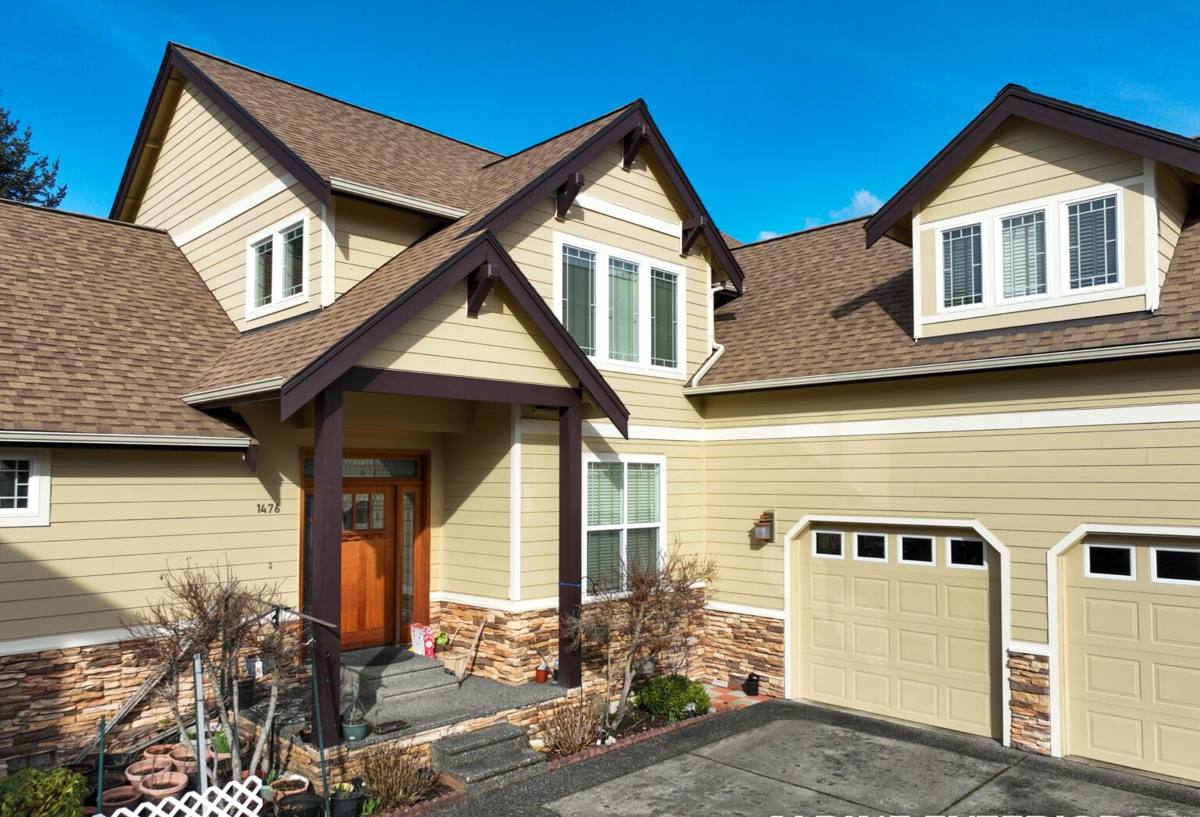
Why We Only Install James Hardie Fiber Cement Here
We install James Hardie fiber cement siding exclusively. We don't install vinyl, LP SmartSide, Cemplank, Allura, primed spruce, or cedar, and in a location like La Conner that's not a brand preference — it's a decision built around what actually holds up against salt air and constant moisture cycling.
Vinyl siding expands and contracts with temperature swings, and over time that movement opens gaps at seams and trim where salt-carrying moisture gets in behind the panel. Wood siding — cedar or primed spruce — is a natural material in a location where it's damp more months than it's dry, which means ongoing maintenance to stay ahead of moss growth and rot at end grain and fastener points. Fiber cement alternatives to Hardie exist, and some are reasonable products, but we've standardized on Hardie specifically for its factory-applied ColorPlus finish and its HZ5 formulation, engineered for wetter climate zones. That combination matters more here than in a drier inland town, because the finish is doing constant work against moisture and salt rather than occasional work against sun.
None of this means other products are junk. It means that for a coastal Skagit County installation, we've made a professional call about which system gives homeowners the best long-term outcome for the least maintenance, and we stand behind that call by only installing the one product we trust for this environment.
What Correct Siding Installation Involves in This Climate
The Water Management Layer Matters More Than the Siding Itself
Most siding failures aren't failures of the siding material — they're failures of what's behind it. A correct install starts with a properly lapped weather-resistive barrier, correctly flashed window and door openings, and a rainscreen or drainage gap where the wall assembly calls for it. In a location that gets sustained driving rain, any shortcut at a flashing detail becomes the point where water gets behind the cladding and stays there, which is exactly how rot and mold problems start in walls that look fine from the outside.
Fastening and Joint Detail
James Hardie siding has specific fastening patterns, nailing zones, and gap requirements at butt joints and trim that are documented by the manufacturer for a reason — get them wrong and you undercut both the warranty and the weather performance. Butt joints need to be properly sealed or flashed, not just caulked and hoped for. In a salt-air environment, we also pay attention to fastener selection, since the wrong fastener metal can corrode and stain the siding face over time.
Finish and Caulk Details
ColorPlus finish is factory-cured, which gives it better adhesion and color retention than field-applied paint over cut edges and fasteners — but cut ends still need to be sealed with the correct touch-up product at the time of installation. Caulk joints at trim, corners, and penetrations should use a high-quality sealant rated for exterior movement, applied to clean, primed surfaces. This is one of the most commonly rushed steps on lower-quality installs, and it's usually the first thing to fail when it's skipped.
Moss, Shade, and Airflow: The La Conner-Specific Problem
Beyond salt and rain, moss is its own local challenge. Homes tucked under tree cover or facing north with limited direct sun stay damp longer after every rain event, which gives moss and algae a head start. A siding installation should account for this with proper standoff from grade and landscaping, adequate soffit and gap clearances for airflow, and drainage details that let the wall assembly actually dry out between storms. Siding that's installed tight to the ground, or with landscaping mulch piled against the base, will hold moisture and encourage growth no matter how good the product is. Part of doing this job right in La Conner is looking at the whole site — tree cover, drainage, sun exposure — not just the wall itself.
Our Installation Process
- On-site assessment — we walk the exterior, check existing siding and trim condition, look at drainage and grade, and note shade patterns and moisture exposure specific to the property.
- Removal and inspection — old siding comes off, and we inspect the sheathing and framing underneath for hidden moisture damage before anything new goes up.
- Water-resistive barrier and flashing — house wrap or building paper is installed and lapped correctly, with flashing detailed at every window, door, and penetration.
- Furring or rainscreen gap — where the assembly calls for it, we create a drainage gap so the wall can shed and dry moisture rather than trap it against the back of the siding.
- Hardie panel or lap installation — installed to manufacturer fastening specs, with correct nailing zones, joint gaps, and butt joint flashing.
- Trim, caulk, and touch-up — trim is set, joints are sealed with exterior-rated sealant, and any field-cut edges are sealed with the specified touch-up product.
- Final walkthrough — we review the finished work with the homeowner and confirm everything meets both our standard and Hardie's installation requirements for warranty coverage.
Why a Local Anacortes Crew Matters for This Job
A crew that already works in and around La Conner and greater Anacortes has already seen how this exact climate treats a wall assembly over several winters — not in theory, but on real jobs in this county. That matters for a few practical reasons. We know which sides of a house in this area typically take the worst driving rain and need extra flashing attention. We know which properties are more prone to moss because of tree cover and orientation, and we plan drainage and clearance accordingly. And because we're local, warranty follow-up and any future service call isn't a drive from out of the area — it's a short trip from a crew that's already familiar with the property and the region's conditions.
Working with a crew that only installs one product system also means there's no ambiguity about what's being warrantied or how it should have been installed. Every job follows the same specification, which makes it easier to diagnose and correct anything if a detail was missed, rather than reverse-engineering an installation done to a different product's requirements.
Cost Factors for a La Conner Siding Project
Every home is different, but the following factors are the ones that most affect the scope and cost of a siding installation in this area specifically:
| Factor | Why It Affects Cost |
|---|---|
| Existing siding removal and disposal | Old wood or vinyl siding removal, plus any sheathing repair from hidden moisture damage, adds labor before new siding can go up |
| Rainscreen/drainage gap detail | Adding a furring or rainscreen system improves drying performance in wet climates but adds material and labor |
| Home size and wall complexity | Dormers, multiple gables, and cut-up wall planes increase trim work and installation time |
| Trim and fascia scope | Full trim replacement alongside siding is more efficient than doing it as a separate project later |
| Panel vs. lap siding selection | Different Hardie profiles have different material and labor costs depending on the look and coverage needed |
| Site access and shade/moss remediation | Tree trimming, grading, or clearance work to address moss-prone areas can add to project scope |
What to Ask Before Hiring Anyone for This Kind of Job
Whether you go with us or another contractor, a coastal siding installation is not the place to shop on price alone. Use this checklist when vetting a crew for a La Conner or Anacortes-area siding project:
- Are they manufacturer-certified or specifically trained on the siding system they're proposing to install?
- Will they explain their flashing and water-resistive barrier plan in specific terms, not just "we'll wrap it"?
- Do they address drainage and rainscreen detailing, or treat the siding as the only line of defense against water?
- Can they speak to moss and algae exposure and how the installation will account for shade and airflow on your specific lot?
- Do they carry proper licensing, bonding, and insurance for exterior work in Washington State?
- Will they put fastening pattern, joint treatment, and touch-up procedures in writing as part of the scope of work?
- Do they have a plan for warranty follow-up, and are they realistically positioned to come back if something needs attention?
Signs Your Current Siding Is Already Losing the Fight
If you're trying to decide whether it's time to replace rather than repair, these are the signals worth taking seriously in this climate specifically:
- Persistent moss or dark staining that returns within a season or two of cleaning
- Caulk joints that are cracked, gapped, or missing at trim and corners
- Soft or spongy spots when pressing on wood siding, especially near the bottom courses
- Paint that's chalking, peeling, or fading unevenly, particularly on water-facing walls
- Visible warping, cupping, or separation at siding seams
- Interior signs like musty smells or staining on walls that share an exterior with problem siding areas
Any one of these on its own might be a minor repair. Several at once, especially on a home that's had the same siding for a couple of decades, usually means the wall assembly as a whole is due for a real look.
Get a Straight Answer About Your Home
If you're weighing a siding project for a home in La Conner or elsewhere around Anacortes, we're happy to come take a look and give you a straightforward, no-pressure assessment of what your house actually needs — not a generic sales pitch. Fill out the form below to schedule a free estimate.