 Anacortes Exterior
 Why Fidalgo Island Siding Has to Work Harder
Fidalgo Island sits right where Puget Sound weather gets concentrated. Homes here take on salt-laden air off the water, long stretches of driving rain, and a moss and mildew season that can run most of the year on shaded north and west walls. That combination is rougher on exterior siding than what a house fifty miles inland deals with. Salt air accelerates corrosion on fasteners and trim metal. Wind-driven rain finds every gap in flashing and caulk. And moisture that never fully dries between storms is exactly what moss, algae, and mildew need to take hold.
None of that is unique to any one street or subdivision on the island — it's a function of being surrounded by water in Skagit County's marine climate. What it means practically is that siding material, fastening, flashing, and finish all matter more here than they would in a drier part of the state. A product or installation detail that's "good enough" in Eastern Washington can fail early on Fidalgo Island.
Why We Standardized on James Hardie
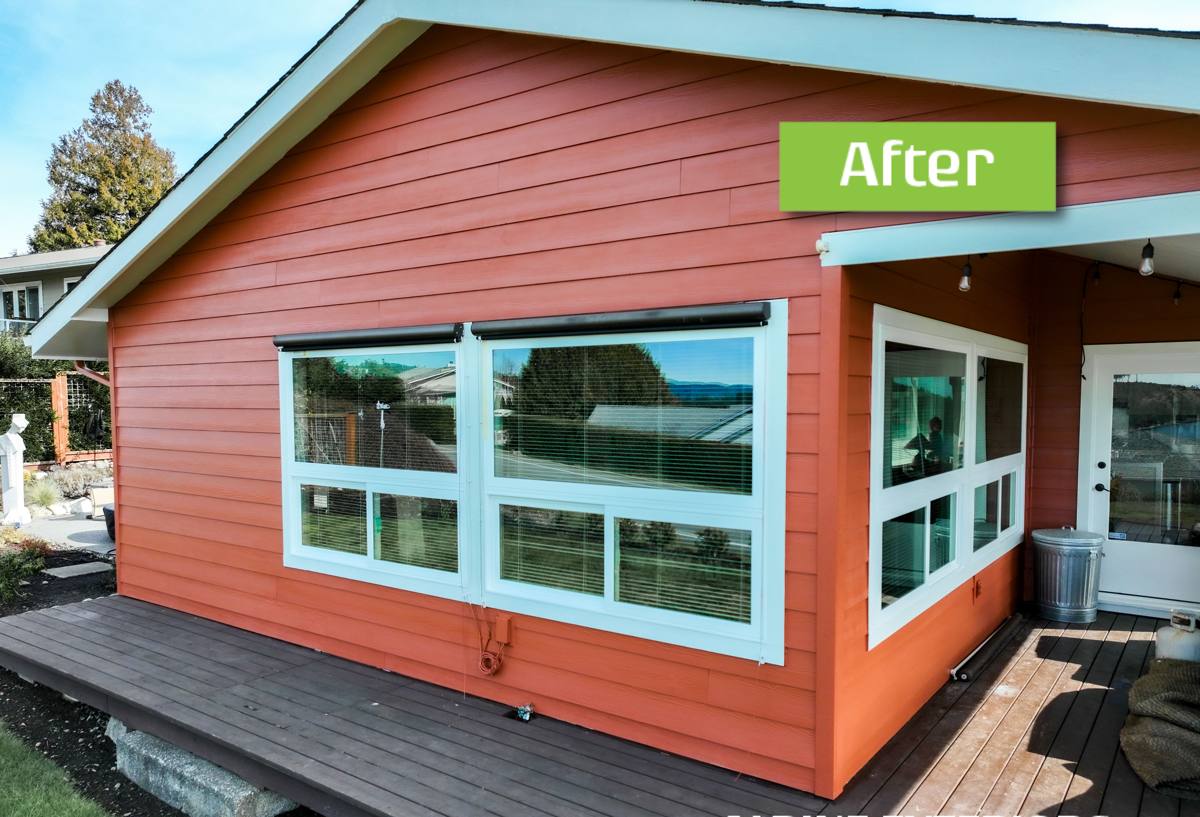
We install James Hardie fiber cement siding exclusively — no vinyl, no LP SmartSide, no Cemplank or Allura, no primed spruce or cedar. That's not a marketing position, it's a decision based on what actually holds up in this climate over decades, not just the first few years.
Fiber cement doesn't rot, it doesn't feed moss the way wood fiber products can, and it's non-combustible. James Hardie backs its boards with a factory-applied ColorPlus finish baked on under controlled conditions, which handles UV and moisture exposure far more consistently than field-applied paint. The company also engineers its HZ5 product line specifically for climates like ours — more moisture and freeze-thaw cycling than the Southwest, less extreme cold than the northern Rockies. That regional engineering is a real factor, not a sales line: siding formulated for the wrong climate zone can perform worse over time even if it looks identical on install day.
We're not going to tell you every other product on the market is junk — vinyl and engineered wood both have legitimate uses and loyal customers. But we've made a professional call that on a marine-climate island like this one, the trade-offs of those alternatives (seam and gap vulnerability, moisture sensitivity at cut edges, shorter realistic service life before recoating or replacement) aren't ones we're willing to put our name behind. James Hardie is what we install because it's what we've seen last.
What a Correct James Hardie Install Actually Involves
The board itself is only part of the system. Most siding failures we get called out to look at — on any brand — trace back to installation details, not the material. On Fidalgo Island specifically, a handful of details matter more than they would elsewhere:
- Proper weather-resistive barrier and rainscreen gap so incidental moisture behind the siding can drain and dry instead of sitting against the wall
- Correct fastener type and spacing — stainless or hot-dip galvanized fasteners hold up far better against salt air than standard coated fasteners
- Flashing at every window, door, and roofline penetration, lapped correctly so wind-driven rain can't work its way behind the board
- Manufacturer-specified clearance between the bottom of the siding and grade, decks, or roof lines, so splash-back moisture doesn't sit against the cut edge
- Factory-cut edges kept intact wherever possible, with any field cuts properly sealed per Hardie's installation guidelines
- Caulking used only where Hardie's install instructions call for it — over-caulking traps moisture just as badly as under-caulking lets it in
Skip any one of these and you can end up with a board that's rated for decades of marine exposure failing at a seam or fastener point in a fraction of that time. The product doesn't fail — the installation does.
HZ5 Product Fit for This Area
| Consideration | Why It Matters on Fidalgo Island |
|---|---|
| Moisture resistance | Engineered for high-rainfall, high-humidity climates rather than arid regions |
| Freeze-thaw performance | Handles our winter freeze-thaw swings without the cracking risk of climates not engineered for it |
| Factory finish (ColorPlus) | Resists UV fading and moisture intrusion better than field-applied paint exposed to salt air |
| Non-combustible core | Doesn't feed fire the way wood-based sidings can — relevant given regional wildfire smoke seasons |
Salt Air, Fasteners, and Trim: The Detail Most Jobs Miss
Salt-laden air off Puget Sound is corrosive to unprotected metal, full stop. On siding jobs, that shows up as rust bleed at fastener heads, corroded trim flashing, and premature failure of hardware that would have lasted decades a few miles inland. We spec corrosion-resistant fasteners and flashing on every Fidalgo Island job for this reason — it costs a little more up front and it's the difference between trim that still looks clean in fifteen years and trim that's staining and streaking in five.
This is also where hiring a crew unfamiliar with marine environments tends to show. A contractor who mostly works inland jobs may default to standard-grade fasteners because that's what performs fine where they usually work. On the island, that shortcut compounds over time.
Moss, Algae, and the North-Wall Problem
Shaded, moisture-retentive wall sections — typically north- and west-facing walls under trees or close to neighboring structures — are where moss and algae growth shows up first and worst. Fiber cement doesn't feed organic growth the way wood siding can, but growth can still take hold on the surface if a wall never gets a chance to dry out. Two things reduce that risk: correct rainscreen ventilation behind the siding (so the wall assembly itself dries between rain events) and reasonable clearance from vegetation and structures that block airflow and sun exposure. We factor wall orientation and shading into the install plan on every job, not just material selection.
Our Process on Fidalgo Island Jobs
The process is the same rigor we apply everywhere, with the site conditions specific to this area factored in from the first walk-through:
- On-site assessment of existing siding, sheathing, and any moisture or rot already present — this determines whether repair work is needed before new siding goes on
- Wall-by-wall plan accounting for sun exposure, prevailing wind and rain direction, and shading, since these vary meaningfully even within a single property
- Weather-resistive barrier and rainscreen installation, corrected or upgraded where the existing wall assembly falls short
- James Hardie HZ5 board installation to manufacturer spec, with corrosion-resistant fasteners and properly lapped flashing throughout
- Final walkthrough covering what routine maintenance looks like for the specific exposures on that home
Why a Crew That Already Works This Island Matters
Fidalgo Island isn't a huge market, and that's actually an advantage if your contractor already works it regularly. A crew that's done multiple jobs here has already seen how a given neighborhood's wind exposure, shading, or proximity to the water behaves over a full season — not just guessed at it from a spec sheet. That translates into fewer surprises during installation and fewer callbacks after. It also means logistics — permitting through the City of Anacortes or Skagit County, material staging, scheduling around the ferry and bridge traffic patterns — are already worked out rather than being figured out on your job.
Maintenance Checklist for Marine-Climate Hardie Siding
James Hardie siding installed correctly is genuinely low-maintenance, but "low" isn't "none" in this climate. A short annual routine keeps it performing the way it's designed to:
- Rinse siding annually to clear salt residue and organic buildup, especially on north and west walls
- Inspect caulking at trim and penetrations yearly and touch up before gaps open into leak points
- Check fastener heads and flashing for early corrosion staining, particularly closest to the water
- Keep gutters clear so overflow doesn't run down and sit against wall sections
- Trim back vegetation that's shading walls and slowing drying time
- Watch for moss or algae film starting on shaded sections and address it before it spreads
Cost Factors for a Fidalgo Island Siding Project
| Factor | Why It Affects Cost |
|---|---|
| Existing wall condition | Rot or moisture damage found under old siding adds repair scope before new siding goes on |
| Home size and wall complexity | More corners, gables, and penetrations mean more flashing, cutting, and labor time |
| Siding profile and trim selection | Lap width, trim detailing, and accent choices affect material and labor cost |
| Access and site conditions | Tight lots, slopes, or limited staging area can add time to material handling |
| Fastener and flashing upgrades | Marine-grade hardware costs more than standard-grade but pays off in longevity here |
We don't quote a project without seeing the walls first — every home on the island carries a different mix of these factors, and an honest number only comes after a real look.
If you're weighing a siding replacement on Fidalgo Island and want a straight answer about what your home actually needs, we're glad to walk the property and give you a free, no-pressure estimate — no obligation, just an honest look and a clear plan using the form below.