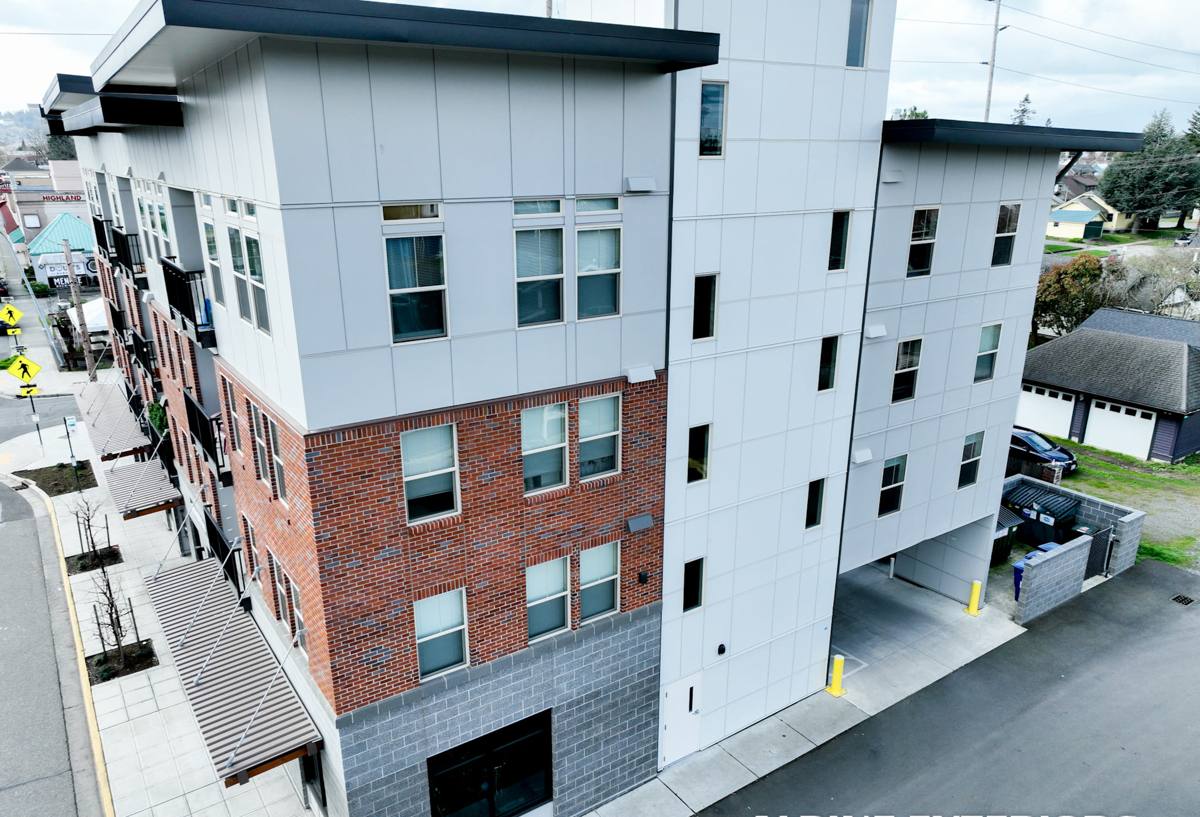
 Anacortes Exterior
 Cap Sante's Exposure Is Its Own Climate
Cap Sante sits up on the hill overlooking the marina and Fidalgo Bay, which means homes here catch wind and salt spray that houses just a mile inland never see. That elevation and water proximity are part of what make the neighborhood desirable, but they're also exactly the conditions that wear out the wrong siding material fastest. Salt-laden air corrodes fasteners and trim, wind-driven rain finds every gap in a poor installation, and the shade from mature evergreens keeps north- and west-facing walls damp long after a storm passes through. Any siding job here has to be planned around those realities, not a generic Pacific Northwest install.
We work throughout Anacortes and Skagit County, and Cap Sante is one of the areas where we see the clearest gap between siding that was installed correctly and siding that was installed to look good on move-in day. The difference shows up in year three or four, not year one.
What Salt Air and Moss Season Do to Siding Over Time
Two separate stresses compound on a Cap Sante home: airborne salt and prolonged dampness.
Salt Air
Salt is hygroscopic — it pulls moisture out of the air and holds it against whatever surface it lands on. On exposed fasteners, trim screws, and metal flashing, that means accelerated corrosion. On wood-based siding products, it means the surface stays wetter, longer, which speeds up rot at seams and cut edges. Paint and coatings also break down faster under salt exposure, so a finish that would last a decade inland can start chalking and fading well before that on a marina-facing wall.
Moss Season
Anacortes gets a long stretch of wet, mild weather where moss and algae have ideal growing conditions, especially on shaded siding that doesn't get direct sun to dry out. Moss holds moisture directly against the siding surface for weeks at a time. On a material that can absorb water or swell, that's a slow path to soft spots, delamination, and paint failure. On a properly finished fiber cement surface, moss can still grow if it's shaded and damp long enough, but the substrate underneath isn't degrading the way an absorbent material would.
Put those two together — salt corrosion plus extended dampness — and you get why some sidings that perform fine in drier parts of the state don't hold up as well two blocks from the water in Anacortes.
Why We Install Only James Hardie Fiber Cement
We made a decision as a company to install James Hardie fiber cement siding exclusively, and not vinyl, not LP SmartSide, not Cemplank or Allura, not primed spruce or cedar. That's not a marketing position — it's a call we made after weighing how each of those products actually performs under years of coastal exposure, and what happens when something goes wrong.
Fiber cement is made from cement, sand, and cellulose fiber. It doesn't absorb water the way wood-based products do, it won't warp or rot, and it's non-combustible, which matters more each year in Western Washington's longer wildfire seasons. James Hardie's HZ5 product line is specifically engineered for the wetter, harsher climate zone the Pacific Northwest falls into, with a moisture and freeze-thaw performance spec built around exactly the conditions Cap Sante deals with. The factory-applied ColorPlus finish is also baked on and cured under controlled conditions, which gives it better fade and wear resistance than field-applied paint — a real advantage on a west- or north-facing wall that's taking direct salt spray and prolonged shade.
We're happy to talk through the trade-offs of other products with any homeowner who asks, honestly and specifically. But when it's our name on the install, we only put up what we're confident will still be doing its job in twenty years on a hill above saltwater.
What a Correct Installation Actually Involves
Fiber cement siding is only as good as the install behind it. The board itself resists water and rot, but the assembly around it — the water-resistive barrier, flashing, fastening, and gaps — is what actually keeps a Cap Sante home dry through a winter storm off the bay.
- Water-resistive barrier: A continuous, properly lapped WRB behind the siding, with seams taped and penetrations flashed, so any water that gets past the siding still drains out instead of into the wall.
- Flashing at every transition: Windows, doors, decks, and roof-to-wall intersections all need correctly lapped flashing — this is where most siding failures actually start, not in the field of the wall.
- Clearances: Hardie's specs call for minimum gaps above roofing, decks, and grade, and consistent gapping between boards. Skipping these is the single most common shortcut we see on older installs, and it's usually what causes rot at the bottom courses.
- Fastening: Corrosion-resistant fasteners driven correctly (not overdriven, not underdriven), following Hardie's nailing pattern — important everywhere, but especially where salt air accelerates corrosion on the wrong hardware.
- Joints and caulking: Butt joints treated correctly, with quality sealant only where Hardie's install specs call for it — over-caulking traps moisture just as often as under-caulking lets it in.
None of this is visible once the job is finished, which is exactly why it's the part worth asking a contractor about before they start.
Choosing the Right Product Line for a View-Facing Home
James Hardie makes several siding profiles, and the right choice depends on the home's style and its exposure, not just personal preference.
| Product | Best for | Notes for Cap Sante exposure |
|---|---|---|
| HardiePlank lap siding | Traditional and craftsman-style homes | Most common choice; wide color range in ColorPlus finish holds up well to sun and salt fade |
| HardiePanel vertical siding | Modern homes, accent walls, gable ends | Clean lines that read well on view-oriented architecture; fewer horizontal joints to detail |
| HardieShingle | Craftsman and cottage-style detailing | Good for accent areas; more seams means installation quality matters even more |
| HardieTrim | Corners, fascia, window and door trim | Matched fiber cement trim avoids the mismatched durability of wood trim on a fiber cement field |
For homes with unobstructed water views, we also talk through color and sheen with an eye toward how a finish will read under strong reflected light off the bay — some colors and textures show fading and salt residue more readily than others.
What Drives Cost on a Cap Sante Project
| Factor | Why it matters |
|---|---|
| Tear-off vs. new construction | Removing and disposing of existing siding, and repairing any sheathing damage found underneath, adds labor beyond a bare install |
| Home height and hillside access | Multi-story homes and steep Cap Sante lots often require additional staging, scaffolding, or lift access |
| Siding profile and trim detail | Vertical panel with heavy trim work costs more per square foot than straightforward lap siding |
| Color and finish | Standard ColorPlus colors vs. premium or custom colors carry different material costs |
| Underlying damage | Rot or moisture damage found once old siding comes off is common near the water and is priced once it's actually visible |
We give straightforward, itemized estimates rather than a single lump number, so a homeowner can see what's driving the price before committing to anything.
How We Approach a Job in Cap Sante
The process starts with a walk-around of the home to check the condition of the existing siding, sheathing, flashing, and trim — this tells us what we're actually dealing with before any number gets quoted. From there we plan around the site: hillside lots often need specific staging and material staging plans, and homes close to the marina sometimes call for extra care around landscaping, retaining walls, or limited driveway access.
During installation, we follow James Hardie's published fastening, clearance, and flashing specifications to the letter — not as a minimum, but because that's what the manufacturer's warranty is actually built on. We also don't rush weather-sensitive steps like sealant application; Anacortes' wet stretches mean timing those steps to actual dry windows, not just the calendar.
Ongoing Maintenance in a Salt Air, Moss-Prone Climate
Fiber cement is low-maintenance compared to wood or vinyl, but "low-maintenance" isn't "no-maintenance" — especially this close to the water.
- Rinse salt residue off exterior walls periodically, particularly on marina- and bay-facing sides
- Keep landscaping trimmed back from siding so shaded walls get airflow and sun exposure to discourage moss
- Inspect caulking at joints, windows, and trim yearly and re-seal where it's cracked or pulled away
- Check flashing at roof lines, decks, and window heads for gaps after major windstorms
- Address any moss or algae growth early with a gentle wash rather than letting it establish and hold moisture
- Watch for chalking or fading on ColorPlus finishes over many years — it's slow, but eventual repainting is still cheaper and easier than replacing a failed material
Why Local Experience on Cap Sante Actually Matters
A crew that hasn't worked this specific stretch of coastline will size up a Cap Sante home the same way they'd size up a house twenty miles inland — and that's how you end up with a technically fine installation that still underperforms because it wasn't planned around salt exposure, hillside wind, or the shade patterns that drive moss growth here. A crew that already works this neighborhood knows which walls take the worst weather, which details tend to fail first on older homes nearby, and how to sequence a job around Anacortes' wet stretches instead of fighting them.
That local knowledge doesn't show up as a line item on an estimate, but it's a big part of why a siding job either holds up for decades or starts needing attention within a few years.
If you're weighing siding options for a Cap Sante home, we're glad to walk the exterior with you and put together a free, no-pressure estimate — no obligation, just a straight look at what your home actually needs.