 Anacortes Exterior
 Burlington Siding Has to Answer to Skagit County Weather
Burlington sits inland from Anacortes along the Skagit River valley, but it doesn't escape the marine climate that defines this part of Skagit County. Moist air pushes up from Padilla Bay and the Salish Sea, and it settles into the valley the same way it settles onto the coast — as a near-constant low-grade dampness that keeps siding wet for days at a stretch during the fall and winter. Add driving rain off the water and the shaded, tree-lined lots common around Burlington, and you get a textbook environment for moss, algae, and slow moisture intrusion.
None of that is dramatic on its own. The problem is what it does over years, not weeks. Siding that isn't built for sustained dampness — or that isn't installed with the right clearances and flashing — traps moisture instead of shedding it. That's when you start seeing soft trim, peeling paint, and siding that looks tired well before it should. A siding job done right in Burlington has to be judged against that slow-moisture reality, not against a sunny-day install.
Why We Only Install James Hardie Fiber Cement
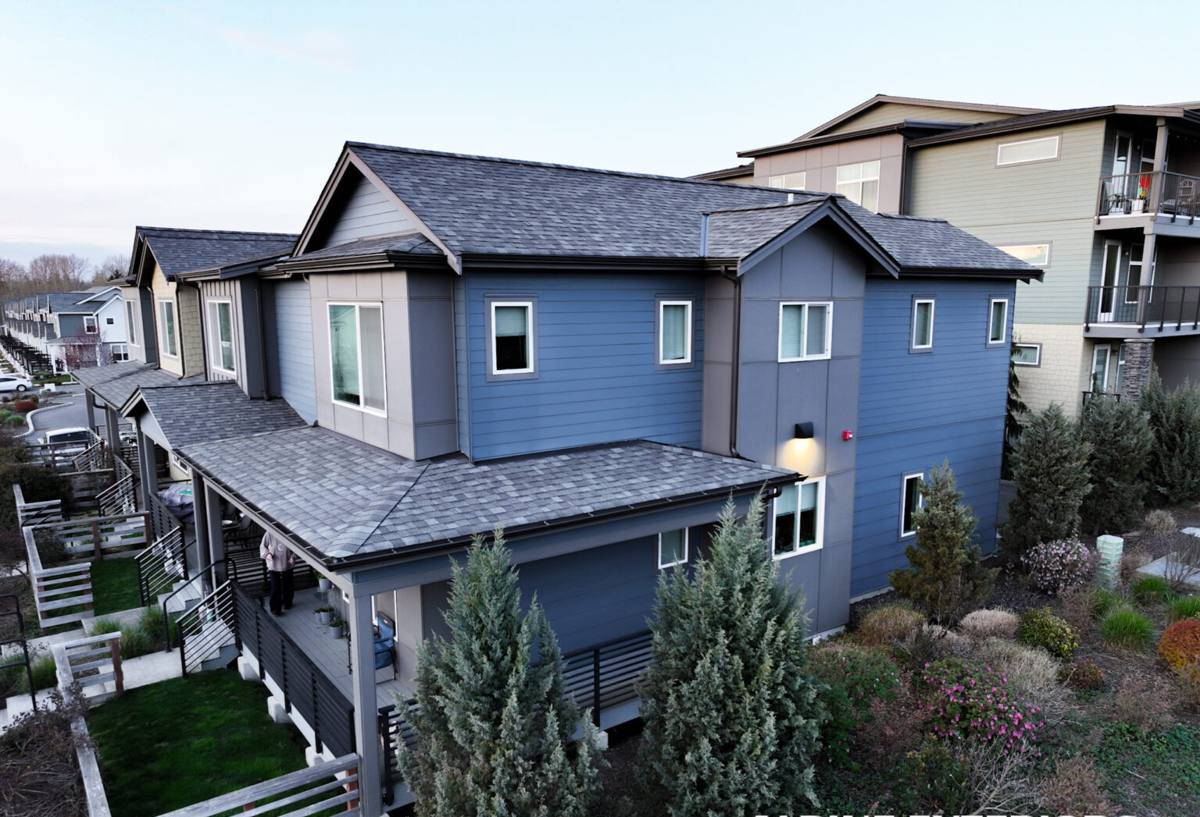
We install James Hardie fiber cement siding exclusively. We don't install vinyl, LP SmartSide, Cemplank, Allura, primed spruce, or cedar. That's not a marketing position — it's a standard we hold ourselves to because of what we've seen these products do, and not do, in exactly this climate over time.
Fiber cement is a cement, sand, and cellulose fiber composite. It doesn't feed mold or wood-boring insects the way wood-based products can, and it doesn't soften, warp, or expand and contract with humidity the way vinyl and engineered wood products do. In a place where siding spends a large share of the year wet, that stability matters more than it does in a dry climate. James Hardie's HZ5 product line is specifically engineered for climates like this one — high-moisture, high-humidity regions where freeze-thaw cycles and sustained dampness are the norm rather than the exception.
Fiber cement is also non-combustible, which matters increasingly across Washington as wildfire smoke and dry-season fire risk have become a bigger part of the conversation even on the wet side of the state. And with the factory-applied ColorPlus finish, the color coat is baked on and warrantied against fading and peeling — it isn't touch-up paint applied on site under whatever weather shows up that week.
What We're Asking Homeowners to Weigh
We're upfront that other products have real advantages — vinyl is cheaper up front, cedar has a look some homeowners specifically want, LP SmartSide is lighter to handle. We're not disputing any of that. What we've found, installing siding across Skagit County, is that those advantages get outweighed by long-term maintenance burden or moisture sensitivity in this specific climate. That's the trade we're not willing to make on a customer's behalf, so we've standardized on the one product line where we don't have to.
What a Correct Fiber Cement Install Actually Involves
Fiber cement siding is only as good as its installation. It's a forgiving material in terms of durability, but unforgiving of shortcuts in the details — and the details are exactly what separate a siding job that lasts twenty-plus years from one that fails at the seams in five.
Moisture Management Comes First
Before any siding goes up, the wall needs a proper water-resistive barrier, correctly lapped and taped at every seam, with flashing integrated at every window, door, and penetration. This is the layer that actually keeps water out of the wall assembly — the siding itself is the second line of defense, not the only one. Skipping or rushing this step is the single most common cause of hidden rot behind siding that looks fine from the outside.
Clearances and Fastening
James Hardie specifies minimum clearances from grade, roof lines, decks, and other flat surfaces so water has somewhere to go instead of wicking up into the bottom edge of the siding. Fasteners need to be the correct type, spaced correctly, and driven to the right depth — over-driven nails crack the board's fiber cement edge and create a moisture entry point that won't show up until years later.
Caulking, Trim, and Finish Details
Joints and butt seams need to be treated with the right sealant, and trim needs to be sized and installed so water sheds away from joints rather than pooling against them. Because ColorPlus finish is factory-applied, field cuts need touch-up with the matched ColorPlus product, not generic exterior paint, to preserve both the look and the finish warranty.
Our Process for a Burlington Siding Project
We keep the process the same whether the home is right in Anacortes or out toward Burlington — the steps don't change, only the details of what we find on your specific house.
1. On-Site Assessment
We walk the exterior, check the condition of the existing siding and sheathing where accessible, look at moisture staining, trim condition, and roofline details, and talk through what you want out of the project — full replacement, partial repair, or a specific problem area.
2. Scope and Product Plan
We spec out the right James Hardie product line and profile for the home, plan for trim, fascia, and any transitions (stone, brick, or masonry details), and walk through color options in the ColorPlus lineup.
3. Tear-Off and Prep
Old siding comes off, sheathing is inspected and repaired as needed, and the water-resistive barrier and flashing go in correctly — this is the stage that determines how the house performs for the next few decades, so we don't rush it.
4. Installation
Siding, trim, and accessories go up to manufacturer spec, with attention to the clearances and fastening details that keep the warranty valid and the wall assembly dry.
5. Final Walkthrough
We check seams, caulking, and touch-ups with you before calling the job done, and make sure you know what routine maintenance (if any) is expected going forward.
Cost Factors for a Burlington Home
Every home is different, so we won't quote a number without seeing the house — but the factors that move a fiber cement project up or down in scope are consistent. Here's what typically drives the estimate:
| Factor | Why It Matters |
|---|---|
| Tear-off vs. new construction | Removing and disposing of old siding, and repairing any sheathing damage found underneath, adds labor beyond a bare install |
| Home size and number of stories | More square footage and taller walls mean more material, more staging/lift access, and more install time |
| Trim and architectural detail | Homes with more corners, gables, or trim transitions take longer to fit and finish correctly |
| Siding profile chosen | Lap siding, shingle-style panels, and vertical board-and-batten each have different material and labor costs |
| Moisture or rot repair needed | Damaged sheathing or framing found during tear-off has to be repaired before new siding goes up |
| Site access | Landscaping, fencing, decks, or tight lot lines around the home can add setup and staging time |
Moss, Algae, and Seasonal Maintenance
Fiber cement doesn't feed moss and algae growth the way wood-based siding can, but nothing that sits outside in the Skagit Valley climate stays perfectly clean on its own. Shaded, north-facing walls and areas under tree cover are the spots most likely to develop surface growth over a wet winter. The good news is that maintenance on correctly installed fiber cement is genuinely light — this is about upkeep, not repair.
- Rinse siding surfaces once or twice a year, especially shaded and north-facing walls, to keep moss and algae from building up
- Keep gutters clear so overflow doesn't run down the siding face and hold moisture against it
- Keep shrubs and landscaping trimmed back from the wall so air can circulate and siding can dry between rain events
- Walk the exterior once a year and check caulking at joints, trim, and penetrations for cracking or separation
- Look at the bottom courses of siding near grade, decks, and patios for staining or soft spots
- Touch up any exposed field cuts or chips promptly with matched ColorPlus touch-up product
Why It Matters That We Already Work in Burlington
A crew that only occasionally works out toward Burlington is guessing at things a crew based in Anacortes already knows from repeat experience — how the moisture behaves on the shaded, tree-covered lots common in this part of Skagit County, which local suppliers keep the James Hardie profiles and colors in stock, and how permitting and inspection typically go with Skagit County versus inside Anacortes city limits. None of that shows up on a glossy brochure, but it shows up in how smoothly your project runs.
It also means we're not a stranger if something needs a follow-up look after the job is done. We're a short drive away, working this same corridor between Anacortes and the Skagit Valley on a regular basis — not passing through once and moving on.
What to Expect From Us
We'll always tell you plainly what your home needs and what it doesn't. If your existing siding still has useful life left, we'll say so. If a full replacement is the right call, we'll walk you through why, what James Hardie product line fits your home, and what correct installation looks like for your specific walls and exposure. We don't upsell products we don't believe in, and we don't install products we wouldn't put on our own homes in this climate.
If you're weighing a siding project on a Burlington-area home, we're happy to take a look and give you a straight, no-pressure estimate — no obligation, just an honest read on your house. The form below gets you started.