 Anacortes Exterior
 Board & Batten in a Waterfront Neighborhood Like Similk Beach
Similk Beach sits close enough to the water that the character of the neighborhood is shaped by it — the light, the wind, and the salt that rides in on both. Board and batten siding has a natural fit here. The vertical lines read as clean and contemporary on newer builds, but the same profile has been used on Northwest coastal and farmhouse-style homes for well over a century, so it also sits comfortably on older Anacortes-area properties that lean traditional. The look is simple: wide flat panels with narrow battens covering the seams, giving the wall a rhythm of shadow lines instead of the horizontal stack of lap siding.
That simplicity is exactly why the installation has to be right. Board and batten has fewer, longer seams than horizontal lap siding, and those seams run vertically — meaning any water that gets behind a batten has gravity working with it, not against it, to travel down and find a gap. On a home a mile or two from Similk Bay and the open water toward Rosario Strait, that's not a small detail.
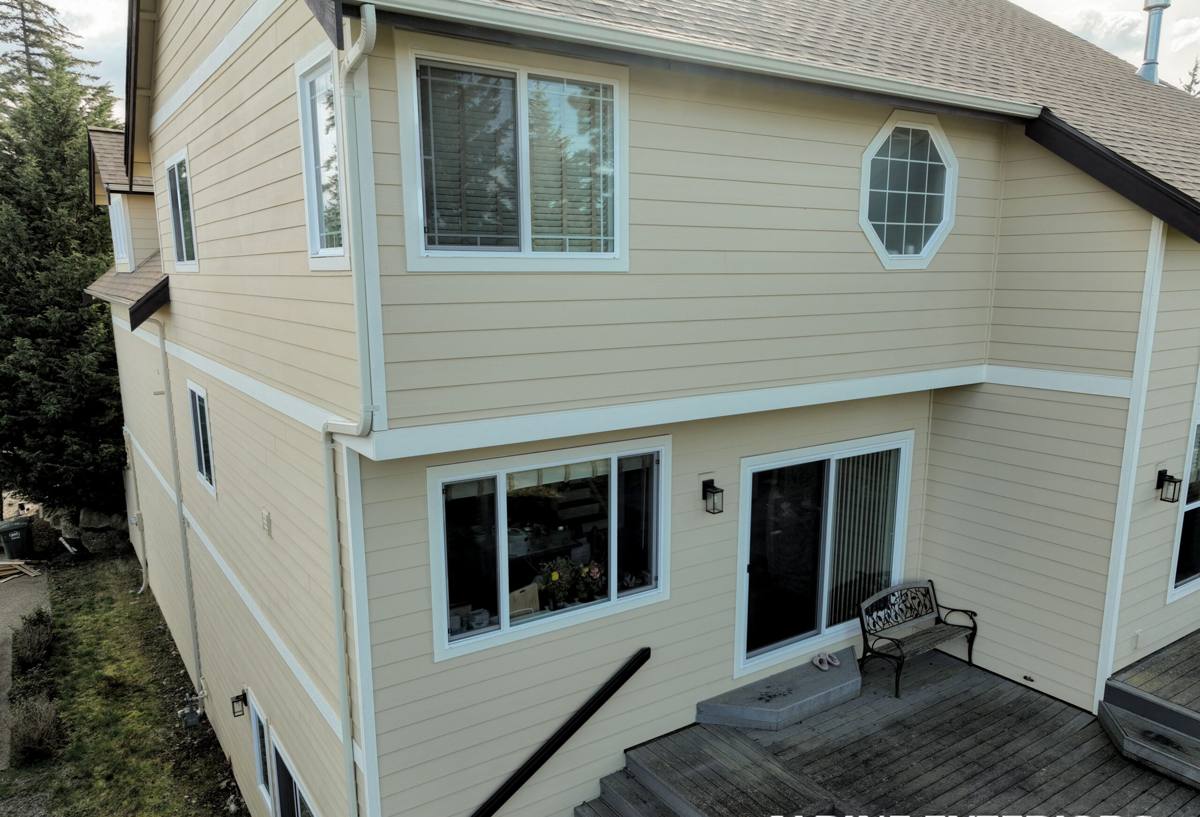
What Similk Beach's Climate Actually Does to Siding
Skagit County's marine climate is mild compared to most of the country, which is part of why people live out here — but "mild" doesn't mean "easy" on a house. Three things wear down siding in this specific pocket of Anacortes faster than homeowners expect:
- Salt air: Airborne salt from the surrounding waters accelerates corrosion on fasteners, flashing, and any exposed metal trim, and it degrades cheap paint and coatings faster than inland exposure would.
- Driving rain: Storms off the water don't just fall straight down — wind-driven rain gets pushed sideways into vertical seams and butt joints, which is precisely where board and batten is most vulnerable if it isn't detailed correctly.
- A long moss season: Damp, shaded conditions for much of the year mean moss and algae get a long runway to establish themselves on any siding surface that holds moisture, especially on north-facing walls and under tree cover.
None of this is unique to Similk Beach, but the combination is more concentrated near the water than it is a few miles inland in Anacortes proper, and it's part of why we treat every near-water job in this area as a job that needs the details done right the first time, not a job to revisit in five years.
Why We Install Board & Batten Only in James Hardie Fiber Cement
We don't install board and batten in LP SmartSide, vinyl, cedar, or primed spruce. That's not a marketing position — it's a standard we hold to because of what we've seen those materials do over time in exactly this kind of environment.
Wood board and batten looks beautiful the day it goes up, but it's an engineered wood or solid wood product that depends entirely on paint film integrity to stay dry. In a moss-prone, high-moisture climate, that paint film is under constant attack, and once it fails at a seam or a fastener head, water gets into the substrate and the clock starts on rot. Vinyl board and batten is low-maintenance in the sense that it doesn't rot, but it's a thin plastic product that becomes brittle in cold snaps, expands and contracts with temperature swings, and simply can't hold the crisp, deep-shadow reveal that gives board and batten its character — it tends to look flat and plasticky up close.
James Hardie fiber cement solves the core problem: it's non-combustible, dimensionally stable, and doesn't feed mold or absorb moisture the way wood-based products do. For board and batten specifically, Hardie's engineered panel and batten systems hold a sharper, more consistent reveal than vinyl, and the factory-applied ColorPlus finish is baked on and warrantied against fading and cracking — which matters more here than in a drier climate, because the finish is the first line of defense against salt air and constant damp.
Built for This Climate, Not a Generic One
Hardie engineers different siding formulations for different climate zones — HZ5 for regions with freeze-thaw cycles, HZ10 for wetter, milder coastal zones like ours. That distinction exists because fiber cement performance is climate-dependent, and installing the wrong formulation is one of the more common mistakes made by crews who don't work the Pacific Northwest regularly.
What a Correct Board & Batten Installation Involves
Board and batten fails or succeeds almost entirely on details that aren't visible once the job is done. This is where we spend the most time, and where corner-cutting shows up years later as staining, soft spots, or moss colonies at the seams.
| Detail | Why It Matters at Similk Beach |
|---|---|
| Rain screen / drainage gap behind panels | Lets any water that gets past the surface drain and dry out instead of sitting against the sheathing — critical with driving rain off the water |
| Corrosion-resistant fasteners | Salt air attacks standard fasteners; stainless or coated fasteners rated for coastal exposure prevent rust streaking and loosened boards |
| Proper batten spacing and fastening pattern | Battens fastened to hit framing, not just the panel, keep the seam tight over years of wind and moisture cycling |
| Flashing at every horizontal transition | Windows, doors, and trim boundaries are where wind-driven rain finds its way in if flashing is skipped or undersized |
| Bottom clearance off grade and hardscape | Keeps the lowest course out of splash-back and standing moisture, which is where moss and rot start first |
| Caulked and sealed panel joints per manufacturer spec | Hardie's warranty depends on installation to spec — skipped or under-sealed joints are a common cause of both leaks and voided coverage |
Every one of these is standard Hardie installation practice. None of it is exotic. But it's also exactly the kind of work that gets rushed by crews trying to move fast on a job, and near open water it doesn't take long for a rushed detail to become a visible problem.
Our Process for a Similk Beach Job
The steps don't change much from house to house, but the attention paid to water management and salt-air detailing does, because this is a more demanding environment than an inland Anacortes lot.
- On-site assessment of the existing wall assembly, moisture readings where rot is suspected, and a look at drainage around the foundation
- Removal of failing siding and inspection of the sheathing underneath — any soft or water-damaged sheathing gets addressed before new siding goes up, not covered over
- Installation of a proper weather-resistive barrier and rain screen gap
- Hardie board and batten installed with coastal-rated fasteners and manufacturer-spec flashing at every window, door, and roofline transition
- Factory ColorPlus finish means no field painting is needed, which also means no exposed cut edges are left unsealed — cut edges get sealed per Hardie spec regardless
- Final walkthrough covering care, what to watch for, and how the warranty works
Maintenance and What to Expect Over Time
Fiber cement board and batten is low-maintenance, not zero-maintenance. In a Similk Beach setting, we tell homeowners to expect two realities: moss and algae will still try to grow on any exterior surface in this climate, and salt air will still reach fasteners and metal trim over time. The difference with a correctly installed Hardie system is that the siding itself isn't the weak point — a periodic rinse-down to keep moss from getting a foothold, and an occasional visual check of caulked joints and trim, is generally all that's needed. Compare that to a wood board and batten system, where the paint film itself needs recoating on a cycle to keep water out, or a vinyl system where UV and cold cycling gradually make the material more brittle.
Why Hiring a Crew That Works Similk Beach Regularly Matters
Anacortes and the surrounding Skagit County waterfront have their own microclimate quirks — wind exposure that varies block by block depending on proximity to open water, tree cover that changes how long a wall stays damp after a storm, and salt exposure that a crew based further inland may not build into their fastener and flashing choices by default. A crew that has worked homes in this specific area knows to spec for it automatically, rather than applying a generic install and hoping it holds up.
There's also a practical trust factor: a local crew has a reputation in the neighborhood to protect, is easy to reach if a question comes up after the job, and understands the permitting and inspection expectations in Skagit County without a learning curve.
Is Board & Batten the Right Call for Your Home?
Board and batten isn't the right fit for every house — it reads best on homes with clean, simple wall planes, and it's often used as an accent alongside horizontal Hardie lap siding rather than across an entire exterior. Part of a good estimate is an honest conversation about where vertical siding will look right on your specific home and where it won't.
If you're weighing board and batten for a home in Similk Beach or elsewhere around Anacortes, we're glad to come take a look, walk the exterior with you, and give you a straightforward, no-pressure estimate — including what we'd flag as a concern before any work starts. Reach out through the form below to get started.