 Anacortes Exterior
 Skyline sits up on the bluff on the west side of Anacortes, with homes looking out over the water and taking the weather that comes with that view head-on. Wind off the Salish Sea, salt-laden air, driving rain, and a moss season that can run most of the year all land directly on exterior walls here in a way that inland Skagit County properties simply don't experience to the same degree. When we talk about fiber cement siding for a Skyline home, we're not talking in the abstract — we're talking about a specific product, installed a specific way, to hold up against a specific set of conditions.
What Skyline's Exposure Actually Does to Siding
Salt air is corrosive. Over years of exposure it accelerates rust on fasteners, flashing, and hardware, and it works on the surface finish of any siding material that isn't formulated to resist it. Driving rain off open water pushes moisture sideways into joints, laps, and trim intersections that would stay dry on a more sheltered lot — which means the quality of flashing and sealant details matters more here than almost anywhere else in the service area. And the long, damp moss season common to this part of Washington keeps shaded and north-facing walls wet for extended stretches, which is exactly the environment moss, algae, and mildew need to take hold.
None of that means a Skyline home can't have great-looking siding for decades. It means the material and the installation both have to be matched to the job. That's the whole reason this page exists as its own topic rather than folding into a general siding page — what's "good enough" siding practice in a sheltered inland neighborhood isn't automatically good enough on a bluff lot facing open water.
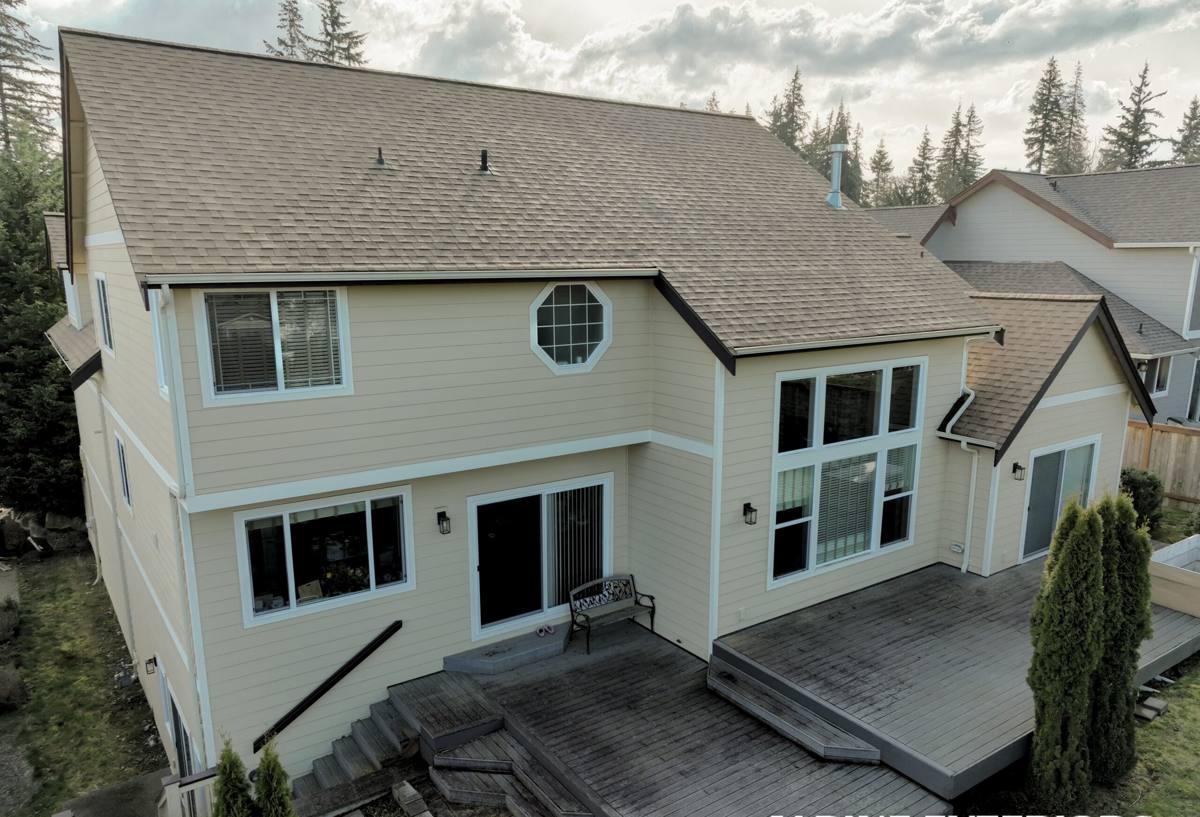
Why Fiber Cement Is the Right Category for This Site
Fiber cement is a mix of cement, sand, and cellulose fibers, pressed and cured into a rigid board. It doesn't absorb and swell with moisture the way wood does, it won't go brittle and crack under UV and cold the way some plastic-based sidings can, and it's non-combustible. On a lot that already deals with more wind and water than most, starting with a base material that's dimensionally stable and doesn't feed on moisture removes one of the biggest long-term risk factors before installation even begins.
Why We Only Install James Hardie
We install James Hardie fiber cement exclusively — not vinyl, not LP SmartSide, not Cemplank, not Allura, not primed spruce or cedar. That's a standard we hold across every job, and it matters even more on a site like Skyline. Hardie factory-applies its ColorPlus finish under controlled conditions with a baked-on process that resists fading and chipping far better than field-applied paint holds up over time, and the company engineers specific product formulations for wetter, harsher climate zones rather than selling one generic board everywhere. We've chosen to specialize in one system we trust rather than offer several products of varying quality, because on a lot exposed the way Skyline's is, the margin for a weak product or a shortcut installation is thin.
Choosing the Right Hardie Products for a Skyline Home
Not every Hardie product or profile is the right call for every home, and part of doing this right is matching the product to the house and the exposure. Most Skyline homes work well with HardiePlank lap siding in either a smooth or cedar-textured finish, which gives a traditional look while shedding water cleanly off each course. Homes with modern lines or accent walls sometimes call for HardiePanel vertical siding, and trim work around windows, doors, and corners uses HardieTrim boards milled to match the siding profile — important because wood trim is one of the first things to fail on an exposed lot, and swapping it for fiber cement removes that weak point.
Product Line Comparison
| Product | Typical Use | Why It Fits Skyline |
|---|---|---|
| HardiePlank Lap Siding | Primary wall siding, most home styles | Sheds wind-driven rain course by course; wide color and texture range |
| HardiePanel Vertical Siding | Accent walls, gables, modern designs | Fewer horizontal laps for water to work into on exposed elevations |
| HardieTrim Boards | Window/door surrounds, corners, fascia | Replaces failure-prone wood trim around the most water-exposed openings |
| HZ5 Climate-Engineered Formulation | Homes in wetter, more humid climate zones | Formulated for the moisture cycling a marine climate like ours produces |
What Correct Installation Involves on an Exposed Lot
Fiber cement siding is only as good as the assembly behind it, and that's especially true on a wall that takes direct wind-driven rain. A correct installation starts with checking and repairing the water-resistive barrier underneath, since siding is the outer layer of a system, not a standalone waterproofing product. Flashing at windows, doors, and any wall penetrations needs to be integrated properly with that barrier, lapped in the right order so water sheds outward at every layer. Fasteners need to be corrosion-resistant and driven at the manufacturer's specified pattern and depth — not just enough to hold the board, but placed correctly to allow the siding to perform as designed through wet and dry cycles. Clearance from grade, roof lines, and decks matters too; siding installed too close to the ground or to a horizontal surface stays wet longer and invites the kind of moisture damage that shows up years later as soft trim or stained sheathing.
What We Check Before, During, and After Installation
- Condition of the existing wall assembly and water-resistive barrier before any new siding goes up
- Correct flashing sequence at every window, door, and roof-to-wall intersection
- Manufacturer-specified fastener type, spacing, and penetration depth for coastal exposure
- Proper clearance between siding and grade, decks, roofing, and other horizontal surfaces
- Caulking only where Hardie's installation guidelines call for it, not as a substitute for proper flashing
- A final walk-through comparing the finished job against Hardie's published installation requirements
ColorPlus Finish and Picking a Color That Holds Up Here
Color choice on a Skyline home isn't purely aesthetic — it affects how the siding performs against the specific conditions on this lot. ColorPlus finish is factory-cured and bonded to the board before it ever reaches the site, which gives it far better resistance to salt air and UV fading than a coat of paint applied after installation. Darker colors on south- and west-facing walls will absorb more heat and show any dust or salt residue differently than lighter tones, while shaded, north-facing elevations that stay damp longer are the ones most prone to visible moss and algae growth over time regardless of color. We walk homeowners through how a given color is likely to weather on their specific elevations before they commit, rather than just handing over a swatch book.
Our Process for a Skyline Siding Project
We start with an on-site walk-around of the home, looking at existing siding condition, trim, flashing, and any signs of past moisture problems, paying particular attention to whichever elevations face the water and get the most wind-driven rain. From there we put together a written scope that specifies the Hardie product line, profile, and color, along with what's involved in prepping the existing wall — full tear-off, sheathing repair where needed, and water-resistive barrier work before a single new board goes up. Installation follows Hardie's published fastening and flashing specifications, and every job gets a final inspection against that standard before we call it complete. We don't rush a Skyline job to hit a schedule; the exposure here doesn't leave room for shortcuts that might get away with it on a more sheltered lot.
Cost Factors for a Skyline Fiber Cement Project
Every home is different, and we don't quote a price without seeing the house, but the factors that move a Skyline estimate up or down are fairly consistent.
| Factor | Why It Matters |
|---|---|
| Existing siding removal | Full tear-off and disposal adds labor versus siding over a prepped, sound wall |
| Sheathing or framing repair | Water damage found once old siding comes off has to be fixed before new siding goes on |
| Home size and wall complexity | More corners, dormers, and roof intersections mean more cutting, flashing, and trim work |
| Access and site conditions | Bluff lots, steep grades, and limited staging area affect equipment and scaffolding needs |
| Product line and profile | Panel, lap, and trim combinations vary in material cost and installation time |
| Number of stories | Taller walls require more scaffolding and safety setup, which adds labor time |
Living With Fiber Cement Siding Through a Long Moss Season
Correctly installed Hardie siding is low-maintenance compared to wood, but "low-maintenance" isn't "no-maintenance," especially on a shaded or damp elevation. A little seasonal attention keeps it looking right and catches small issues before they become expensive ones.
- Rinse siding annually, especially shaded north-facing walls where moss and algae are most likely to establish
- Keep gutters clear so overflow doesn't run down and stain siding or saturate the base course
- Trim back tree branches and shrubs that keep siding shaded and damp longer than the rest of the wall
- Check caulk joints around windows and trim yearly for cracking or separation
- Have any soft spots, staining, or bubbling in trim looked at promptly rather than waiting for the next season
Why It Matters That We Already Work Skyline
Skagit County's coastal exposure isn't uniform from one neighborhood to the next, and a crew that's worked Skyline specifically already knows which elevations on a bluff lot take the worst of a winter storm, where moss keeps coming back no matter what, and which flashing and clearance details are worth extra attention versus which ones are just code minimums. That's knowledge you build by doing the work here repeatedly, not by reading a spec sheet once. It also means fewer surprises around site access, staging materials on a sloped lot, or timing work around the wetter months — practical details that affect how smoothly a project actually goes.
If you're looking at re-siding a home in Skyline, or you've got a newer home going up and want it done right the first time, we're happy to take a look and give you a straight answer. Reach out for a free, no-pressure estimate — we'll walk the property with you and explain exactly what we'd recommend and why.