 Anacortes Exterior
 Why Fidalgo Island Siding Wears Differently
Fidalgo Island sits right where Skagit County meets the Salish Sea, and that location shapes everything about how siding ages here. Homes close to the water take on a steady dose of salt-laden air that settles into every seam, fastener, and coating on the exterior of a house. Add in the driving rain that comes sideways off the water during winter storms, plus a long, damp moss season that can stretch from fall through spring, and you have a climate that is genuinely harder on siding than most inland Washington neighborhoods. It's not dramatic weather — it's relentless, low-grade exposure that finds every weak point in a siding system over years, not days.
We work on Fidalgo Island regularly, and the failure patterns we see are consistent: caulk that's cracked and pulled away at trim joints, paint that's chalked and faded on the sun-and-wind-exposed sides of a house, soft spots low on walls where splash-back and moss have kept wood siding wet for months at a stretch, and streaking or dark staining anywhere moisture sits without a chance to fully dry. None of this is a mystery once you understand the environment. It's also exactly why the choice of siding material and the quality of the installation matter more here than they would in a drier, more sheltered part of the state.
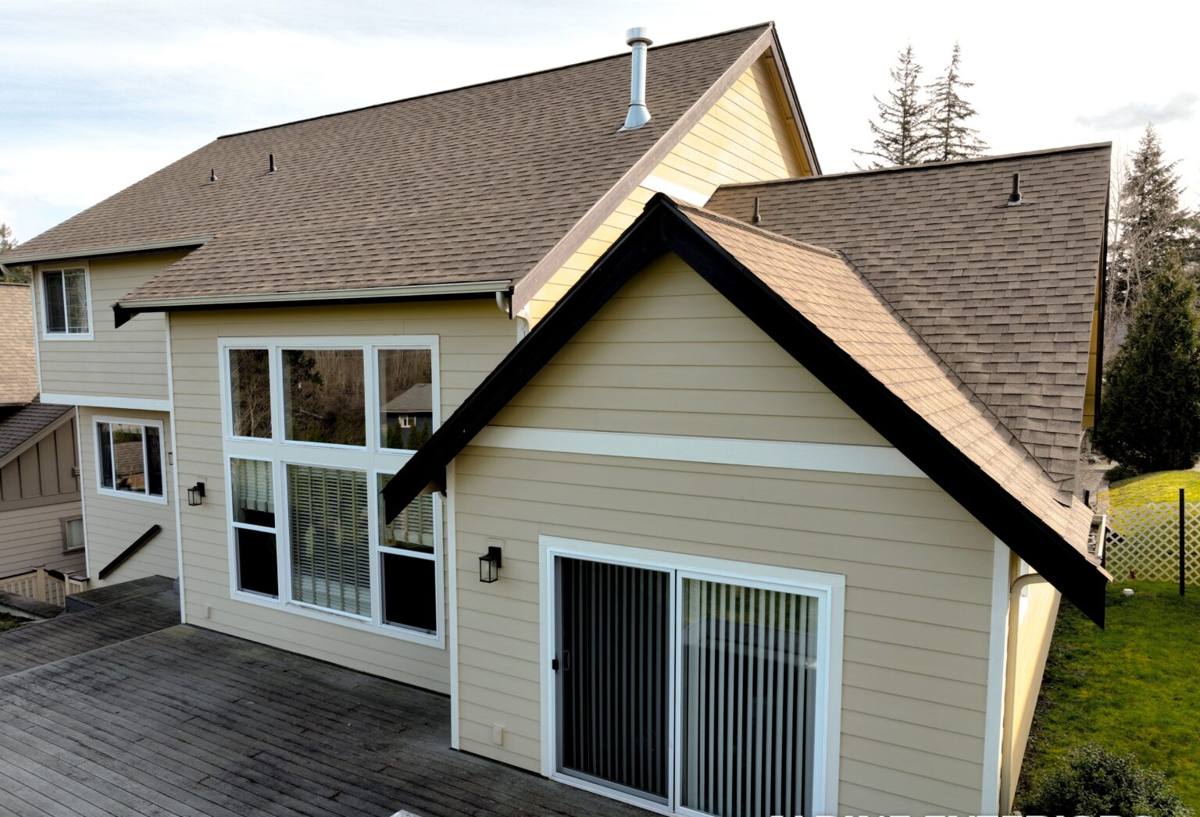
What Salt Air Actually Does to a House
Salt air isn't just "humid air." Airborne salt is corrosive to metal, and it accelerates the breakdown of many finishes and adhesives over time. On a home near the water, that means:
- Fasteners and flashing that aren't corrosion-resistant can degrade faster than they would inland, weakening the siding's attachment over time
- Painted or coated surfaces can chalk, fade, and lose their protective sheen sooner, exposing the substrate underneath to moisture
- Caulking and sealants at joints and penetrations break down faster under repeated salt-and-moisture cycling, opening small gaps that let water in
- Any siding material with a weak factory finish will show wear years before the same product would in a sheltered inland location
This is why the specification of a siding job on Fidalgo Island — the fastener type, the flashing details, the caulk quality, the finish system — deserves more scrutiny than it would on a similar home twenty miles inland.
Driving Rain and Wind-Driven Water
Storms off the water don't just drop rain straight down — they push it sideways into walls, under trim, and up under laps that were never designed to handle water moving in that direction. A siding installation with proper overlap, correctly lapped and sealed flashing, and tight-fitting trim details handles this without issue. A rushed or undersized installation lets that wind-driven water find its way behind the cladding, where it can sit against sheathing and framing for weeks at a time in our wet months. Once water gets behind siding on a home exposed to this kind of weather, drying it out before real damage occurs becomes a race against the calendar.
Moss Season and Moisture Retention
Anacortes gets a long stretch of cool, damp weather where surfaces that don't get direct sun or good airflow stay wet for extended periods. That's exactly the environment moss and algae need to take hold. On siding, this shows up most on north-facing walls, under eaves, and anywhere shaded by trees or neighboring structures. Moss itself isn't just cosmetic — it holds moisture directly against the siding surface, which is a problem for any material that isn't built to tolerate sustained dampness. The longer a wall stays wet, the more the siding, the fasteners, and the wall assembly behind it are put at risk.
What a Correct Siding Replacement Involves Here
Replacing siding on Fidalgo Island isn't just swapping old boards for new ones. Given the exposure this area gets, a proper job addresses the whole wall assembly, not just the visible surface.
Tear-Off and Inspection
Once the old siding is off, we inspect the sheathing and framing underneath for rot, soft spots, or existing water damage — problems that are common on older homes in this climate and that need to be addressed before anything new goes up. Covering over hidden damage just locks the problem in behind a new wall.
Weather-Resistive Barrier and Flashing
A correctly installed weather-resistive barrier, with flashing properly integrated at windows, doors, and every other penetration, is what actually keeps wind-driven rain out of the wall — the siding is the second line of defense, not the only one. This step gets rushed on cut-rate jobs and it's usually the reason a siding job fails early in a climate like ours.
Material Selection
This is where the biggest long-term decision gets made. Given the salt air, rain exposure, and moss season on Fidalgo Island, we install James Hardie fiber cement siding exclusively — we don't offer vinyl, LP SmartSide, primed wood, or cedar as alternatives. That's a deliberate standard, not a limitation of what we're capable of installing, and we explain why below.
Fastening and Sealant Details
Corrosion-resistant fasteners, correct nailing patterns, and quality sealant at trim and penetrations all matter more here than in a sheltered inland location. These are the details that determine whether a siding job holds up through fifteen winters of driving rain or starts showing problems in five.
Why We Install James Hardie Only — Not Vinyl, LP, or Wood
Homeowners on Fidalgo Island are often comparing several siding options, and it's a fair question why we've standardized on one product. Here's the honest breakdown:
| Material | What it gets right | Why it's a harder sell in this climate |
|---|---|---|
| Vinyl | Low upfront cost, low maintenance in mild climates | Can warp or become brittle with temperature swings and wind exposure; seams and edges give wind-driven rain a path in; not fire-rated |
| LP SmartSide (engineered wood) | Workable cost, decent impact resistance | Wood-based core is vulnerable if moisture gets behind it — a real risk given our rain and moss exposure; relies heavily on perfect caulking and paint maintenance |
| Primed spruce / cedar | Classic look, renewable material | Needs frequent repainting and sealant upkeep to survive salt air and sustained dampness; highest long-term maintenance burden of any option here |
| James Hardie fiber cement | Non-combustible, engineered for damp/coastal climates, factory-baked ColorPlus finish, strong transferable warranty | Higher material cost upfront; installation is less forgiving of shortcuts, so it has to be done right |
Every one of those other products has legitimate uses somewhere. But on a home taking regular salt air, wind-driven rain, and months of damp shaded moss growth, the trade-offs stack up against them. Fiber cement doesn't have a wood core to rot, doesn't warp or become brittle in temperature swings, and carries a factory-applied finish engineered to hold its color and integrity far longer than field-applied paint. We standardized on Hardie because we don't want to be back at a Fidalgo Island house in eight years explaining why the siding we installed didn't hold up to the weather it was always going to face.
James Hardie Product Lines for This Climate
Hardie makes climate-engineered product lines (their "HZ" designations), and for coastal Washington exposure we specify the products built for wetter, harsher climates rather than the version engineered for hot, dry regions. In practice that means:
- Lap siding sized and profiled to shed wind-driven rain effectively
- A factory ColorPlus finish that resists fading and chalking better than field-applied paint, which matters directly for salt-air exposure
- Trim and soffit components matched to the same finish system so the whole exterior weathers evenly
- A manufacturer warranty that's transferable to a future homeowner — a real factor if you ever sell the house
Our Process for Fidalgo Island Projects
- On-site assessment — we look at sun exposure, shading, drainage around the foundation, and any visible signs of moisture or moss issues specific to your lot
- Written estimate — a clear scope covering tear-off, any sheathing repair anticipated, materials, and installation, with no vague allowances
- Tear-off and inspection — old siding removed, wall assembly inspected before anything new is installed
- Weather barrier and flashing correction — the unglamorous work that actually keeps water out
- Hardie installation — installed to manufacturer spec, which is what keeps the warranty valid
- Final walkthrough — we go over the finished work with you before calling the job done
Why Hiring a Crew That Already Works This Area Matters
Fidalgo Island isn't a uniform environment — a house facing open water gets different exposure than one tucked back from the shoreline, and a north-facing wall under tree cover ages differently than a south-facing one in full sun. A crew that already works siding jobs across Anacortes and Skagit County has seen how these micro-climates actually play out on real houses, not just in theory. That translates into practical decisions on your project: where extra flashing attention is worth it, which walls are most likely to need moss-resistant detailing, and how to sequence the job around our wetter months so the wall assembly isn't left exposed longer than it needs to be.
It also means fewer surprises. A contractor unfamiliar with coastal Skagit County conditions may spec a job the way they would for a drier, more sheltered area — and that's how homeowners end up with premature caulk failure, staining, or moisture problems a few years after a "new" siding job.
Signs Fidalgo Island Homeowners Should Watch For
- Cracked or pulling caulk at trim joints and corners
- Persistent moss or algae staining that keeps returning after cleaning
- Soft or spongy siding, especially low on walls or near ground level
- Paint that's chalking, fading unevenly, or peeling on wind-exposed sides
- Visible gaps or warping at siding seams and butt joints
- Dark staining or discoloration around window and door trim
Any one of these on its own might just mean routine maintenance. Several at once, especially on an older home, usually means the siding system is reaching the point where replacement makes more sense than continued patching.
Get a Straightforward Look at Your Options
If you're seeing wear on your Fidalgo Island home's siding, or you're just planning ahead for a home in this climate, we're happy to take a look and give you an honest read on what's going on and what it would take to fix it right. Reach out for a free, no-pressure estimate — there's no obligation, just a clear picture of your options.