 Anacortes Exterior
 Sedro-Woolley's Climate Is Harder on Siding Than It Looks
Sedro-Woolley sits up the Skagit River valley, tucked between farmland and the foothills of the North Cascades, and that setting creates its own version of Pacific Northwest weather stress. The valley holds moisture longer than open coastline does. Morning fog off the river, heavy fall and winter rain, and humid summers that never quite dry the shade side of a house all add up to siding that stays damp more often than homeowners realize. On breezy days, marine air off Skagit Bay and the Salish Sea reaches up the valley too, adding a mild salt component to the mix of moisture the exterior of a home has to shed.
That combination is exactly what breaks down the wrong siding material. Wood siding and trim in shaded, tree-lined Sedro-Woolley yards grow moss and algae faster than in open, sunnier parts of Skagit County. Vinyl siding can hold condensation behind it in humid stretches, and its seams are a natural place for the freeze-thaw cycles of a cold valley winter to work joints loose over time. Engineered wood products absorb moisture at cut edges and swell if that edge isn't sealed and maintained on a strict schedule. None of this is theoretical — it's the pattern we see on siding tear-offs across this part of the county, house after house.
Why We Install Only James Hardie Fiber Cement
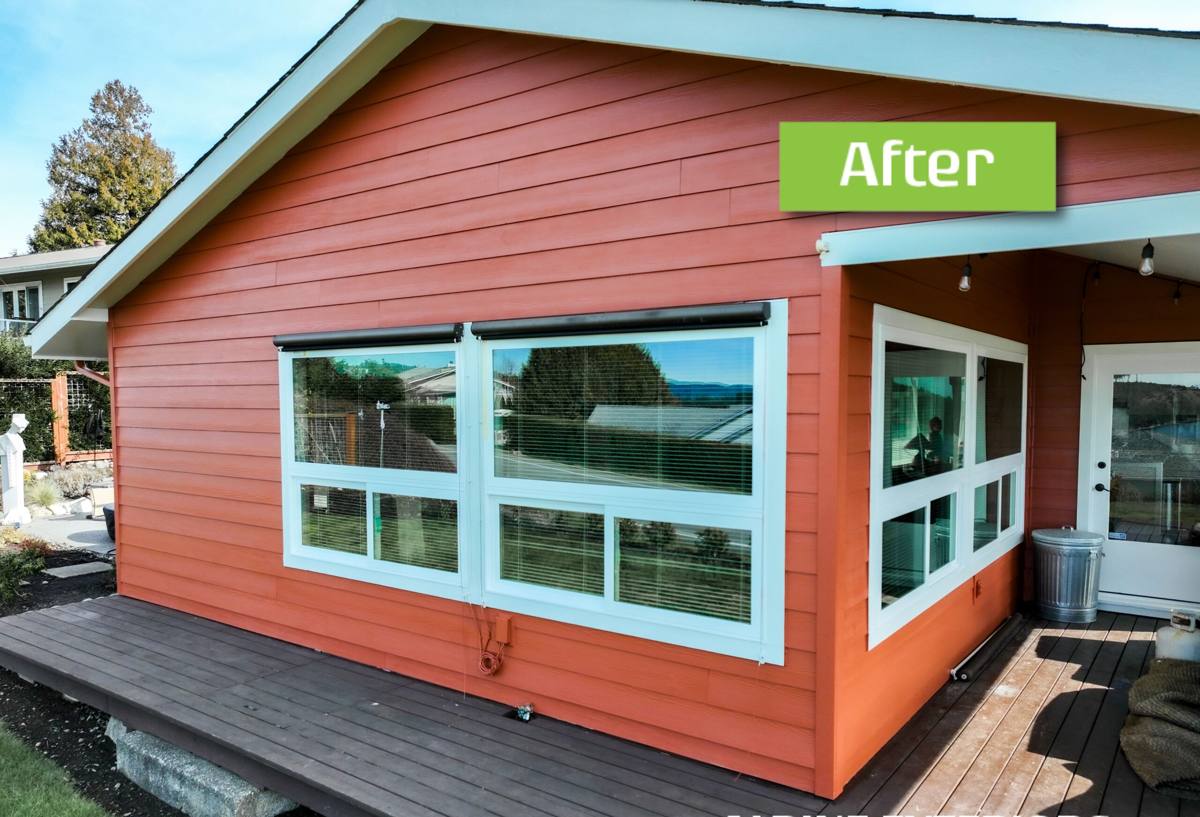
We made a decision a long time ago to install one siding system: James Hardie fiber cement. We don't offer vinyl, LP SmartSide, Cemplank, Allura, primed spruce, or cedar, and that's a deliberate standard, not a lack of options. Fiber cement is made from cement, sand, and cellulose fibers — it doesn't have the organic wood content that feeds moss and rot, and it isn't a plastic product that can warp or crack in a hard freeze. That matters directly in a place like Sedro-Woolley, where the exterior of a home is wet, damp, or humid for a large share of the year.
James Hardie also engineers regional product lines, and for western Washington that means HZ5 formulations built specifically for wetter, more humid climates. The factory-applied ColorPlus finish is baked on under controlled conditions rather than field-sprayed, which gives it far better resistance to fading and moisture intrusion at the surface than a job-site paint job. Hardie backs its siding with a long, transferable limited warranty when it's installed to their specification — which is also why correct installation isn't optional on our jobs. A great product installed wrong still fails.
What Hardie Doesn't Fix By Itself
We're upfront about this: fiber cement is not a "install it and forget it" material. It still needs proper flashing, correct fastening, and the right clearances to perform the way it's designed to. The product buys you a non-combustible, moss-resistant, rot-proof base — the installation is what determines whether that base actually stays dry behind the cladding for the next 30-plus years.
What a Correct Siding Installation Actually Involves
Siding is a weather-management system, not just a finish. On every Sedro-Woolley installation, the parts that matter most are the ones a homeowner won't see once the job is buttoned up:
- Weather-resistant barrier: a continuous, correctly lapped house wrap or building paper behind the siding, with no gaps at seams or penetrations.
- Flashing at every opening: windows, doors, and any wall penetration get flashed so water is directed out and down, never behind the barrier.
- Proper fastening: James Hardie specifies fastener type, spacing, and penetration depth — we follow their published fastening schedule, not a generic one.
- Correct clearances: siding held above grade, roof lines, decks, and patios per manufacturer minimums so splash-back and standing water don't sit against the bottom edge of the board.
- Caulking and sealant only where specified: Hardie's system relies on some joints being sealed and others left to drain — sealing the wrong joint traps water instead of shedding it.
Skip any one of these and the siding can look perfect for a year or two while moisture works its way in behind it — which is often how a bigger repair bill starts.
Signs a Sedro-Woolley Home Needs New Siding
Because of how much shade and moisture this area holds, siding failure here often shows up as a maintenance problem before it shows up as visible damage. Watch for:
- Moss or dark green-black staining that returns within weeks of being cleaned off
- Soft, spongy spots when you press on wood or engineered wood siding
- Paint that's bubbling, peeling, or needing repainting more than every 4-5 years
- Visible gaps, warping, or buckling at panel seams
- A musty smell along an exterior wall inside the house
- Rising heating bills that aren't explained by anything else
- Siding that's original to a home built more than 20-25 years ago
Any one of these is worth a look. Several together usually mean the siding system, not just the surface, is compromised.
How Siding Materials Actually Compare in This Climate
Homeowners in Sedro-Woolley are usually choosing between a few common options. Here's how they hold up given the local moisture and shade conditions specifically:
| Material | Moisture/Moss Resistance | Maintenance | Fire Resistance | Typical Lifespan |
|---|---|---|---|---|
| James Hardie fiber cement | Strong — non-organic, engineered for wet climates | Low — occasional wash, factory finish holds up | Non-combustible | 30-50+ years with proper install |
| Vinyl | Moderate — can trap moisture behind panels | Low, but seams and warping increase over time | Combustible, can melt/warp near heat | 20-30 years |
| LP SmartSide / engineered wood | Moderate — vulnerable at unsealed cut edges | Moderate — edge sealing and inspection needed | Combustible | 20-30 years with upkeep |
| Cedar / primed spruce | Weak in shaded, humid spots — feeds moss/rot | High — regular staining, sealing, moss treatment | Combustible | 15-25 years with heavy upkeep |
This is the exact comparison behind why we standardized on one product. It's not that the alternatives are worthless everywhere — it's that in a shaded, humid Skagit Valley setting, they ask a homeowner to do a lot more ongoing work to get a shorter service life.
Our Installation Process for Sedro-Woolley Homes
- On-site assessment: we look at existing siding, sheathing condition, moisture points, drainage, and shade exposure specific to the property.
- Tear-off and inspection: old siding comes off and we check the sheathing underneath for hidden rot or water damage before anything new goes on.
- Weather barrier and flashing: house wrap, window and door flashing, and drainage details are installed or corrected first — this is the step that determines long-term performance.
- James Hardie installation: panels, lap siding, or trim installed to manufacturer fastening and clearance specifications.
- Detail work: corners, trim, and joints finished so water sheds correctly and the ColorPlus finish is protected at cut edges.
- Final walkthrough: we go over the finished exterior with the homeowner before calling the job complete.
What Siding Installation Typically Costs
Every Sedro-Woolley home is different, and an honest number only comes from seeing the house, but the main cost drivers are consistent:
| Factor | Why It Matters |
|---|---|
| Home size and wall complexity | More corners, gables, and dormers mean more cutting, flashing, and labor time |
| Condition of the sheathing underneath | Hidden rot found during tear-off adds repair scope before new siding goes on |
| Siding profile chosen | Lap siding, shingle-style panels, and board-and-batten differ in material and install time |
| Trim and detail work | Window and door trim, corner boards, and fascia detail add labor beyond flat wall area |
| Access and site conditions | Steep lots, mature landscaping, or tight access around a home affect scaffolding and staging |
We'd rather walk a property and give a real number than quote a range that doesn't mean anything for your specific house.
Why Hiring a Crew That Already Works Sedro-Woolley Matters
Skagit County's building requirements, typical framing conditions, and weather exposure aren't identical to Seattle or Bellingham, and a crew that works this area regularly already knows what to check for. We know which sides of a house in this valley tend to hold shade and moisture the longest, where moss problems tend to start, and how local wind and rain patterns tend to drive water into a wall system if flashing isn't done right. That local pattern-recognition is what keeps a siding job from becoming a callback a year later — it's the difference between a crew guessing and a crew that's seen the same conditions on the last several Sedro-Woolley homes they worked on.
Caring for Hardie Siding After Installation
Fiber cement is low-maintenance, not no-maintenance. A simple annual routine keeps it performing for decades in this climate:
- Rinse siding gently once or twice a year to keep moss and algae from establishing, especially on shaded walls
- Keep gutters clean and downspouts directed away from the foundation and siding base
- Trim back landscaping so branches and shrubs aren't holding moisture against the wall
- Do a quick visual check after major storms for anything knocked loose around trim or flashing
- Address any caulking that cracks or separates at seams promptly rather than waiting
If you're weighing new siding for a Sedro-Woolley home, we're glad to come take a look and walk you through what your specific house needs — no pressure, no upsell, just a straight assessment and a real estimate.