 Anacortes Exterior
 Building Decks for Fidalgo Island's Marine Climate
Fidalgo Island sits right where the Salish Sea meets a wet, mossy Pacific Northwest winter, and that combination is harder on outdoor decking than most homeowners realize. Salt-laden air off the water accelerates corrosion on fasteners and hardware. Long stretches of driving rain push moisture into every seam, gap, and end cut. And the shaded, damp conditions that define a Skagit County winter create a moss and algae season that can run from late fall through spring. A deck built to a generic spec sheet, without accounting for any of that, tends to show its age fast — soft spots at the ledger, green film on the walking surface, streaking around fasteners, and boards that cup or gap unevenly.
We work on Anacortes homes, including plenty on Fidalgo Island itself, and we've adjusted how we spec and build composite decks specifically for this environment. This page covers what that actually means in practice: material selection, substructure details, drainage, hardware, and the maintenance rhythm that keeps a deck looking good through multiple wet seasons instead of just the first one.
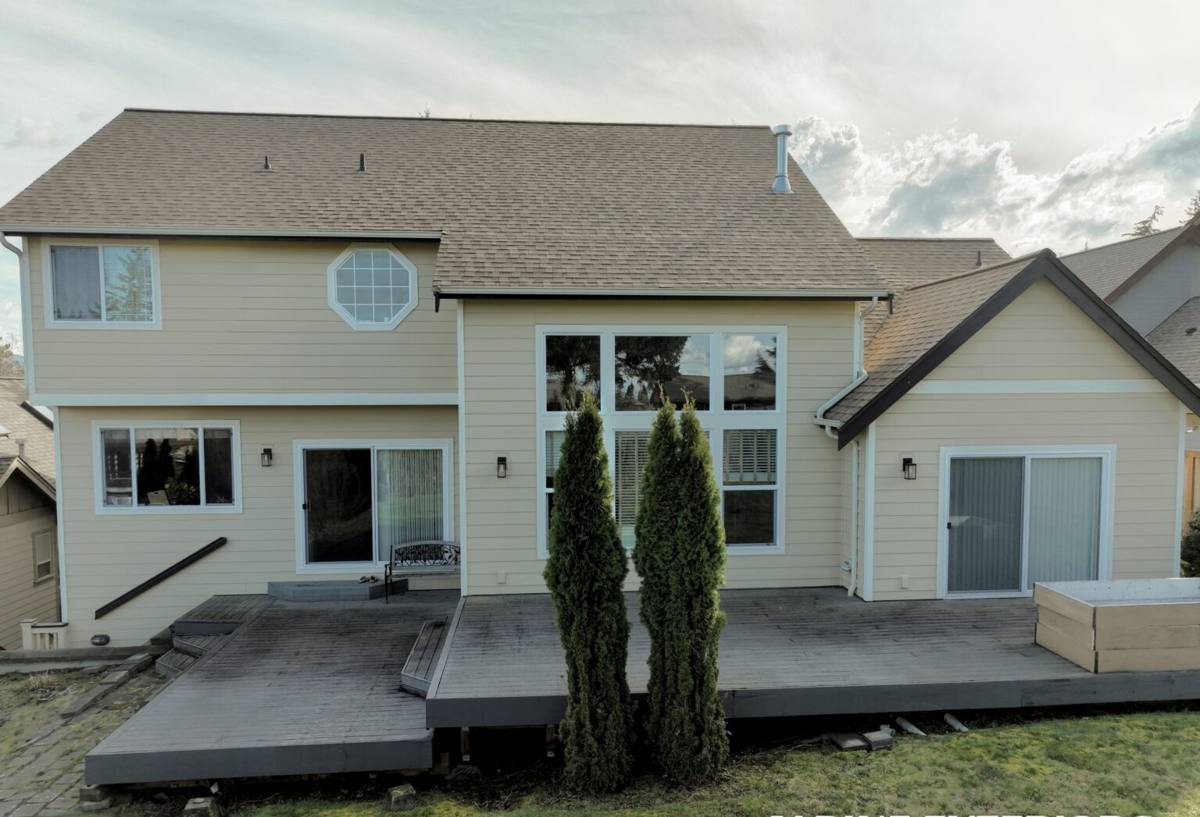
What a Correct Composite Deck Build Involves Here
Composite decking is popular on the island for good reason — it doesn't need annual staining, it resists rot at the board level, and modern capped boards hold up to moisture far better than early-generation composites did. But "composite" isn't one product, and installing it correctly in a marine climate takes more than following the manufacturer's minimum spec.
The Board Itself
Not all composite decking is built the same. Capped composite (a wood-plastic core with a protective polymer shell) resists moisture absorption and staining far better than uncapped composite, which can still take on water at cut ends and swell over time. In a climate with this much sustained rain and humidity, we treat capped boards as the standard, not an upgrade — and we seal or cap every exposed cut end during install, since that's the one place uncapped core is left vulnerable regardless of board type.
Color and Surface Considerations
Darker composite tones hide dirt and algae staining less forgivingly than lighter, variegated colors — a deep solid brown or black shows green and gray streaking sooner than a multi-tonal gray or driftwood blend. Darker boards also run hotter in direct sun, which matters less on a shaded, tree-covered lot but is worth factoring in on a south-facing deck with open water exposure. We talk through color with an eye on both moss visibility and sun exposure, not just what looks good in a sample chip.
Substructure, Drainage, and Ventilation — Where Decks Actually Fail
Most composite deck problems we get called out to fix aren't a problem with the boards. They're a problem with what's underneath them. In a climate that stays wet for months at a stretch, airflow and drainage under the deck matter as much as the decking material itself.
- Joist protection: Joist tape or a comparable flashing membrane over the top of every joist keeps standing water from wicking into the framing lumber, which is the single biggest cause of premature substructure failure we see.
- Ledger flashing: Where the deck ties into the house, proper flashing (not just caulk) is what keeps water from tracking behind the siding and into the rim joist — a slow leak here can go unnoticed for a year or more.
- Airflow underneath: Composite decking still needs ventilation below it to let moisture escape rather than pool. Low-clearance decks near grade need extra attention to grading and airflow paths so the space underneath isn't sitting damp all winter.
- Board gapping: Composite expands and contracts with temperature and moisture. Correct gapping — both between boards and at picture-frame edges — keeps water moving off the surface instead of trapping it at tight joints, which is exactly where algae gets a foothold first.
- Fastening system: Hidden fastener clip systems, installed per the manufacturer's spacing, allow the boards to move slightly as designed. Over-driven or face-screwed fasteners restrict that movement and are a common cause of buckling we see on older installs.
None of this is visible once the deck is finished, which is exactly why it's worth asking about before work starts rather than after a problem shows up.
Railings, Fasteners, and Hardware for Salt Air
Salt air is genuinely corrosive to standard hardware, and it doesn't take direct waterfront exposure to matter — homes anywhere on Fidalgo Island get some level of salt-laden moisture in the air year-round. Fasteners, brackets, and railing hardware rated for coastal or marine-grade use cost more up front than standard exterior-rated hardware, but they don't rust-stain the decking or weaken at connection points the way standard hardware can after a few wet seasons. We spec stainless or coated marine-grade hardware on structural connections as a default here, not an add-on.
Railing systems matter too. Composite and aluminum railing systems both hold up well; the key details are making sure post bases are properly flashed and that any wood blocking inside a composite or aluminum post sleeve is treated and won't trap water against untreated lumber.
Composite vs. Other Decking Materials: A Local Comparison
Homeowners often ask how composite stacks up against cedar or pressure-treated wood for an island property. Here's the honest trade-off breakdown based on what actually holds up in this climate:
| Material | Moisture & Moss Resistance | Maintenance | Typical Lifespan Here |
|---|---|---|---|
| Capped Composite | Strong — resists absorption, cut ends need sealing | Periodic wash-down, no staining/sealing | Long-term, backed by manufacturer warranty |
| Cedar | Moderate — natural rot resistance but surface grays and absorbs moisture over time | Regular cleaning, sealing/staining every 1–3 years | Shorter without consistent upkeep |
| Pressure-Treated Wood | Weaker in constant wet conditions — prone to splintering, checking, and moss growth | Regular cleaning, staining/sealing needed | Shortest of the three without diligent maintenance |
Composite costs more per square foot at install than pressure-treated lumber, and often more than cedar depending on the grade. What it saves is the recurring maintenance cost and labor — no annual sanding, staining, or sealing — which matters more in a climate where a deck spends half the year wet.
Our Process on Fidalgo Island Jobs
Every deck starts with a site walk, not a sales pitch. We look at drainage on the lot, sun and shade exposure (which drives both moss risk and board color choice), the condition of any existing ledger or foundation, and how the deck will actually be used — a hot tub deck, a grilling area, and a simple sitting deck all call for different substructure specs.
- On-site evaluation of grade, drainage, and existing structure (for replacement or reattached decks)
- Material and color selection walk-through, including hardware grade for the site's exposure
- Written estimate with a clear scope — substructure work, flashing, and hardware spelled out, not bundled into a vague line item
- Build, with joist protection, ledger flashing, and correct gapping done before a single board goes down
- Final walkthrough covering care and what to watch for in the first year
Maintenance in a Moss-Prone Environment
Composite decking doesn't need staining or sealing, but it isn't maintenance-free in a climate like this. A build-up of pollen, fir needles, and organic debris left sitting on the surface through a wet Skagit County winter is exactly what feeds moss and algae growth, even on a well-built deck. A simple annual routine keeps that from taking hold:
- Sweep or blow off debris regularly through fall, when needle and leaf drop is heaviest
- Rinse the surface periodically through winter rather than letting standing debris sit for months
- Wash with a soft-bristle brush and a mild composite-safe cleaner once or twice a year, focusing on shaded areas and board seams where algae shows up first
- Check gutters and downspouts near the deck so runoff isn't dumping directly onto the decking surface
- Confirm underneath ventilation hasn't been blocked by stored items, planters, or overgrown landscaping
Why Hiring a Crew That Already Works Fidalgo Island Matters
A lot of the details above — joist tape as standard practice, marine-grade hardware by default, gapping specs adjusted for a wetter climate, color guidance that accounts for algae visibility — aren't things every contractor thinks through, especially crews that mostly work drier inland areas. They matter here because the climate is genuinely different from what a lot of standard decking specs assume. A crew that regularly builds decks on Anacortes and Fidalgo Island properties has already seen which shortcuts cause callbacks two winters later, and builds around them from the start rather than fixing them after the fact.
If you're planning a new composite deck or replacing an aging one on Fidalgo Island, we're happy to walk the site, talk through material and hardware options honestly, and put together a straightforward estimate — no pressure, no upsell. Use the form below to get started.