 Anacortes Exterior
 Why Edison Roofs Take a Beating
Edison sits in a part of Skagit County where the weather doesn't do anything halfway. You've got open farmland funneling wind straight off the water, damp air rolling in from Samish and Padilla Bay, and a rainy season that doesn't just drizzle — it drives sideways into fascia, soffits, and anything with a seam. Add a moss season that can run eight or nine months out of the year in shaded, low-sun spots, and you've got a roofing environment that's genuinely tougher than what a lot of manufacturers design for on paper.
Asphalt shingles struggle here for a specific reason: they're a porous, granulated surface sitting in near-constant moisture, which is exactly what moss and algae need to take hold. Metal roofing handles that combination differently — but only when it's specified and installed correctly for this exact climate. A metal roof installed the way you'd install one in a dry inland county won't hold up the same way out here.
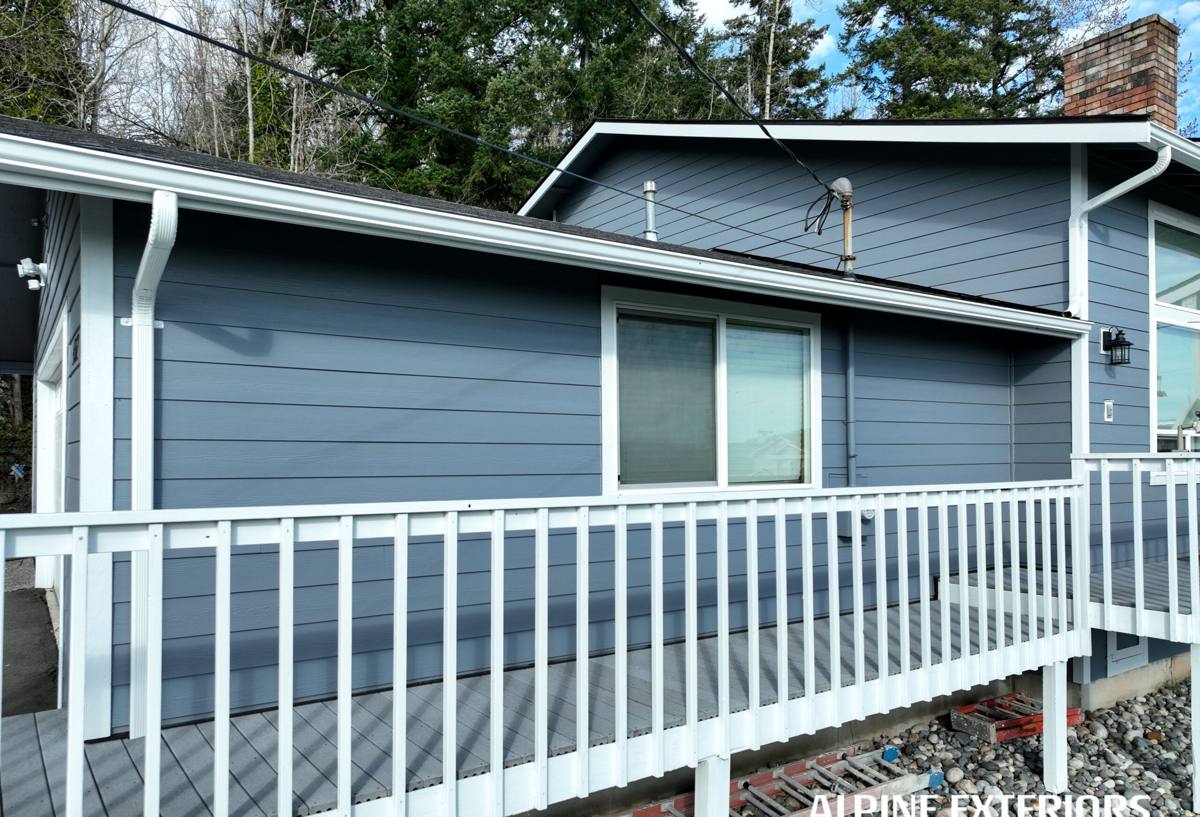
What a Correct Metal Roof Looks Like in Edison
"Metal roofing" isn't one product — it's a category, and the details matter more here than almost anywhere else in Skagit County because of the salt-tinged, moisture-heavy air near the bay.
Panel Types
Standing seam panels are the standard for homes in this area because the fastening system is concealed under the seam rather than exposed on the panel face. That matters when wind-driven rain is a regular event — exposed fasteners are the first thing to fail and the first place water finds its way in. Exposed-fastener panel systems (sometimes called corrugated or ag-panel style) are less expensive but require more frequent fastener inspection and gasket replacement over the life of the roof, which is a real maintenance commitment for a homeowner to weigh.
Fasteners and Coatings
In a coastal-influenced area, the metal itself and its coating matter as much as the profile. Galvalume steel with a quality paint finish is the common, cost-effective choice and performs well when properly coated and maintained. Aluminum resists corrosion inherently and is worth discussing for homes closer to open water or with direct salt air exposure, since it doesn't rely on a coating to prevent rust the way steel does. Whatever the base metal, we don't cut corners on fasteners — stainless or coated fasteners rated for coastal exposure cost more upfront but they're the difference between a roof that's still tight in fifteen years and one that's leaking at every screw hole.
Moss, Algae, and Coastal Growth
Metal's smooth, non-porous surface gives moss and algae far less to grab onto compared to shingles, and that's the single biggest reason it performs so well in Skagit County's long wet season. But "moss-resistant" doesn't mean "moss-proof." Debris still collects in valleys, at panel-to-wall transitions, and around penetrations like vents and chimneys — and once organic material sits there long enough, moss will grow on top of the debris even if it can't grip the metal itself. Proper panel spacing, clean valley design, and keeping overhanging branches trimmed back all reduce how much debris a roof collects in the first place, which is more effective long-term than any treatment applied after the fact.
Installation Details That Actually Matter Here
A metal roof is only as good as what's underneath it and how the edges are finished. This is where a lot of problems start on jobs that weren't built for this climate.
- High-quality synthetic or self-adhered underlayment at eaves, valleys, and any low-slope transitions, since driving rain can push water uphill under a panel edge in a way vertical rain never would
- Closed-cell foam closures or properly detailed panel ends so wind-driven rain and blowing debris can't work their way up under the panel
- Ridge and gable flashing sized and lapped for sustained wind exposure, not just the manufacturer's minimum spec
- Balanced attic or roof-deck ventilation so warm, moist interior air doesn't condense on the underside of cold metal panels during our long damp stretches
- Valley and penetration flashing detailed to shed debris rather than collect it
None of this is exotic. It's standard trade practice applied with the local weather actually in mind, rather than installed the same way a crew would do it in a dry climate 200 miles inland.
Metal Roofing vs. Asphalt for Edison Homes
Both are legitimate roofing materials — the right call depends on your home, your budget, and how long you plan to own it. Here's how they compare against the specific conditions Edison deals with.
| Factor | Metal Roofing | Asphalt Shingles |
|---|---|---|
| Moss and algae resistance | Smooth surface resists growth; debris still needs clearing | Porous granule surface is prone to moss in shaded, damp areas |
| Wind-driven rain performance | Excellent with correct flashing and closures | Vulnerable at edges and laps if not well maintained |
| Typical lifespan | 40-60+ years depending on material and coating | 20-30 years in this climate |
| Upfront cost | Higher | Lower |
| Maintenance | Periodic fastener and sealant checks, debris clearing | Regular moss treatment, more frequent granule loss over time |
| Salt air durability | Strong with the right base metal and coating | Not typically a limiting factor |
What Drives Cost on a Metal Roof
Every roof is different, but the same handful of factors move the price up or down on nearly every job we quote in this area.
| Cost Factor | Why It Matters |
|---|---|
| Panel material (steel vs. aluminum) | Aluminum costs more but resists corrosion without relying on coating integrity |
| Roof complexity | More valleys, dormers, and penetrations mean more custom flashing labor |
| Tear-off vs. re-cover | Removing old roofing and inspecting the deck adds cost but avoids hiding problems |
| Panel profile and finish | Standing seam with premium coatings costs more than basic exposed-fastener panel |
| Access and pitch | Steeper or harder-to-access roofs take longer and require more safety setup |
We'll walk through which of these apply to your specific roof before any number gets put on paper, so you know what you're paying for and why.
How We Handle a Metal Roofing Project in Edison
Our process is straightforward because the goal is a roof that performs, not a fast sale.
- On-site inspection — we look at your current roof, deck condition, ventilation, and how your home is exposed to wind and rain given its orientation and surroundings
- Material and system recommendation — we walk you through panel and metal options honestly, including trade-offs, rather than steering you to whatever's easiest to install
- Written estimate — clear scope, materials, and cost factors specific to your roof, no vague allowances
- Tear-off and deck check when needed — we don't install a new roof over problems we can't see
- Installation with underlayment, flashing, and ventilation detailed for coastal Skagit County conditions, not a generic spec sheet
- Final walkthrough — we go over the finished roof and what maintenance, if any, it'll need going forward
Keeping a Metal Roof Performing Long-Term
Metal roofing needs far less upkeep than shingles, but "low maintenance" isn't "no maintenance." A short annual checklist keeps a well-installed metal roof performing for decades:
- Clear valleys, gutters, and low-slope transitions of leaves and debris, especially heading into fall
- Check that fastener heads (on exposed-fastener systems) are tight and gaskets aren't cracking
- Look at flashing around chimneys, vents, and skylights for any lifting or sealant breakdown
- Trim back tree limbs that overhang the roof to reduce debris buildup and moss-friendly shade
- Watch for any staining or streaking that could indicate a coating issue rather than just surface dirt
Why It Matters to Hire a Crew That Already Works Edison
A lot of roofing problems we get called out to fix weren't caused by bad materials — they were caused by a roof detailed for the wrong climate. Crews unfamiliar with what this stretch of Skagit County actually throws at a roof tend to underbuild flashing, skip closures at panel ends, or ignore ventilation because those shortcuts don't show up as failures for a year or two. Out here, with the moisture load and wind exposure this area sees, they show up fast. Working in Edison and the surrounding Anacortes area regularly means we're not guessing at how a roof needs to be detailed — we're building to what we've already seen hold up, and what we've seen fail.
If you're weighing a metal roof for your Edison home, we're happy to take a look and talk through what makes sense for your specific roof, your budget, and how long you plan to stay in the house. Reach out for a free, no-pressure estimate using the form below.