 Anacortes Exterior
 Deck Replacement Built for Old Town Anacortes Conditions
Old Town Anacortes sits close enough to the water that its homes deal with a different set of stresses than a deck twenty miles inland. Salt-laden air off Fidalgo Bay and Guemes Channel accelerates corrosion on fasteners and hardware. Driving rain off the water finds every gap in old flashing. And the long, damp Pacific Northwest shoulder seasons mean moss and algae get a real head start on any deck surface that doesn't shed water well. If your deck is original to an older Old Town home, there's a good chance it was built before anyone was thinking about these specific problems.
Deck replacement here isn't just about swapping tired boards for new ones. It's about correcting the parts of the original build that never accounted for this exposure, so the next deck actually holds up instead of repeating the same failure in another ten or fifteen years.
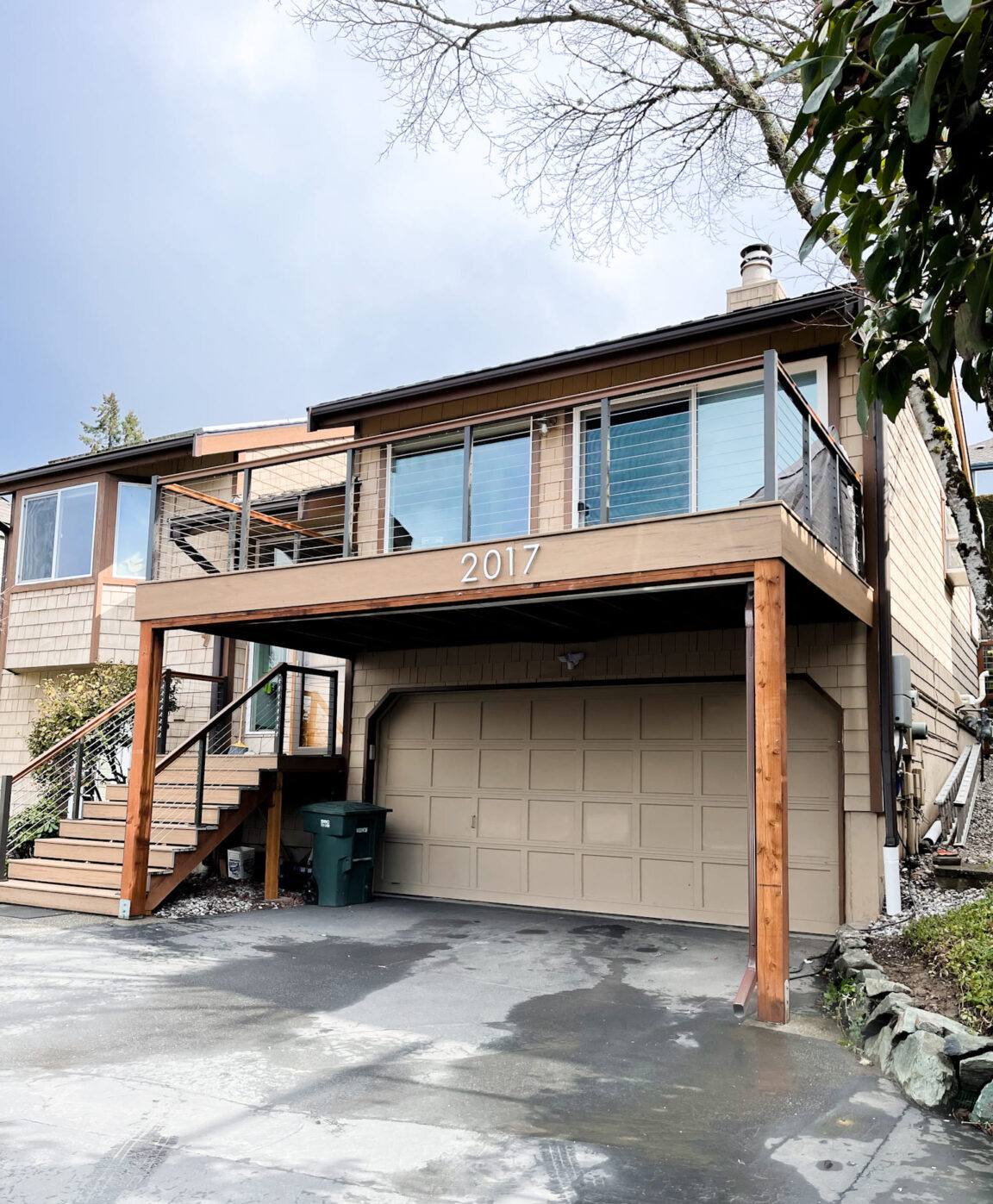
What Old Town's Older Housing Stock Means for Your Deck
A lot of homes in this part of Anacortes are older builds, some with additions and deck work done in different decades by different hands. That history matters when we're replacing a deck:
- Ledger boards attached to older framing may not meet current structural or flashing standards, even if the deck "looks" fine.
- Older decks were often built without proper drainage planes behind ledgers, letting moisture track into the house rim joist over years.
- Post footings on older properties may be undersized, shallow, or shifted from decades of freeze-thaw and saturated soil.
- Mixed repair histories mean hardware, fastener types, and wood species are often inconsistent from one section of the deck to the next.
None of this means the house was built wrong — deck-building standards have simply changed, and marine-exposed neighborhoods like Old Town expose those older assumptions faster than a dry inland lot would.
What a Correct Deck Replacement Involves
Structure First
Before any decking material goes down, we look at what's holding the deck up: footings, posts, beams, joists, and — critically — the ledger connection to the house. In a salt-air, high-rainfall setting, this is where a deck actually fails, even if the surface boards still look serviceable. We check footing depth and condition, joist spacing and span for the decking you're choosing, and whether the ledger has proper flashing that directs water away from the house rather than behind it.
Flashing and Water Management
This is the step that gets skipped most often on budget deck jobs, and it's the one that matters most this close to the water. Correct ledger flashing, proper joist tape on top of framing, and flashing at any point the deck meets a wall or roofline keep water moving off the structure instead of soaking into it. Skagit County's rain doesn't fall lightly and briefly — it settles in for days, and a deck built without real water management will show rot at the ledger and joist ends well before the decking itself wears out.
Hardware and Fasteners
Salt air corrodes standard hardware faster than most homeowners expect. We use fasteners and structural connectors rated for coastal or treated-lumber exposure, not general-purpose hardware that's fine sixty miles from saltwater but marginal here. This is a small cost difference at build time and a large difference in how the deck looks and performs by year eight or ten.
Decking Material
Composite, PVC, and quality pressure-treated or cedar all have a place, and the right choice depends on your budget, how much shade the deck sits in, and how much upkeep you want to do. What matters more than brand is how the material handles constant moisture cycling and moss growth, since that's the real test in this location.
Comparing Decking Materials for a Marine Climate
| Material | Moisture & Moss Behavior | Maintenance | Typical Lifespan |
|---|---|---|---|
| Pressure-treated lumber | Sheds water reasonably well if sealed regularly; moss grip increases if surface isn't cleaned | Annual cleaning, periodic sealing/staining | 15–20 years with upkeep |
| Cedar | Natural moisture resistance but needs consistent sealing near saltwater exposure | Sealing every 1–2 years, moss removal | 15–20 years with upkeep |
| Composite decking | Doesn't absorb moisture like wood; still needs surface cleaning to prevent moss film | Occasional washing, no sealing | 25–30 years |
| PVC decking | Fully moisture resistant, least hospitable surface for moss buildup | Occasional washing | 25–30+ years |
We'll walk through these trade-offs honestly during your estimate — the "best" material is the one that fits your maintenance appetite and budget, not necessarily the most expensive option on the list.
Moss and Surface Drainage: The Ongoing Battle
Even a well-built deck in Old Town Anacortes needs to be designed to shed water and dry out between rain events, because moss doesn't just sit on top of decking — it holds moisture against the board surface and accelerates whatever wear process is already happening underneath. A few things we factor into every replacement:
- Proper board spacing so water and debris don't pool between boards
- Slight slope away from the house so surface water actually runs off
- Gap clearance under the deck for airflow, which slows moss and mildew growth
- Surface texture choices that don't trap standing moisture the way some smooth, low-cost boards do
None of this eliminates moss entirely — nothing does in this climate — but it's the difference between a deck you hose off twice a year and one that stays slick and green no matter how often you clean it.
Our Process for a Deck Replacement Project
- On-site assessment — we inspect the existing structure, ledger connection, footings, and surface material to understand what's failing and why.
- Honest scope discussion — we tell you what's structural (non-negotiable) versus cosmetic (your choice), so you're not paying to fix things that don't need fixing.
- Material selection — we go through decking options against your budget and how much maintenance you actually want to do.
- Demolition and structural correction — old decking, and any framing or footings that don't meet current standards, come out and get replaced properly.
- Flashing and water management — ledger flashing, joist protection, and drainage detailing go in before a single deck board is installed.
- Decking installation — boards, railings, and stairs go in to code, with attention to spacing and slope for long-term drainage.
- Final walkthrough — we go over the finished deck with you, including what maintenance (if any) it needs going forward.
Signs Your Old Town Deck Needs Replacing, Not Repairing
Not every aging deck needs a full replacement — sometimes targeted repair is the right call. But a few signs usually point toward replacement rather than patching:
- Soft or spongy spots in decking, especially near the house or stair landings
- Visible rot or staining at the ledger board where the deck meets the house
- Rusted, corroded, or loose fasteners and connector hardware throughout
- Posts or footings that shift, wobble, or show cracking
- Persistent moss or algae that returns within weeks of cleaning, suggesting the surface no longer drains properly
- Multiple past repairs that never fully resolved the underlying issue
If you're seeing one or two of these, a repair might buy you time. If you're seeing several at once, that's usually the structure telling you it's past patching.
Why Hire a Crew That Already Works in Old Town Anacortes
A contractor who works this neighborhood regularly already knows what Skagit County inspectors look for on ledger flashing and footing depth, what the older housing stock in this area tends to hide, and how aggressively moss and salt exposure act on an unprotected deck here compared to a drier, inland job. That's not something you get from a crew that mostly builds decks elsewhere and treats coastal exposure as an afterthought. It shows up in the flashing details, the hardware choices, and the follow-up conversations about maintenance — the parts of the job that don't get noticed until they've failed.
We also know that in a neighborhood with a lot of older homes, no two decks have quite the same history. We don't apply a one-size-fits-all spec — we look at your specific structure and build a plan around what it actually needs.
Get a Free, No-Pressure Estimate
If your deck is showing its age — soft spots, stubborn moss, corroded hardware, or a ledger you're not sure about — we're happy to take a look and give you a straight assessment. There's no obligation and no pressure, just an honest read on what your deck needs and what it would take to do it right. Use the form below to request your free estimate.