 Anacortes Exterior
 Building a Deck That Actually Holds Up in West Anacortes
West Anacortes sits close enough to the water that salt-laden air is a daily fact of life, not an occasional nuisance. Add in the long stretches of driving rain that come through Skagit County most of the year, plus the shade and dampness that lets moss and algae take hold on north-facing and tree-covered lots, and you have a climate that is genuinely hard on outdoor decking. A deck built for a drier, sunnier region simply won't perform the same way here. Composite decking, installed correctly for this environment, is one of the more reliable answers we've found for homeowners in this neighborhood who want a deck that still looks and functions well years down the road without constant upkeep.
This page focuses specifically on composite decking for West Anacortes properties — what the local conditions actually do to a deck, what a correctly built one involves, and how we approach the work here.
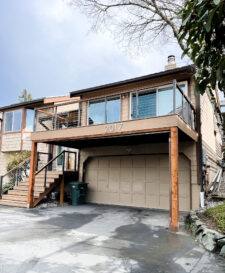
What Salt Air, Rain, and Moss Actually Do to a Deck
It helps to understand the specific ways this climate attacks a deck, because it changes what "correct installation" means.
Salt Air
Airborne salt accelerates corrosion on any exposed metal fasteners, brackets, and hardware. Over time, corroding fasteners can loosen, stain the decking around them, and weaken structural connections. It also settles into porous surfaces, which is part of why fastener and hardware selection matters more here than it would further inland.
Driving Rain
Wind-driven rain doesn't just fall straight down — it gets pushed sideways into ledger connections, under poorly flashed rim joists, and into any gap where water can collect instead of shed. Standing water against wood framing, even framing under composite boards, is what leads to rot in the structure a deck is built on.
Moss and Algae
Shaded, damp surfaces in this region grow moss and algae readily, especially on decks that don't get much direct sun or airflow underneath. Moss holds moisture against the board surface, and on the wrong product or the wrong substructure, that trapped moisture becomes a long-term problem rather than a cosmetic one.
None of this means decking is a bad investment in West Anacortes — it means the build has to account for these three things specifically, from the framing up.
Why Composite Decking Fits This Climate
Composite decking (a blend of wood fiber and plastic, typically capped with a protective polymer shell) resists moisture absorption, rot, and insect damage far better than solid wood. It won't need annual staining or sealing, and a quality capped composite board sheds algae and moss growth more easily than natural wood, which stays porous and grippy for organic growth no matter how well it's maintained.
That said, composite isn't maintenance-free, and it isn't immune to poor installation. A composite deck built without proper ventilation underneath, correct fastener spacing, or adequate drainage will still trap moisture, stain, and develop problems — just more slowly than wood would. The material helps; it doesn't replace a correct build.
Composite vs. Other Decking Materials
| Material | Moisture/Salt Air Resistance | Maintenance | Typical Lifespan Here |
|---|---|---|---|
| Pressure-treated wood | Moderate — absorbs moisture, needs sealing | Annual staining/sealing, regular moss removal | 10–15 years with upkeep |
| Cedar | Good natural resistance but still porous | Regular sealing, prone to graying and moss | 15–20 years with diligent care |
| Capped composite | Strong — resists rot, salt corrosion of the board itself, and moisture absorption | Periodic washing, no staining/sealing | 25–30+ years (manufacturer-backed) |
| PVC decking | Very strong, fully synthetic | Low, similar to composite | 25–30+ years, different look/feel and cost |
We install composite for most West Anacortes homeowners because it gives the best balance of moisture and salt-air performance, appearance, and cost. PVC is a reasonable alternative worth discussing for high-exposure sites; we'll walk through the trade-offs honestly rather than push whichever product happens to be in stock.
What a Correct Composite Deck Build Involves Here
The decking boards themselves get most of the attention, but in this climate, what's underneath them determines whether the deck lasts.
Substructure and Framing
We use fasteners and structural hardware rated for coastal or high-moisture exposure — this matters more in West Anacortes than in drier parts of the county, given the salt air off the water. Joists and framing get properly flashed and, where wood framing is used under composite boards, protected with joist tape or an equivalent moisture barrier so rain doesn't sit against bare lumber.
Ventilation and Drainage
Composite boards need airflow underneath to dry out after rain and to discourage moss and algae from taking hold on the underside and in board gaps. We build in proper joist spacing, and on ground-level or low-clearance decks, we pay close attention to grading and drainage so water moves away from the structure instead of pooling under it.
Fastening and Board Gapping
Composite boards expand and contract with temperature more than people expect. Correct gapping between boards prevents buckling and also gives water somewhere to go instead of sitting on the surface — which reduces the moss and algae film that forms on standing water over time.
Railings and Hardware
Any exposed metal — railing brackets, post connectors, screws — gets specified for corrosion resistance. This is a small line item that makes a real difference in a salt-air environment over a 10- or 20-year timeframe.
Our Process for West Anacortes Projects
- Site assessment — we look at sun exposure, tree cover, prevailing wind and rain direction, and existing drainage on your specific lot, since these vary block to block in this neighborhood.
- Material and layout discussion — we talk through composite brand and color options, railing style, and layout based on how you actually use the space.
- Permitting — decks typically require a permit through the City of Anacortes; we handle that process as part of the job.
- Demo or prep — removal of an existing deck if applicable, and inspection of ledger board and framing connections to the house.
- Build — framing with moisture protection, proper ventilation gaps, correct fastener selection, then composite board and railing installation.
- Final walkthrough — we go over care and cleaning specific to your deck's sun exposure and shade pattern.
Living with a Composite Deck in a Moss-Prone Climate
Composite decking cuts down maintenance dramatically compared to wood, but "low maintenance" isn't "no maintenance" — especially on shaded lots common in this area.
- Sweep debris (leaves, needles, tree litter) off the deck regularly — trapped organic material is what feeds moss and algae growth
- Rinse the deck surface periodically with water, and use a soft-bristle brush with mild soap on any areas developing a green or black film
- Keep gutters and downspouts near the deck clear so runoff isn't dumping extra water onto the surface
- Trim back overhanging branches where possible to increase sun exposure and airflow on shaded sections
- Check railing hardware and fasteners periodically for early signs of corrosion, particularly on decks with more direct water exposure
- Avoid pressure-washing at close range or high pressure, which can damage the board's protective cap over time
What Affects the Cost
| Factor | Why It Matters |
|---|---|
| Deck size and shape | More square footage and complex layouts (angles, multiple levels) mean more material and labor |
| Composite tier | Entry-level capped composite vs. premium lines vary in price, color retention, and warranty length |
| Substructure condition | Existing rot, undersized framing, or drainage issues found during demo add scope |
| Railing style | Composite, aluminum, cable, or glass railing systems price very differently |
| Site access and elevation | Sloped lots, limited access, or higher elevation decks require more structural work |
We don't quote broad numbers here because every West Anacortes lot is different — a flat, easy-access backyard and a sloped, shaded one with drainage issues are not the same project. We'll give you a real, specific number after seeing the site.
Why Hire a Crew That Already Works This Neighborhood
A contractor who works regularly in West Anacortes already knows which fastener specs hold up against the local salt air, how much ventilation a shaded lot actually needs, and where drainage tends to be a problem on this terrain. That's the difference between a deck that needs attention again in five years and one that's still performing well in twenty. We also know the City of Anacortes permitting process for decks, which keeps the project moving instead of stalling on paperwork. We build to hold up against what this specific climate does to a deck, not to a generic set of instructions.
If you're considering a new composite deck or replacing an aging one in West Anacortes, we're happy to walk the site with you and give you a straightforward, no-pressure estimate — just fill out the form below.