 Anacortes Exterior
 Conway's Climate Is Rougher on Siding Than It Looks
Conway sits low in the Skagit River delta, close enough to the Salish Sea that salt-laden air rides inland on the wind almost year-round. Add Skagit County's long wet season, low winter sun angles that leave north and west walls damp for weeks at a stretch, and the moss and algae bloom that follows, and you have a siding environment that punishes anything less than a fully engineered product installed correctly the first time. Homes here don't fail because owners neglect them. They fail because the siding, the flashing details, or the installation weren't built for this specific mix of salt, moisture, and shade.
We work Conway and the surrounding Anacortes area regularly, which means we're not guessing at what this climate does to a wall assembly — we're seeing it on job after job. That local pattern recognition is a big part of why the work holds up.
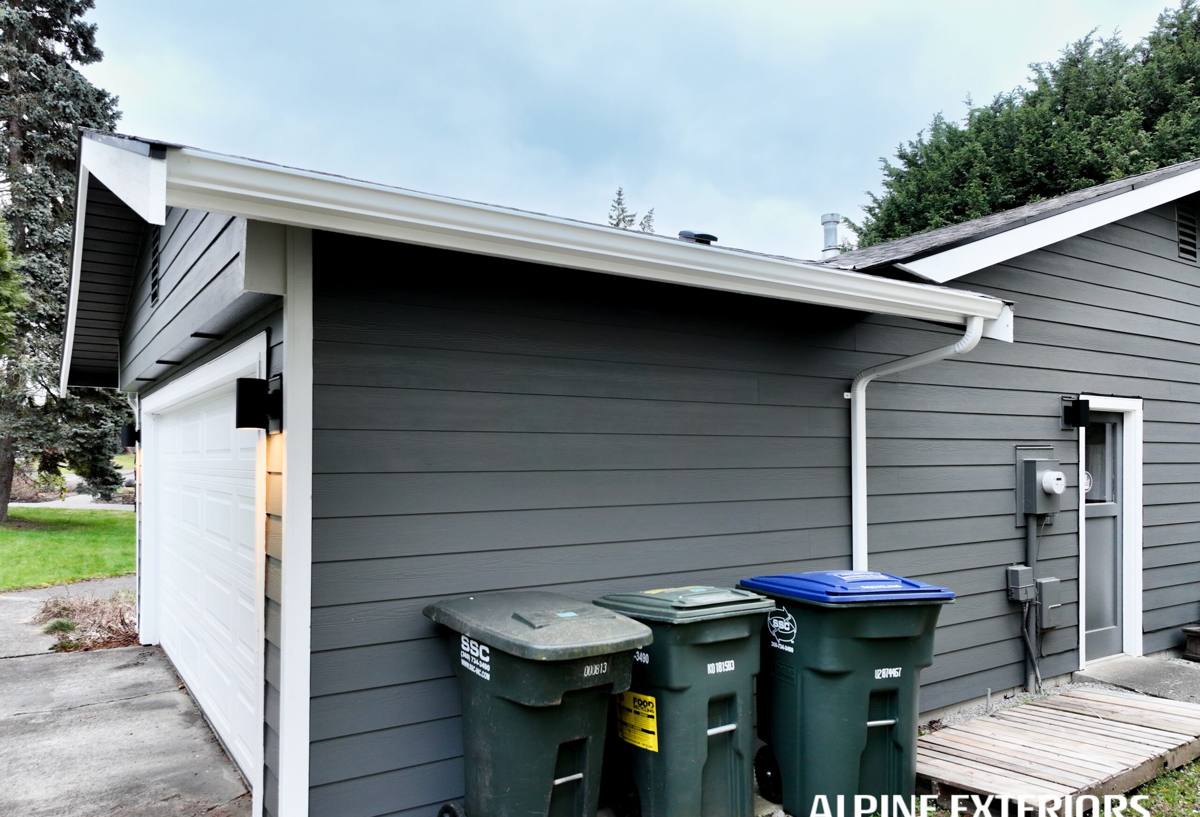
What Fiber Cement Siding Has to Do Right Here
Fiber cement is cement, sand, and cellulose fiber pressed and cured into a plank. Done right, it doesn't rot, it doesn't feed insects, and it doesn't warp the way wood-based products can when they take on repeated moisture. But "fiber cement" isn't one product — the composition, the factory finish, and the installation details all vary, and in a delta climate like Conway's, those differences show up fast.
Three things a Conway installation has to handle
- Moisture cycling — planks need proper gapping, back-priming at cuts, and flashing that actually sheds water away from the wall, not just siding that looks tight when it's new
- Salt exposure — fasteners, flashing metal, and caulk all need to be rated for a coastal-adjacent environment, or they corrode and fail years before the siding itself would
- Shaded, damp wall sections — north-facing and tree-shaded walls stay wet longer, which is where moss and mildew take hold first if the finish and installation aren't built to resist it
Why We Only Install James Hardie
We made a decision to install one fiber cement system — James Hardie — rather than mixing in other brands or cheaper alternatives, and we stand behind that on every Conway job. It's not that other products can't be installed; it's that we won't put our name on a job we don't fully trust to hold up in this climate.
Hardie's HZ5 product line is engineered specifically for climates with heavy moisture exposure, which describes Conway well. The ColorPlus factory finish is baked on under controlled conditions rather than field-applied, which matters a lot in a place where paint has to fight salt air and prolonged dampness instead of just sun fade. And Hardie backs the product with a long, transferable warranty — worth something to a future buyer if the home ever sells.
We also turned down other options for practical reasons. Vinyl siding can warp and gap over time as it expands and contracts, leaving seams where moisture works its way behind the panel. Primed wood and cedar look great initially but need consistent repainting and sealing to survive this much rain and shade — maintenance that's easy to fall behind on. LP SmartSide and other engineered-wood products use a wood-strand core that, if the factory coating is ever compromised at a cut edge or fastener hole, can take on moisture in a way fiber cement simply can't. None of these are bad products in the right setting. We just don't think they're the right call for a delta-climate home in Skagit County, and we'd rather install one system exceptionally well than install several adequately.
What a Correct Installation Actually Involves
The siding material is maybe half the story. The other half — the part homeowners can't always see once the job is finished — is installation detail. This is where most premature siding failures actually start, on any brand.
What we check and build into every job
- House wrap or weather-resistive barrier inspected and repaired before a single plank goes up
- Proper drainage gap behind the siding so any moisture that gets past the surface can dry out instead of sitting against the sheathing
- Flashing at every window, door, and roofline intersection, lapped correctly so water is directed out and down, not into the wall
- Corrosion-resistant fasteners and trim hardware suited to a coastal-adjacent environment
- Manufacturer-specified nailing pattern and plank gapping, not a rushed "close enough" install
- Cut edges back-primed or sealed before installation, since a raw cut edge is the fastest way for a fiber cement plank to take on moisture
- Caulk and sealant used only where Hardie's installation instructions call for it — over-caulking traps moisture just as often as it keeps it out
Skip any one of these and the siding can still look fine for a season or two. In Conway's climate, the shortcuts tend to show up as staining, soft trim, or moss creeping in at seams within a few years — well before the material itself would have failed on its own.
How Our Process Works on a Conway Job
1. Walk and assessment
We start with a full walk of the exterior — looking at existing siding condition, trim and fascia, window flashing, roofline transitions, and any wall sections showing moss, staining, or soft spots. This tells us what's driving the current problem, not just what the surface looks like.
2. Scope and estimate
We put together a clear, itemized estimate: tear-off (if needed), repair of any damaged sheathing or trim found underneath, the Hardie product line and ColorPlus color, and the full installation scope. No vague allowances — you should know what you're paying for before work starts.
3. Prep and repair
Anything compromised under the old siding — rot, damaged sheathing, failed flashing — gets addressed before new siding goes up. Covering a problem instead of fixing it just guarantees a callback later.
4. Installation
Full crew install following Hardie's specifications and the moisture-management details above, with attention to the wall orientations that take the most weather in this area.
5. Final walkthrough
We walk the finished job with the homeowner, check every elevation, and confirm trim, caulking, and touch-up are complete before calling it done.
What Drives the Cost of a Conway Siding Job
| Factor | Why It Matters |
|---|---|
| Tear-off vs. install over existing wall prep | Removing old siding, disposing of it, and prepping bare sheathing takes more labor than a wall that's already ready |
| Hidden moisture or rot found during tear-off | Delta-climate homes often have some degree of hidden water damage behind old siding; repair scope isn't known until the wall is opened up |
| Home size and wall complexity | Dormers, multiple gables, and cut-up wall lines take more time per square foot than a simple rectangular elevation |
| Trim and fascia condition | Trim exposed to the same salt air and moisture often needs replacement alongside the siding, not just the field panels |
| Access and site conditions | Steep grades, tight lot lines, or limited equipment access add labor time |
| Product line and finish selection | HZ5 plank profiles, panel vs. lap siding, and ColorPlus color selections carry different material costs |
We walk through all of this in the estimate itself rather than giving a number and letting surprises show up later. If tear-off reveals something we didn't expect, we stop and talk it through with you before proceeding — not after the invoice arrives.
Why a Crew That Already Works Conway Matters
Anacortes and the surrounding Skagit County communities aren't interchangeable when it comes to siding performance. A crew used to drier, more sheltered conditions can install a technically correct job that still underperforms here, because the flashing and moisture-management details that matter most in a delta, coastal-adjacent climate aren't the ones that matter most everywhere else. Working this area regularly means we already know which wall orientations take the worst of the weather, what moss and algae growth typically signals underneath, and how to detail a job so it's built for what Conway actually throws at it — not a generic installation spec.
It also means faster response if something needs a look after the job is done. We're not driving in from out of the area for a warranty check or a quick question.
Living With Fiber Cement Siding in Conway
One advantage of a correctly installed Hardie system is how little upkeep it asks for compared to wood-based alternatives. There's no repainting cycle to keep up with — the ColorPlus finish is warrantied against fading and is far more resistant to the salt-air bleaching that dulls field-applied paint over time. That said, a few simple habits keep any siding performing well in this climate:
- Rinse pollen, salt residue, and grime off with a garden hose a couple of times a year
- Keep gutters clear so overflow isn't running down the wall face
- Trim back vegetation and tree cover on shaded walls to reduce the moss and mildew that thrive in constant damp
- Have caulking at trim and penetrations checked periodically, since sealant is the one component that wears out well before the siding does
Ready to Talk About Your Conway Home?
If your siding is showing moss, staining, soft spots, or you're just planning ahead for a home that has to hold up to Conway's salt air and long wet season, we're glad to take a look. Fill out the form below for a free, no-pressure estimate — we'll walk the exterior with you, tell you honestly what we find, and give you a clear, itemized scope with no obligation.